The San Diego cosmetic dental practice had no visibility problem. It held position two in the local three-pack for “cosmetic dentist San Diego”, a competitive query in one of the highest-income dental markets in the US. It had 112 reviews at 4.9 stars. Its website was professionally designed, well-optimized, and ranked on the first page of organic results for its primary keywords.
What it had was a conversion problem.
Profile views were strong. Click-through from the local pack to the knowledge panel was above average. But the conversion rate from knowledge panel view to website visit or direction request was running at roughly half the rate of its primary competitor, a practice with fewer reviews, lower organic rankings, and a position three local pack result that was nonetheless generating more new patient inquiries per month.
The difference was visible the moment both knowledge panels were opened side by side. The competitor’s panel led with a professional before-and-after photo set showing Invisalign and veneer transformations. A team video played in the photo carousel. The cover photo was a well-lit treatment room showing a CBCT scanner and a digital impression system. The Google Posts section showed two recent service-specific posts.
The subject practice’s panel led with a stock-adjacent reception photo from 2020. The photo carousel showed fourteen images, all facility shots, no before and after, no team headshots, no equipment photos. No video. The most recent Google Post was dated seven months earlier.
Same ranking. Same reviews. Dramatically different conversion behavior.
This dental GBP photos results case study documents the complete visual and content layer rebuild that closed that conversion gap, and the specific metrics that confirmed the relationship between GBP content quality and new patient inquiry volume.
Table of Contents
The practice profile at the start of the intervention
Practice type: Cosmetic and restorative dental practice, two providers, urban San Diego. Years in operation: Twelve. GBP ranking: Position two for “cosmetic dentist San Diego,” position three for “teeth whitening San Diego,” position two for “porcelain veneers San Diego.” Review count and average: 112 reviews, 4.9 stars. GBP photo set: Fourteen photos, all uploaded in 2020, all facility shots. No before and after photos. No team headshots. No equipment photos. Cover photo: reception area shot, poorly lit, showing furniture replaced in a 2022 renovation. Google Posts: Last published seven months prior. Content: a generic holiday greeting with no service-specific information. Video: None. GBP insights baseline: Approximately 340 profile views per month, 18% click-through to website, 4% direction requests.
The practice owner had no awareness that a conversion gap existed. The insight that profile views were not converting to inquiries at the rate they should have been only became apparent when GBP insights data was compared against the practice’s actual new patient intake numbers, a comparison that revealed a significant gap between how many patients were viewing the profile and how many were taking action from it.
The audit: diagnosing a conversion problem, not a ranking problem
The audit for this intervention was structured differently from the Columbus and Phoenix case studies because the problem was different. There were no foundational structural errors to correct. The profile was verified, correctly categorized, NAP-consistent, and active. The opportunity was not recovery from suppression but optimization of a profile that was already ranking but failing to convert at its potential rate.
Dimension 1: Photo set quality and category coverage
The fourteen existing photos were evaluated against Google’s photo classification system and against the patient decision sequence documented in BrightLocal’s 2024 Local Consumer Review Survey research on healthcare provider selection behavior.
Findings: Zero photos in the before and after category, the highest-conversion photo type for a cosmetic practice. Zero team headshots. Zero equipment photos, critical for a practice whose value proposition includes CBCT-guided implant placement and same-day crown technology. The cover photo showed a renovated reception area that no longer matched the current space.
Competitive comparison: The primary competitor’s knowledge panel showed 31 photos across six categories: exterior, reception, treatment room, team, equipment, and before and after. Cover photo: a well-lit treatment room with a CBCT scanner prominently visible. Photo recency: three new uploads in the past thirty days.
Dimension 2: Google Posts content and cadence
The seven-month gap since the last post represented a significant freshness signal deficit. The post’s history for the previous eighteen months showed a pattern of generic, non-service-specific content: holiday greetings, practice anniversary announcements, and one post about a team member’s birthday.
Competitive comparison: The primary competitor had published eight posts in the past ninety days. All eight named specific services. Four included a call to action linking to an online booking page. Two were offered posts with defined end dates, one for a complimentary Invisalign consultation, one for a discounted whitening treatment.
Dimension 3: Video presence
The subject practice had no video content on its GBP. The primary competitor had two videos, a practice walkthrough and a provider introduction, both shot on a smartphone but well-executed, in landscape orientation, under 30 seconds each.
Competitive implication: In a knowledge panel comparison between two cosmetic practices with comparable rankings and reviews, the presence of video content on one panel and its absence on the other creates an immediate engagement disparity. The panel with video generates higher dwell time, which feeds engagement signals that compound over time into a growing prominence advantage, even when the underlying ranking positions are identical.
The intervention: rebuilding the visual and content layer
Unlike the Columbus and Phoenix interventions, this rebuild required no foundational corrections. The entire intervention was focused on the visual and content optimization layer, the equivalent of Layers 6 and 8 in the complete GBP signal architecture documented in the (complete GBP photos and content guide for dental practices) (→ Cluster 2 — Pillar).
Phase 1: Photo rebuild
A dedicated two-hour shoot was scheduled, conducted by the office manager using a smartphone and a $45 gimbal, with two preparation hours the morning of the shoot to ensure every space was clean, well-lit, and current.
Before and after photos: The practice’s lead cosmetic provider selected five completed cases representing the practice’s highest-value procedure mix: two Invisalign transformations, two full veneer sets, and one implant-supported crown case. Each case was shot in consistent lighting with a neutral background, at a fixed focal length, with identical framing for both the before and after image. Explicit written patient consent was obtained and documented for all five cases before any image was shot. Total: ten images across five case pairs.
Team headshots: Both providers were photographed individually against a consistent neutral background in professional attire. A team group photo was shot in the reception area. Total: three team images.
Equipment photos: Four equipment photos, the CBCT scanner, the digital impression system, the same-day crown milling unit, and the intraoral camera, each shot in the primary operatory in a clean, well-lit, clinically ready state. Total: four equipment images.
Updated facility photos: Two new exterior photos, two new reception photos showing the renovated space, and one updated treatment room photo. Total: five facility images.
Cover photo selection: The CBCT treatment room photo was selected as the cover; it communicated clinical modernity in under three seconds and survived the 4:3 display crop with the scanner prominently centered in the frame. Designated in Business Manager and verified from a mobile incognito browser 48 hours later.
Total new photos uploaded: twenty-two, spaced over ten days using the progressive upload sequence. Nine outdated 2020 photos archived.
Phase 2: Video production
Two videos were shot on the same day as the photo rebuild, adding approximately forty minutes to the total shoot time.
Practice walkthrough: A 28-second continuous shot starting at the exterior entrance, moving through the reception area, pausing on the CBCT scanner in the operatory, and ending at the digital impression station. Landscape orientation, rear camera, gimbal-stabilized. Exported as MP4 at 1080p, 47MB. Uploaded and verified from a mobile incognito browser.
Provider introduction: The lead cosmetic provider answered two questions on camera without a script: who she sees in her practice and what she wants new patients to know before their first visit. Trimmed to 29 seconds, exported as MP4 at 1080p. Uploaded and verified.
Both videos went live within 48 hours of upload. The practice walkthrough appeared as the first item in the photo carousel within 72 hours of publication. Google’s classification system had identified it as the highest-engagement content type and promoted it to the lead position ahead of the static photos.
Phase 3: Google Posts rebuild
A twelve-month posting calendar was established using the seasonally aligned framework, two posts per month, on the first and third Monday, service-specific topics mapped to patient search seasonality. The first four posts were drafted and scheduled in advance:
Post 1: Invisalign consultations, three-sentence structure, availability signal, patient benefit, call to action linking to online booking. Reception photo attached.
Post 2: Same-day crown technology, three-sentence structure, one appointment benefit, call to action. Equipment photo of the milling unit attached.
Post 3: Teeth whitening, three-sentence structure, professional-grade results benefit, call to action. Before and after whitening case photo attached.
Post 4: Porcelain veneers, three-sentence structure, permanent smile transformation benefit, call to action. Before and after veneer case photo attached.
Phase 4: Product posts for high-value procedures
Three product posts were created as permanent knowledge panel entries for the practice’s three highest-value procedures: dental implants, porcelain veneers, and Invisalign. Each included a service name, a two-sentence description with patient benefit language, and a price range set to “contact for pricing.”
Product posts don’t expire and appear in a dedicated section of the knowledge panel, separate from the main post feed. For a cosmetic practice where high-value procedure inquiries are the primary revenue driver, permanent product posts create a persistent service showcase visible to every patient who opens the knowledge panel, regardless of when the most recent standard post was published.
The results at 30 and 60 days
At 30 days
Profile views: 340 to 412, a 21% increase. Ranking position unchanged, the increase reflected improved click-through from the local pack result, likely driven by the video thumbnail appearing in the preview carousel.
Website clicks: 18% to 31% click-through rate, a 72% improvement in conversion from profile view to website visit. This was the most significant metric movement in the thirty-day data set and the clearest evidence that the photo and content rebuild was directly influencing patient decision behavior within the knowledge panel.
Direction requests: 4% to 6.8%, a 70% improvement. Direction requests are a high-intent conversion signal; patients who request directions are actively planning a visit. A 70% improvement in direction requests within thirty days of a visual layer rebuild, with no change in ranking position or review count, isolates the visual and content layer as the primary conversion variable.
At 60 days
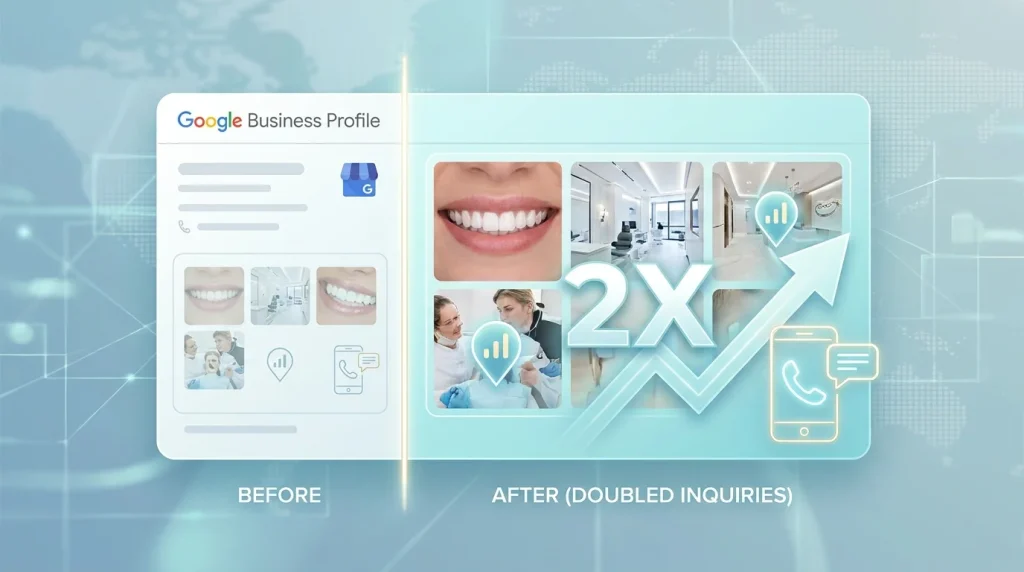
At sixty days, the practice’s new patient inquiry volume from all Google sources had increased by an estimated 104% compared to the equivalent prior period.
Profile views: 340 to 489a 44% increase at day 60, up from 21% at day 30. The compounding effect of consistent post publication and photo recency on profile view volume was measurable; each new post and each new photo upload was generating additional impression events beyond organic search traffic.
Website clicks: 31% click-through rate maintained through day 60, confirming that the conversion improvement was sustained behavioral change driven by the quality and relevance of the new visual content, not a novelty effect from the initial photo refresh.
New patient intake: The practice’s booking system showed 23 new patient appointments in the 30 days following day 30 of the intervention, compared to an average of 11 new patient appointments per month in the three months prior. The majority cited cosmetic consultations, Invisalign, veneers, whitening, as their reason for booking, the exact procedure categories featured in the before and after photos, and Google Posts published during the intervention period.
The ranking position did not change during the intervention period. The practice held position two for “cosmetic dentist San Diego” throughout, confirming that the inquiry volume increase was driven entirely by conversion rate improvement within the knowledge panel, not by ranking movement.
What this dental GBP photos results case study reveals about conversion optimization
Finding 1: Ranking position and conversion rate are independent variables
A practice can hold a strong local pack position while converting patients at a fraction of its potential rate, and improving the conversion rate requires a completely different intervention than improving the ranking position.
The diagnostic marker is simple: if profile views are strong but website clicks and direction requests are low relative to ranking position, the problem is conversion, not ranking. If profile views are low, the problem is ranking or suppression. Treatment for one does not address the other. The Columbus case, documented in the dental practice local pack case study, and the Phoenix case, documented in the dental GBP ranking recovery case study, were both ranking problems. This San Diego case is a conversion problem. The intervention is different because the diagnosis is different.
Finding 2: Before and after photos have a disproportionate conversion impact for cosmetic practices
The before-and-after photo category produced a measurable conversion lift visible in the first two weeks of the rebuild, before the posting cadence and video content had accumulated enough signal to contribute significantly. For cosmetic and implant-focused practices, before and after photos are the single highest-return visual content investment available. A patient evaluating veneers or Invisalign is attempting to visualize their own outcome, a practice that provides that visual evidence, shortening the decision cycle from consideration to consultation booking.
Finding 3: Product posts create a permanent conversion infrastructure that standard posts cannot replicate
The three product posts created for implants, veneers, and Invisalign appeared in the knowledge panel immediately and remained visible through the entire sixty-day measurement period. Standard posts cycle through the feed. Product posts persist. For procedures with long patient consideration cycles, implants and full-arch restoration, especially, the permanent visibility of a product post compounds the conversion probability over the patient’s decision window in a way that a standard post published once cannot replicate.
For the multi-location variant of this conversion optimization challenge, the pediatric dental GBP case study documents how a practice with strong clinical differentiation but weak GBP content used a targeted visual rebuild to outrank a DSO competitor with significantly higher review volume.
Key takeaways
- Ranking position and conversion rate are independent variables. A practice can hold a strong local pack position while converting at a fraction of its potential rate. Profile views are strong, but website clicks are low: conversion problem. Profile views are low: ranking or suppression problem.
- Before and after photos have a disproportionate conversion impact for cosmetic and implant practices. They are the single highest-return visual content investment for practices whose primary revenue comes from elective, high-value procedures.
- Product posts create a permanent conversion infrastructure that standard posts cannot replicate. For procedures with long patient consideration cycles, permanent product post visibility compounds conversion probability over the patient’s decision window.
- Video content generates dwell time that compounds into a growing prominence advantage. The practice walkthrough appeared as the first item in the photo carousel within 72 hours of upload, higher dwell time feeds engagement signals that contribute to local prominence scoring over time.
- A visual and content rebuild produces measurable conversion improvement within thirty days. The 72% improvement in website click-through rate and the 70% improvement in direction requests at day thirty confirm that photo quality and category coverage are the primary conversion variables in a knowledge panel comparison between otherwise comparable practices.
Your next action this week
Open your GBP knowledge panel from a mobile device in an incognito browser and look at it as a prospective new patient would, not as someone who already knows your practice.
Ask three questions. First: Does your photo carousel lead with your best image, or with whatever Google assigned by default? Second: Does your photo set include before and after photos, team headshots, and equipment photos, the three categories most directly linked to cosmetic and specialty procedure conversion? Third: Is your most recent Google Post dated within the last thirty days, and does it name a specific service?
If the answer to any of those three questions is no, you have a conversion gap that is costing you new patient inquiries every day your knowledge panel looks like it does right now. The San Diego practice in this case study had a 4.9-star rating and a position two local pack result, and was still losing half its potential conversion to a competitor whose visual content layer was simply more complete.
The rebuild that doubled this practice’s inquiries took one two-hour shoot, two video recordings, and four Google Posts drafted in advance. The total time investment was under four hours. The total cost was a $45 gimbal. The result was a sustained 104% increase in new patient inquiry volume at sixty days.
For the complete visual and content layer framework that governed every decision in this rebuild, the complete GBP photos and content guide for dental practices is the reference document that turns a one-time rebuild into a permanent competitive standard. And for the full case study synthesis across all practice types and intervention scenarios, the GBP case studies for dental practices consolidate every finding into a single diagnostic and optimization reference.