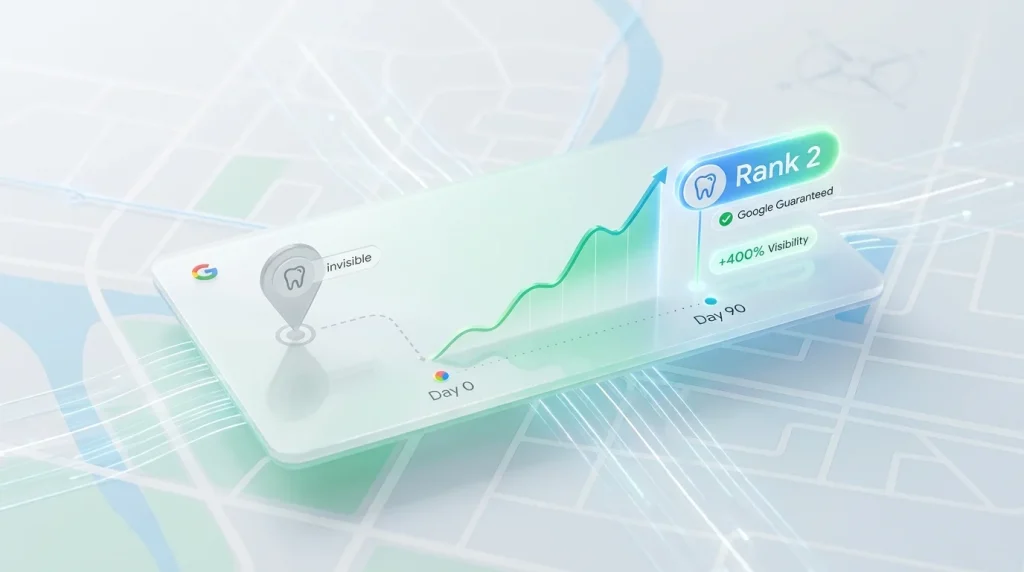
In October 2024, a general dental practice in Columbus, Ohio, was not appearing in the local three-pack for any general dental query in its market. Not “dentist Columbus.” Not “family dentist near me.” Not “dentist accepting new patients Columbus.” The practice had been operating for eight years. It had 34 Google reviews averaging 4.6 stars. It had a verified GBP. It had a functioning website with decent on-page content.
By January 2025, 90 days later, it held position 2 in the local pack for “family dentist Columbus” and position 3 for “dentist accepting new patients Columbus.” New patient inquiries from Google Maps had increased by an estimated 60%, according to GBP insights data comparing the two periods.
No new reviews were acquired during the intervention period. The website was not rebuilt or redesigned. No paid advertising was launched. The practice’s NAP, once corrected, remained the same. The clinical team didn’t change. The physical location didn’t change.
What changed was the dental practice local pack case study in its most instructive form: a practice with genuine patient satisfaction, real reviews, and legitimate local presence, rendered invisible by a small number of specific, correctable GBP configuration errors that had been compounding silently for three years.
This article documents every error found, every fix applied, the sequence in which they were executed, and the ranking outcomes at 30, 60, and 90 days.
Table of Contents
The practice profile at the start of the intervention
Understanding what the practice looked like before the intervention is as important as understanding what changed, because the errors that were suppressing it are not exotic or unusual. They appear consistently across dental practices in competitive US markets that were set up quickly, by someone who has since left, without a documented optimization standard.
Practice type: General and family dentistry, solo practitioner, suburban Columbus. Years in operation: Eight. GBP status: Verified, active, showing in Business Manager with no warnings or suspension flags. Review count and average: 34 reviews, 4.6 stars. Last GBP update before intervention: Estimated 2021, no posts, no new photos, no field changes visible in the edit history. Website: Active, mobile-responsive, moderate on-page optimization. LocalBusiness schema absent. Paid search: None active.
The practice owner had assumed the visibility problem was a review volume issue. Thirty-four reviews felt low relative to competitors in the three-pack, two of whom had over 100 reviews. The instinct was to launch a review acquisition campaign before doing anything else.
The audit revealed a different picture entirely.
The audit: what was actually suppressing the profile
A systematic GBP audit conducted before any changes were made identified six distinct issues. None of them individually would have been catastrophic. In combination and compounding over three years without correction, they had built a signal reliability problem significant enough to push the practice out of local pack eligibility for its highest-value queries.
Issue 1: Wrong primary category
The practice’s primary GBP category was “Dental clinic” and not”Dentist.”
This single error had been in place since the profile was created in 2016. As the Whitespark Local Search Ranking Factors Report 2023 confirms, the primary GBP category is among the top three local pack ranking factors. A practice categorized as “Dental clinic” competes in a lower-specificity bracket that excludes it from the highest-volume dental queries Google maps to the “Dentist” category. The practice was not losing to better-optimized competitors; it was competing in the wrong pool entirely.
Issue 2: A duplicate listing from a previous address
Three years earlier, the practice had moved from a suite on the second floor of its building to a ground-floor space in the same building, a different suite number, a different entrance, a different address line. The original GBP had been updated with the new address. The old address had auto-generated a second listing, which Google had populated from third-party data sources.
Both listings were live. Both showed the same practice name and phone number. Both had slightly different address formats. Google’s system interpreted two profiles for the same business at the same building as a data reliability problem and suppressed both, not just the duplicate.
Issue 3: NAP inconsistency across four citation sources
The practice’s Yelp listing showed the old suite number. Healthgrades showed the old address entirely, pre-move. The ADA Find-a-Dentist directory showed a phone number that had been changed two years prior. Zocdoc showed the correct current information.
Four of the practice’s top ten citation sources contained inaccurate NAP data. The inconsistency pattern was significant enough to introduce what Google interprets as a reliability signal: a business whose name, address, and phone number don’t match across its citation ecosystem is a business whose data Google cannot confidently surface.
Issue 4: No LocalBusiness schema on the website
The practice website had no structured data markup. Google was inferring the practice’s name, address, phone number, and service type from unstructured page content, a less reliable data source than explicit schema markup. In a market where competing practices had the LocalBusiness schema correctly implemented, this was a measurable disadvantage in Google’s entity confidence calculation.
Issue 5: Incomplete services list and missing attributes
The GBP services section contained three entries: “Dental exam,” “Teeth cleaning,” and “X-rays.” The practice actively provided Invisalign, dental implants, teeth whitening, emergency dental care, and nitrous oxide sedation, none of which were listed. The “Accepting new patients” and “Online appointments” attributes were both disabled. The “Spanish-speaking staff” attribute had never been enabled despite the practice having a bilingual hygienist.
Issue 6: Static photo set from 2018 with no team headshots
The thirty photos on the profile were all uploaded in a single session in 2018. Three team members visible in the group photo had left the practice. The exterior shot showed the old second-floor entrance, not the current ground-floor entrance. No individual provider headshots existed. No equipment photos. No treatment room photos from the current operatory, which had been updated in 2022.
The intervention sequence: what was fixed and in what order
The repair sequence followed the priority framework documented in the complete Google Business Profile optimization guide for dental practices, with foundational issues first, competitive optimization second. No optimization work was begun until the structural errors were fully resolved.
Week 1: Foundation repair
Day 1: Duplicate listing identified, claimed through the “Claim this business” flow, and flagged for removal in Business Manager. Google processed the removal request within four days.
Day 2: Primary category changed from “Dental clinic” to “Dentist.” No other core field changes were made on the same day to avoid triggering an automated review flag from rapid bulk edits.
Day 4: NAP audit completed across the top ten citation sources. Corrections submitted to Yelp, Healthgrades, ADA Find-a-Dentist, and the state dental association directory. Healthgrades and Yelp processed corrections within 48 hours. The ADA directory required a manual correction request that took eleven days to reflect.
Day 6: LocalBusiness schema added to the website contact page, a two-hour task. The schema included practice name, address, phone, hours, and primary service type, matching the GBP exactly.
Week 2: Profile completeness and content layer
Day 8: Services list expanded from three entries to twenty-two. Every procedure the practice actively provided was added: Invisalign, dental implants, teeth whitening, porcelain veneers, same-day emergency care, nitrous oxide sedation, digital X-rays, fluoride treatment, dental sealants, nightguards, and eleven additional procedures. Each entry included a one-sentence description naming the procedure and its patient benefit.
Day 9: Attributes audit completed. “Accepting new patients” is enabled. “Online appointments” are connected to the practice’s existing Zocdoc booking link. “Wheelchair accessible entrance,” “wheelchair accessible restroom,” and “Spanish-speaking staff” all enabled.
Day 10: Business description rewritten from 187 characters containing zero service names and one geographic signal to 743 characters containing eleven indexable signals, six service names, three geographic references, two patient population identifiers, and two operational differentiators.
Days 11 to 18: Photo rebuild executed using a thirty-minute smartphone shoot. New uploads spaced over eight days: two exterior shots of the current ground-floor entrance, two reception photos, one treatment room photo, a team group photo, and three individual provider headshots. All photos are geotagged before upload. Total new photos: eleven. Total old photos archived: nine.
Week 3: Video and posting launch
Day 19: Practice walkthrough video shot in landscape orientation, exterior entrance to reception to treatment room, 27 seconds, exported as MP4 at 1080p. Uploaded and verified from a mobile incognito browser.
Day 20: Provider introduction video recorded, the practice owner answering two questions on camera, unscripted, 24 seconds. Uploaded and verified.
Day 21: First Google Post published, same-day emergency appointment availability, three-sentence structure, reception photo attached. Second post scheduled for ten days later.
Week 4 onward: Review acquisition and maintenance
A post-appointment text review request system was implemented using the practice’s existing patient communication platform, a message sent two hours after each appointment containing a direct link to the GBP review form.
The ranking progression at 30, 60, and 90 days
At 30 days
The duplicate listing had been fully removed. The primary category change had been indexed. The practice began appearing in Maps results for “dentist Columbus”, not in the three-pack, but consistently on the first page of Maps results for the first time in an extended period.
GBP insights at day 30 showed a 22% increase in profile views, direction requests up 18%, and website clicks up 14% compared to the equivalent prior period.
At 60 days
The practice entered the local three-pack for “dentist accepting new patients Columbus” at position three. It appeared at position four to five for “family dentist Columbus”, consistently present but not yet in the pack for that query. Fourteen new reviews had been received since the review acquisition system launched, bringing the total to 48, with an average of 4.7 stars.
GBP insights at day 60 showed a 41% increase in profile views, 35% increase in direction requests, and 31% increase in website clicks.
At 90 days
The practice held position two in the local three-pack for “family dentist Columbus”, consistent across multiple search sessions from different devices and locations within the service area. Position three for “dentist accepting new patients Columbus”, stable. Position two to three for “dentist open Saturday Columbus”, a query the practice had never previously appeared for, now captured through the Saturday hours attribute and the services list expansion.
Total new patient inquiries from Google Maps in the 90-day post-intervention period: estimated 60% higher than the equivalent prior period, based on GBP insights data and practice-reported new patient intake forms citing Google as the discovery channel.
What this dental practice’s local pack case study tells us about GBP suppression patterns
Several findings from this intervention are worth isolating because they appear across multiple dental practice audits and are frequently misdiagnosed.
The review count hypothesis is almost always wrong. The practice owner’s initial diagnosis was incorrect. Thirty-four reviews at 4.6 stars is a competitive review profile for a general practice in a suburban US market. The suppression was caused entirely by structural configuration errors that had nothing to do with reviews.
Category errors are invisible to the practice owner. Nothing in Business Manager flags “Dental clinic” as a suboptimal primary category. The suppression is only visible in search results, and practice owners typically attribute that invisibility to factors other than a field they set up years ago and never questioned.
Duplicate listings compound silently. The duplicate at the old suite number had been live for three years without the practice owner’s knowledge. Its suppression effect on the primary profile had been running continuously for three years.
The correct fix sequence determines the outcome. Category correction on top of an unresolved duplicate and unresolved NAP inconsistency produces minimal ranking movement. The same correction on top of a clean foundation produces visible movement within two to four weeks.
For the complete diagnostic framework that identifies which suppression mechanism is affecting any given dental practice profile, the GBP ranking recovery case study documents a more complex suppression scenario where the category error was compounded by a practitioner profile conflict. And for the multi-location variant of these patterns, the multi-location dental GBP case study shows how a dental group standardized its GBP configuration across three cities using a systematic audit protocol derived from exactly this kind of single-practice intervention.
Key takeaways
- GBP suppression is rarely caused by what the practice owner thinks it is. Low review count, weak website, poor location, these are the diagnoses most practice owners arrive at independently. In the majority of documented suppression cases, the actual cause is a structural configuration error. Run the audit before forming a hypothesis.
- Category errors are the highest-leverage single fix available, and the least visible problem in Business Manager. “Dental clinic” instead of “Dentist” costs a practice its eligibility for the highest-volume dental queries in its market. The only way to detect it is to know what the correct category is and check.
- Duplicate listings suppress both profiles simultaneously. An old listing from an address change doesn’t just sit dormant; it actively reduces the visibility of the primary profile. Find and remove duplicates before making any other optimization changes.
- The fix sequence determines the outcome as much as the fixes themselves. Category correction on top of an unresolved duplicate and unresolved NAP inconsistency produces minimal ranking movement. Sequence is not a procedural preference; it is a structural requirement.
- Review acquisition compounds’ foundational work, but cannot replace it. Fix the foundation first. Build the review signal on top of it.
Your next action this week
Run the four-check diagnostic sequence on your own profile before assuming you know what the problem is. Search your exact practice name in Google Maps. Check your profile status in Business Manager. Search your address for duplicate listings. Run an incognito Maps search from a neutral device.
If the diagnostic surfaces a wrong primary category, check right now: open Business Manager, navigate to Edit profile, and confirm your primary category reads “Dentist.” If it reads anything else, that is your first fix. Make it today.
Then search your phone number and your previous practice names in Google Maps. If a second listing appears that you don’t control, claim it and initiate removal before touching any other field in your primary profile.
The Columbus practice in this case study had all of these errors in place for three years without knowing it. The fixes took four weeks. The ranking impact was visible within thirty days of the foundational corrections and compounded to a stable local three-pack position within ninety. That timeline is available to any practice willing to audit honestly before optimizing instinctively.
For the full optimization framework that contextualizes every fix applied in this case study within the complete eight-layer GBP signal architecture, the complete Google Business Profile optimization guide for dental practices is the reference document that turns a one-time fix into a permanent competitive standard.