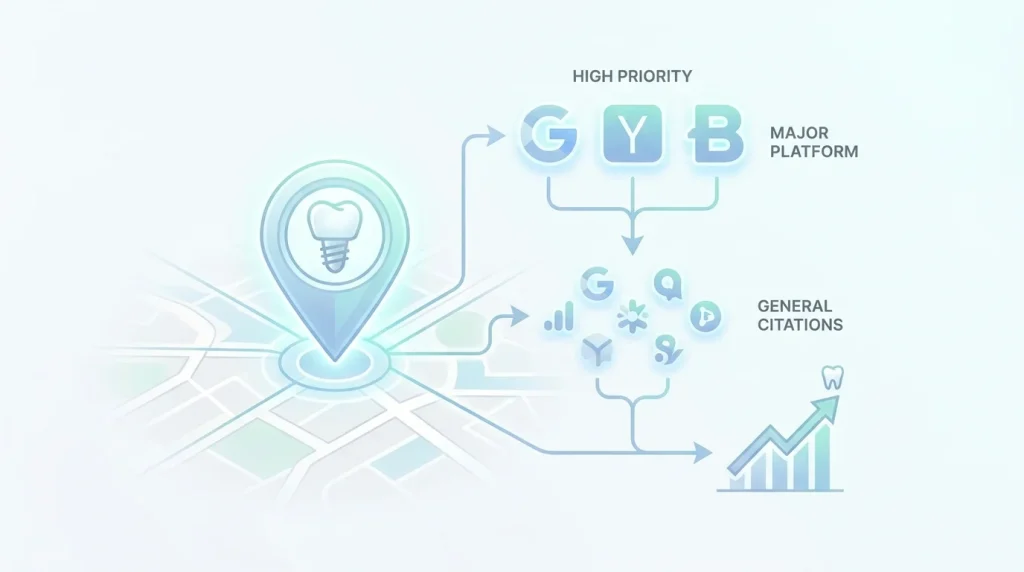
A dental implant practice in Denver had spent five months building citations. Its office manager had submitted the practice NAP to 74 directories working from a general dental citation list sourced from a dental marketing agency’s blog. The list covered Yelp, Yellow Pages, Healthgrades, Foursquare, the Better Business Bureau, and sixty-eight additional general business and healthcare directories. It did not include the American Academy of Implant Dentistry member directory. It did not include the American Academy of Cosmetic Dentistry member directory. It did not include RealSelf, the dominant cosmetic procedure patient research platform in the US market, with over 10 million monthly visitors actively researching providers. It did not include the Smile Guide, a dental implant patient education and provider directory operated specifically for the implant patient research market.
Five months of citation building. Zero movement in the local pack for “dental implants Denver” or “All-on-4 Denver.” The problem was not citation quantity. It was citation relevance. The directories that carry topical authority for dental implant and cosmetic practices in Google’s entity model are categorically different from the directories that carry topical authority for general dental practices, and categorically different again from the generic local business directories that dominate most off-the-shelf citation building lists.
Dental implants local citations require a directory priority framework built around three authority dimensions that generic dental citation lists do not account for: specialty professional association membership, cosmetic patient research platform presence, and implant patient education directory coverage. This guide covers the complete citation-building system for US dental implant and cosmetic practices, the directories to build first, the specialty-specific sources that general dental lists miss entirely, and the NAP consistency standards that prevent the citation footprint from fragmenting the entity signal it is designed to build.
Table of Contents
Why implant and cosmetic citation building differ from general dental
The foundational citation authority principle, domain authority plus topical relevance, determines citation weight, applies to implant and cosmetic practices as it does to general dental practices. But the topical relevance dimension operates differently for implant and cosmetic specialties because these practices have access to three citation source categories that general dental practices either cannot access equivalently or have not historically prioritized.
Specialty association directories. The American Academy of Implant Dentistry (AAID) and the International Congress of Oral Implantologists (ICOI) each maintain member directories that are crawled by Google as high-authority, specialty-specific citation sources. An AAID member directory listing is available only to dentists who have completed AAID-recognized implant training and met membership criteria. This creates a citation source that is simultaneously high-authority, high topical relevance, and credentialing-verified, a combination that no general business directory replicates. For cosmetic practices, the American Academy of Cosmetic Dentistry (AACD) member directory carries the equivalent specialty association citation authority in the cosmetic query space.
Cosmetic patient research platforms. RealSelf is the largest cosmetic procedure patient research platform in the US, with over 10 million monthly visitors actively researching cosmetic dental and medical providers before booking consultations. A RealSelf provider profile carries both a high-authority citation signal and a direct patient acquisition function, appearing in Google search results for “dental veneers [city],” “smile makeover [city],” and “cosmetic dentist [city]” queries independently of the practice’s own website. This dual function, citation authority plus patient acquisition channel, makes RealSelf the highest-ROI single citation build available to any US cosmetic dental practice that has not yet claimed its provider profile.
Implant patient education directories. The Smile Guide (smileguide.com) is a dental implant patient education platform and provider directory operated specifically for the implant patient research market. Unlike general healthcare directories that aggregate all dental specialties, the Smile Guide focuses exclusively on implant and cosmetic dental procedures, carrying a topical relevance signal that Healthgrades and WebMD, which cover all healthcare provider types, cannot replicate for implant-specific queries.
The implant and cosmetic citation priority framework has four tiers
Tier 1: Data aggregators, the NAP propagation foundation
The four primary US data aggregators are the foundation of any implant or cosmetic citation strategy, identical to the foundation for general dental and orthodontic practices, because their structural function, downstream data propagation, applies regardless of specialty.
Data Axle (data-axle.com) supplies NAP data to hundreds of secondary directories, local search apps, and mapping platforms automatically. A verified, accurate Data Axle listing propagates the practice NAP outward into the downstream ecosystem within weeks of verification. For an implant practice that has recently relocated to a larger surgical facility, changed its phone number during a call-tracking setup, or updated its practice name from a solo to a group designation, a corrected Data Axle listing is the highest-leverage single NAP correction available for practices carrying widespread downstream inconsistencies.
Neustar Localeze (neustar.biz/business-listings) is the primary data supplier for navigation systems and a significant supplier for voice search platforms. An implant patient asking Siri “dental implants near me” on an iPhone is drawing on data that flows through Neustar Localeze to Apple Maps. A practice with an incorrect or missing Neustar Localeze listing is providing inaccurate location data to the voice search ecosystem, and voice search for implant queries is disproportionately high among the 45 to 65 age demographic, which represents the largest implant patient segment in most US markets.
Foursquare (foursquare.com) remains a major data supplier for app developers, mapping platforms, and location intelligence systems. Its business data flows into Uber, Snapchat, Apple, and dozens of other platforms that represent patient touchpoints in the digital ecosystem where implant and cosmetic practices operate.
Apple Maps (mapsconnect.apple.com) directly controls the practice’s visibility in Apple Maps and Siri local search results on iOS devices. With iPhone representing the dominant smartphone platform in the US market, Apple Maps’ visibility for “dental implants near me” queries is a patient acquisition channel of equivalent importance to Google Maps for most US implant practices. Apple Maps listing verification requires an Apple ID and a business verification process that takes five to seven business days. Budget this timeline into the citation building sequence.
Build and verify all four Tier-1 aggregator listings before submitting to any other directory. An incorrect Tier-1 record propagates errors downstream at the same scale as a correct record propagates accurate NAP data, and it overwrites corrections made at lower tiers during the next aggregator data refresh cycle.
Tier 2: Implant and cosmetic specialty directories
Tier-2 sources for implant and cosmetic practices differ significantly from Tier-2 sources for general dental practices. This tier is where the specialty-specific citation sources that carry the highest topical relevance for implant and cosmetic queries are concentrated.
The American Academy of Implant Dentistry member directory (aaid.com/find-a-member) is the highest-authority specialty-specific citation source available to US dental implant practices. The AAID member directory is crawled by Google and treated as a professional credentialing signal, a citation that simultaneously confirms the practice’s NAP, its implant specialty classification, and its membership in the recognized national implant specialty body. For practices with AAID Fellowship or Associate Fellow designations, the directory listing carries additional credentialing weight that Google’s entity model treats as a high-confidence implant specialty classification signal. Claim and verify this listing before any other Tier-2 source.
The International Congress of Oral Implantologists member directory (icoi.org/find-a-member) is the second major implant specialty association directory. ICOI membership and the ICOI Diplomate designation are recognized implant credentialing signals that carry topical relevance for implant queries equivalent to the AAID directory. Practices that hold both AAID and ICOI membership should claim and optimize both directory listings, as each provides an independent specialty association citation signal from a distinct recognized credentialing body.
The American Academy of Cosmetic Dentistry member directory (aacd.com/find-a-dentist) is the highest-authority specialty-specific citation source for US cosmetic dental practices. The AACD member directory is crawled by Google and functions as a professional credentialing signal for cosmetic procedure queries, confirming the practice’s cosmetic specialty classification and AACD membership status. For practices with AACD Accreditation, the directory listing carries the highest individual cosmetic credentialing signal available in any citation source.
RealSelf (realself.com/find/dentist) is the dominant US cosmetic procedure patient research platform and a high-authority citation source for cosmetic dental queries. RealSelf provider profiles appear prominently in Google search results for “dental veneers [city],” “smile makeover [city],” “cosmetic dentist [city],” and “dental implants [city]” queries, functioning simultaneously as a citation signal and a direct patient acquisition channel. A complete RealSelf provider profile with before-and-after photos, Q&A responses, and patient reviews is both a citation authority asset and a conversion asset that appears in search results independently of the practice’s own website.
Smile Guide (smileguide.com) is a dental implant patient education platform and provider directory targeting the implant patient research market specifically. A Smile Guide provider listing carries high topical relevance for implant queries because the platform’s entire content ecosystem is built around implant patient education, making it a topically specific citation source that general healthcare directories cannot replicate for implant-specific query relevance.
Healthgrades (healthgrades.com) remains a high-authority general healthcare citation source for implant and cosmetic practices. For implant practices, the Healthgrades profile should be claimed under the correct specialty designation, with implant dentistry highlighted in the services section. For cosmetic practices, the profile should surface cosmetic procedures prominently in the services and specialties fields.
Zocdoc (zocdoc.com) is relevant for implant and cosmetic practices that accept online consultation bookings. A Zocdoc listing functions simultaneously as a citation signal and a direct patient acquisition channel, appearing in Google search results for implant and cosmetic queries and routing patients directly to the practice’s online booking system.
Tier 3: High-authority general directories, the broad authority foundation
Tier-3 sources for implant and cosmetic practices are the same high-authority general directories that anchor the general dental and orthodontic citation frameworks, with implant and cosmetic-specific profile configuration requirements that determine whether each listing contributes to the implant or cosmetic signal stack or defaults to the general dental signal stack.
Yelp (biz.yelp.com) maintains a high domain authority and is crawled by Google with significant frequency. For implant practices, the Yelp profile category should be set to “Dental Implants” or “Oral Surgeons,” depending on the practice’s primary clinical designation. For cosmetic practices, the Yelp profile category should be set to “Cosmetic Dentists.” A Yelp listing categorized as “General Dentistry” for an implant specialist practice is a category signal mismatch that reduces the listing’s topical relevance contribution for implant-specific queries. Yelp data is also used by Apple Maps as a review source and by Bing Local as a citation signal, making a correctly categorized Yelp listing simultaneously valuable for Google’s entity model and two additional search platforms.
Facebook Business (business.facebook.com) is cross-referenced by Google as a social citation signal. The Facebook page category for an implant practice should be set to “Dental Implants” or “Dentist and Dental Office” with implant services prominently listed in the services section. For cosmetic practices, the Facebook page category should reflect cosmetic dental specialization. The NAP in the “About” section must match the GBP exactly.
Better Business Bureau (bbb.org) carries a high domain authority and appears prominently in Google search results for “[practice name] reviews” queries. For implant and cosmetic practices, the BBB profile category should reflect the implant or cosmetic specialty designation.
Bing Places for Business (bingplaces.com) feeds Microsoft’s search ecosystem, including Edge browser search, Cortana voice queries, and LinkedIn local business data. The Bing Places profile for an implant or cosmetic practice should be configured with the specialty category and complete NAP matching the GBP.
Chamber of Commerce directories carry strong local geographic relevance signals and function as community establishment signals, a trust marker for the 45 to 65 demographic that represents the primary implant patient population.
US News Health (health.usnews.com/doctors) maintains a healthcare provider directory with significant domain authority. Claiming and completing the US News Health listing under the appropriate specialty designation adds a high-authority general healthcare citation to the implant or cosmetic signal stack.
WebMD / Vitals (doctor.webmd.com / vitals.com) is among the most-crawled healthcare citation sources in the US. The profile should be claimed under the appropriate specialty designation, with implant or cosmetic procedures featured prominently in the services section.
Tier 4: Supplementary directories build last or deprioritize
Consumers’ Checkbook is available in major US metro markets and lists dental specialists separately from general dentists. For implant and cosmetic practices in markets where Consumers’ Checkbook is active, primarily Washington DC, San Francisco, Boston, Chicago, Seattle, Minneapolis, and Philadelphia, a listing carries geographic specificity and local domain authority that generic national directories cannot replicate.
Yellow Pages (yellowpages.com) has moderate domain authority and adequate crawl frequency. Its value is as a citation signal rather than a patient acquisition channel. The Yellow Pages category should reflect the specialty designation for topical relevance consistency.
Angi (angi.com) is relevant for cosmetic practices offering elective aesthetic procedures. For practices positioning their cosmetic dentistry alongside other aesthetic services in the local market, an Angi listing contributes both a citation signal and a cosmetic aesthetic category signal.
Local newspaper business directories carry geographic specificity and local domain authority. For implant and cosmetic practices in competitive urban markets, local newspaper directory citations contribute geographic signal depth that generic national directories cannot replicate.
Hospital and healthcare system provider directories are relevant for implant practices that have referral relationships with oral surgery departments, maxillofacial surgery practices, or healthcare systems that maintain provider directories.
What to skip entirely: generic coupon sites without healthcare categories, home and garden services aggregators, event directories, foreign-language directories with no US geographic relevance, and any directory with a domain authority below 20 that lacks implant, cosmetic, or healthcare topical relevance.
NAP consistency standards specific to implant and cosmetic practices
The NAP consistency principles that apply to general dental and orthodontic practices apply equally to implant and cosmetic practices, with three implant and cosmetic-specific inconsistency patterns that appear with disproportionate frequency in specialty practice citation audits.
The call-tracking number fragmentation problem. Implant and cosmetic practices frequently implement call-tracking numbers to measure marketing return on investment. When tracking numbers are placed in citation sources rather than the main practice line, the citation footprint becomes fragmented across multiple phone numbers that Google’s entity model cannot consolidate into a single authoritative practice NAP. Use the main practice line as the primary NAP phone number across all citation sources. Implement call tracking at the website level, using dynamic number insertion on specific landing pages, rather than at the citation source level, where it creates entity fragmentation.
The surgical facility versus the clinical office address split. Implant practices that perform surgical placement at a separate surgical facility sometimes have citation sources showing the surgical facility address alongside citation sources showing the main office address. Google’s entity model treats different addresses as different locations. The NAP used across all citation sources should reflect the primary patient-facing address, the address where initial consultations occur, and where patients should be directed for all non-surgical appointments, not the surgical facility address.
The DBA versus specialty designation name split. Implant and cosmetic practices frequently rebrand over time, evolving from “Dr. Smith Family Dentistry” to “Smith Implant Center.” Citation sources populated before the rebrand retain the old practice name, creating a name inconsistency across the citation footprint that Google’s entity model treats as potentially distinct entities rather than the same practice under a new name. Establishing the current DBA as the authoritative practice name, updating every citation source to reflect it, and verifying that the GBP reflects the same name is the name standardization task that most rebranding practices complete for the GBP and website, but fail to extend to their full citation footprint.
For the complete NAP audit methodology that identifies every existing inconsistency before new citations are built, including the four-layer audit framework from internal website NAP through Tier-3 external directories and the master NAP record format, the dental practice NAP consistency guide covers the complete correction protocol applicable across dental specialty practices.
And for the general dental citation priority framework that covers the foundational Tier-1 through Tier-4 directory sequence in full detail, the dental practice local citations guide covers the complete citation building system that underpins the implant and cosmetic-specific framework in this article.
Key takeaways
The AAID member directory, the AACD member directory, and RealSelf are the three citation sources that most implant and cosmetic practices have never claimed, and the three that carry the highest topical relevance for implant and cosmetic local pack queries. A citation campaign that misses these three sources and builds instead on seventy-four general business directories produces citation quantity without citation relevance. Topical relevance is what moves implant and cosmetic local pack rankings. Claim these three sources before submitting to any Tier-3 or Tier-4 directory.
RealSelf is simultaneously the highest-authority cosmetic citation source and the highest-ROI direct patient acquisition channel available to US cosmetic dental practices. A complete RealSelf provider profile with before-and-after photos, Q&A responses, and patient reviews appears independently in Google search results for cosmetic dental queries, functions as a citation signal in Google’s entity model, and routes high-intent cosmetic patients directly to the practice. No other citation source available to a cosmetic dental practice delivers both functions simultaneously.
Profile category configuration on Tier-3 general directories determines whether each listing contributes to the implant or cosmetic signal stack or defaults to the general dental signal stack. Setting the category to “Dental Implants” or “Cosmetic Dentists” rather than “General Dentistry” on Yelp, Facebook, BBB, and Bing Places ensures each listing contributes topical relevance signals for implant or cosmetic queries.
The call-tracking number fragmentation problem is the most common NAP inconsistency pattern in implant and cosmetic practice citation audits, and the most frequently self-created. Use the main practice line across every citation source. Implement call tracking at the website level, using dynamic number insertion, rather than at the citation source level, where it creates entity fragmentation that no subsequent citation-building effort can fully repair.
Audit before building, always. An implant or cosmetic practice with uncorrected NAP conflicts across existing citation sources compounds the inconsistency problem with every new citation built from a different version of the NAP. The pre-build audit using BrightLocal’s Citation Tracker or Whitespark’s Citation Finder is the step that determines whether the citations built strengthen or fragment the entity signal.
Your next action this week
Open the AAID member portal at aaid.com and verify whether your find-a-member directory listing is active, claimed, and displays your current NAP. If the listing shows outdated information or has never been claimed, update it now. This is the implant-specific citation source that carries the highest combination of domain authority, topical relevance, and credentialing signal of any directory available to an implant practice, and it is the most commonly unclaimed high-authority specialty citation in implant practice citation audits.
Then go to realself.com and search for your practice name. If no profile exists, create one at realself.com/join/provider. If a profile exists but is unclaimed or incomplete, claim it and complete the provider profile with before-and-after photos, a practice description that surfaces your implant and cosmetic specialty signals, and responses to the most common patient questions in the RealSelf Q&A section. A complete RealSelf profile takes two to three hours to build and produces both a high-authority cosmetic citation and an independently ranking patient acquisition asset.
Once both specialty sources are verified and complete, run a citation audit using BrightLocal’s Citation Tracker or Whitespark’s Citation Finder. Use the Tier-1 through Tier-4 framework in this article to prioritize the correction and build sequence: aggregators first, AAID, AACD, and RealSelf second, general Tier-3 directories third.
For the complete dental implants local citations framework integrated with GBP optimization, website signals, review management, and competitive positioning into a unified local SEO system for US dental implant and cosmetic practices, the dental implants and cosmetic dentistry local SEO guide is the reference document that connects every element.