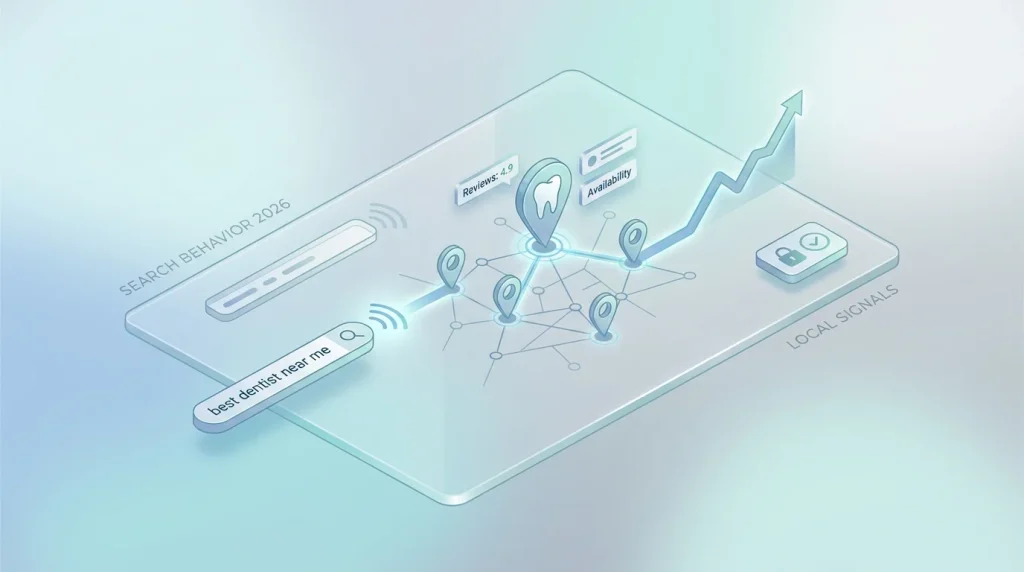
A dental practice in Nashville, Tennessee, invested $8,400 in a website redesign in early 2024. The decision rested on an assumption that prospective patients were visiting the practice website, forming an impression of the practice, and then deciding whether to call. New patient intake interviews conducted six months after launch tested that assumption directly. When asked how they found the practice and what drove their decision to call, 14 of the 19 new patients interviewed that month described the same sequence: they searched “dentist near me” or “dentist Nashville” on their phone, found the practice in the local pack, looked at the photos and reviews directly in the Google listing, checked the rating and hours, and called from the phone number displayed in the GBP without visiting the website.
The website redesign had improved the experience for the minority of new patients who reached it. The GBP listing, which the majority of new patients used as their primary and final evaluation interface, had not been updated during the redesign process. The photos were 14 months old. The services list had two entries. There were no Google Posts in the last 60 days.
This is not a Nashville-specific pattern. The BrightLocal 2023 Local Business Consumer Survey documents that the Google Business Profile is the primary interface through which patients evaluate local practices before making contact, with healthcare providers, including dental practices, ranking among the business categories where GBP engagement most directly precedes contact decisions. (Source: BrightLocal Local Business Consumer Survey, 2023.) Understanding dental patient search behavior, how patients initiate a search, what they evaluate in the local pack before clicking or calling, and what drives their final selection decision is the market intelligence that determines which GBP signals to prioritize and which optimization investments reach patients at the moment they are actually making their choice.
Table of Contents
How dental patients initiate their search
The majority of dental searches in the US are initiated on mobile devices, and the majority carry local intent regardless of whether the query explicitly includes a location term. A patient who types “teeth whitening” into Google Search on their phone in Chicago will see a local pack result populated with Chicago-area cosmetic dental practices. The local intent is inferred by Google from the device location, not declared by the patient. This means the local pack is the primary visibility format for dental queries. Even when patients are not explicitly searching for a local practice, they are searching for a service, and Google is surfacing local providers.
The dental patient search behavior data shows three distinct search initiation patterns, each corresponding to a different patient intent state.
The pain-or-urgency search. The highest-intent search pattern in dental. Queries in this category, “emergency dentist near me,” “tooth pain dentist open now,” “same day dental appointment,” are initiated under physical distress or acute scheduling pressure. Patients in this state have the shortest evaluation timeline and the lowest tolerance for any friction in the practice contact process. BrightLocal consumer research consistently identifies healthcare as among the highest-urgency categories for local business contact decisions following a search. (Source: BrightLocal Local Consumer Review Survey, 2023.) For emergency dental practices, the patient’s decision window from search to phone call is measured in minutes, not days. The GBP signals that convert this patient type hours accuracy, phone number visibility, and same-day availability indication are evaluated before any other profile element.
The planning search. The most common search pattern for general and specialty dental practices. Queries in this category, “family dentist [city],” “pediatric dentist near me,” “Invisalign dentist [city]” are initiated by patients who are not in immediate pain but are actively looking for a practice to establish care with or a specific treatment provider. This patient type has a longer evaluation timeline and a higher willingness to compare multiple practices before calling. They are more likely to read reviews, examine photos, check service lists, and compare average ratings across the two or three practices they are considering. The evaluation window for a planning-search patient may span several days between initial search and final contact decision.
The referral-validation search. A search initiated by a patient who has already received a recommendation from a friend, family member, or primary care provider and is using Google to validate the recommendation before calling. Queries in this pattern include the practice name directly, “[Practice Name] dentist Nashville reviews,” or simply the practice name as a branded search. The patient in this state is not comparing alternatives in the same way as a planning-search patient. They are looking for confirmation that the practice is legitimate, that the reviews are consistent with the recommendation, and that the location and hours fit their schedule. A GBP with few photos, stale reviews, or a below-4.5 average rating can interrupt a referral conversion that was otherwise already decided.
What patients evaluate in the local pack before clicking or calling
The local pack result the three practices Google displays with ratings, phone numbers, hours, and a photo, are the primary evaluation interface for the majority of dental patient search journeys. For planning-search patients, what is visible in the local pack result determines whether they click through to the full GBP, call directly, or move to the next listing.
The BrightLocal 2023 Local Business Consumer Survey found that star rating is the primary signal patients use to evaluate a business when browsing local pack results. (Source: BrightLocal Local Business Consumer Survey, 2023.) For dental practices, the visible star rating and review count in the local pack result are evaluated before any other profile element, before photos, before the practice name, and before the address.
Average star rating. The rating visible in the local pack result operates as a pre-click filter. Patients browsing local pack results for planning-search queries apply an informal rating floor before engaging further with any individual listing. Composite observations from dental market analysis suggest this floor operates at approximately 4.0 to 4.3 stars for most patient types. Practices below this threshold are scrolled past without further evaluation. For specialty procedures with higher patient investment (implants, Invisalign, cosmetic treatment), the rating floor applied by patients appears to rise toward 4.5, because the perceived risk of selecting a lower-rated provider for an expensive elective procedure is higher.
Review count and recency. Review count is visible in the local pack result alongside the star rating. Patients who read the rating and find it above their floor threshold then apply a volume judgment: a 4.9 average from 11 reviews receives a different patient-side interpretation than a 4.9 average from 84 reviews. The BrightLocal 2023 Local Consumer Review Survey found that 98% of consumers read online reviews for local businesses before making contact decisions for healthcare providers. (Source: BrightLocal Local Consumer Review Survey, 2023.) The same survey documents that consumers consider review recency, how recently the reviews were posted, as a significant trust factor, with reviews older than three months given lower weighting in consumer trust assessments than recent reviews.
Photos visible in the local pack result. Google often surfaces a thumbnail image from the practice’s GBP photo set in the local pack result. The photo visible in this thumbnail is typically the most-viewed or highest-engagement photo from the practice’s GBP set, determined by Google’s own engagement signals. For practices with low photo counts or low-quality images, the thumbnail visible in the local pack result may represent the practice unfavorably at the highest-traffic point in the patient evaluation journey.
Hours and availability. For urgency-search patients, the hours displayed in the local pack result are evaluated as the first decision criterion. A practice whose GBP hours show as “Closed” at the moment of the search is eliminated from consideration regardless of its rating, review count, or photo quality. For planning-search patients, Saturday hours and extended evening hours are evaluated as convenience signals that influence the likelihood of contact.
How reviews shape the patient selection decision
The patient who has passed the local pack pre-click filter, whose rating and review count have passed the informal threshold evaluation, and has clicked through to the full GBP listing, enters the detailed review evaluation phase. This is the stage at which dental patient search behavior most directly intersects with the review benchmark data documented in dental local SEO research.
The BrightLocal 2023 Local Consumer Review Survey documents that the average consumer reads 10 reviews before feeling they can trust a local business. For healthcare providers, including dental practices, the survey identifies healthcare as among the categories where review volume, recency, and content have the strongest combined influence on trust formation. (Source: BrightLocal Local Consumer Review Survey, 2023.)
Review content evaluation. Patients evaluating dental practices do not only read the star rating, but also read the review text. The content of reviews provides information that the star rating alone cannot: whether the practice is good with anxious patients, how the front desk handles insurance questions, whether wait times are reasonable, and whether the dentist explains procedures clearly. Practices whose reviews include specific, detailed descriptions of positive patient experiences convert at higher rates from profile views to contact than practices with equally high ratings but generic or sparse review text.
Review recency as a trust signal. A practice with 80 reviews, 60 of which were posted between 18 and 24 months ago, presents a review profile that patients unconsciously evaluate as potentially representing a past version of the practice rather than its current state. A practice with 55 reviews, 12 of which were posted in the last 60 days, presents a review profile that reflects the current patient experience. This distinction maps directly to the review recency signal documented in the Whitespark Local Search Ranking Factors research recency matters to Google’s ranking algorithm because it matters to patients. (Source: Whitespark Local Search Ranking Factors, 2023.)
Practice response behavior as a trust signal. The BrightLocal 2023 Local Consumer Review Survey found that 88% of consumers would use a business that responds to all reviews, compared to 47% who would use a business that does not respond to reviews at all. (Source: BrightLocal Local Consumer Review Survey, 2023.) For dental practices, where the patient relationship involves a high degree of personal trust, the visible evidence that the practice engages thoughtfully with patient feedback, including negative feedback, contributes meaningfully to the decision to initiate contact. A practice’s response behavior is visible to every patient evaluating the GBP. An unanswered one-star review is not a private failure. It is visible evidence of how the practice handles patient experience problems.
For the complete review acquisition framework that produces the velocity and recency standards patients are evaluating in this process, the getting more Google reviews for your dental practice guide covers the systematic acquisition system applicable to every practice type.
The direct-action search pattern: from GBP to phone call
A significant proportion of dental patients who find a practice through a local pack search and evaluate the GBP listing never visit the practice website. They call, request directions, or initiate an appointment booking request directly from the GBP. This direct-action pattern is most pronounced for urgency-search patients, where the practice website is bypassed entirely, and is common for planning-search patients who have completed their evaluation in the GBP and feel sufficient confidence to make contact without additional information.
The direct-action search pattern has a specific implication for local SEO investment prioritization: the GBP listing is not a gateway to the website. For a significant share of new dental patients, it is the final decision interface. The phone number, the hours, the booking link, the “Accepts new patients” attribute, and the overall impression produced by the photo set, review corpus, and business description are the conversion elements, not the homepage, not the services page, not the contact form.
This does not make website optimization unimportant. Patients arriving through referral-validation searches, specialty-service searches, and high-consideration procedures are more likely to visit the website before calling. But the behavioral data consistently show that a large proportion of new dental patients, particularly those acquired through planning and urgency searches for general dental care, complete their evaluation and make their contact decision within the GBP listing.
The operational implication: optimizing the GBP listing for the patient decision journey it is actually serving is a higher-priority investment than optimizing the website for patients who are not reaching it. For most dental practices, the GBP listing is generating more patient first impressions than the website homepage.
What the patient behavior data means for local SEO investment priorities
The dental patient search behavior data produces a specific investment priority sequence when applied to the optimization decisions a practice faces:
Priority 1: Star rating and review count visibility in the local pack result. These are the first signals patients evaluate before any click or further engagement. A practice below the 4.3 to 4.5 floor for its patient type is being filtered out at the top of the funnel before photos, hours, or services list have any opportunity to convert. Maintaining a rating above this floor through sustained high-quality patient care and systematic review acquisition is the prerequisite for everything else in the patient acquisition funnel.
Priority 2: Review recency and volume at the GBP listing level. Patients who pass the initial rating filter evaluate review recency and volume at the full listing level. A practice with adequate volume but stale recency is losing trust and credibility at the evaluation stage. A sustained review acquisition workflow, not a periodic campaign, is the operational investment that maintains patient trust signals continuously.
Priority 3: Photo quality and recency for the patient evaluation stage. The photos in a GBP listing serve the planning-search patient who is comparing two or three practices and needs visual evidence of the practice environment, team, and (for specialty practices) treatment outcomes. Professional-quality photos in the four benchmark categories, exterior, interior, team, and clinical or outcomes, are evaluated at this stage. Low-quality or outdated photos undermine the trust signals that reviews and ratings have built.
Priority 4: Hours accuracy, booking link, and contact information for the conversion stage. The patient who has completed their evaluation and is ready to call needs accurate hours, a functional phone number, and, where offered, a direct booking link. Hours inaccuracy reflected in the “hours may differ” warning or in a “Closed” status that does not match actual availability is a conversion failure at the highest-intent moment of the patient journey.
For the competitive context that determines how many active competitors are generating these patient-facing signals simultaneously in any given local pack, the dental local SEO competitive landscape guide provides the market density framework that calibrates how much sustained investment each of these priority areas requires in a specific competitive context.
For the complete market analysis that integrates patient behavior data with competitive landscape, ROI, and emerging search trends, the dental local SEO market analysis covers the full multi-dimensional market intelligence framework.
Key takeaways
The Google Business Profile listing, not the practice website, is the primary evaluation and decision interface for the majority of dental new patient searches. BrightLocal research identifies the GBP as the primary local business evaluation tool for consumers, with healthcare, including dental, among the highest-influence categories. A significant proportion of new dental patients form their impression, complete their evaluation, and make their contact decision entirely within the GBP listing, without visiting the practice website. Optimizing the website for patients who are not reaching it before optimizing the GBP for patients who are is an investment sequencing error. (Source: BrightLocal Local Business Consumer Survey, 2023.)
Dental patient searches fall into three intent patterns: urgency, planning, and referral validation, each with a different evaluation timeline, different GBP signals that convert, and different optimization priorities. Urgency patients evaluate hours, availability, and phone number within seconds. Planning patients evaluate rating, review count, recency, and photos over a multi-day comparison period. Referral-validation patients evaluate rating, review content, and response behavior as a confirmation check on an existing recommendation. A GBP optimized only for one patient type is underperforming for the other two.
Star rating is the first filter patients apply in the local pack result before clicking, before reading reviews, and before evaluating photos. Composite observations suggest an informal patient-side rating floor of 4.0 to 4.3 for general dental care and 4.5 for specialty or high-investment procedures. Practices below this floor are filtered out at the top of the acquisition funnel before any other GBP signal has the opportunity to convert. Rating maintenance is a prerequisite for funnel entry, not a downstream optimization target.
Review recency is a patient trust signal before it is a ranking signal. Patients evaluating dental practices weigh recent reviews more heavily than older reviews when forming trust assessments, because recent reviews represent the current patient experience rather than a historical version of the practice. The operational practice of generating consistent monthly review velocity serves both the Google ranking algorithm’s recency weighting and the patient-side trust evaluation that produces the click-to-call conversion. (Source: BrightLocal Local Consumer Review Survey, 2023; Whitespark Local Search Ranking Factors, 2023.)
Practice review response behavior is a visible trust signal that 88% of consumers factor into their local business selection decision. An unanswered negative review is not a private failure; it is visible evidence to every prospective patient evaluating the GBP of how the practice handles patient experience problems. Systematic review response, applied to all reviews regardless of rating, is a patient conversion investment as much as a reputation management function. (Source: BrightLocal Local Consumer Review Survey, 2023.)
Your next action this week
Map your current GBP listing against the three-stage patient evaluation journey documented in this article.
Stage 1: Check the local pack result. Search your primary query category in an incognito browser. What is the star rating and review count visible in your local pack result? Is it above the 4.3 floor for general dental and 4.5 for specialty? When was your most recent review posted? Is the recency visible in the listing? What photo appears in your local pack thumbnail?
Stage 2 check full GBP listing: Open your full GBP. Count your total reviews. Check the date of the most recent review. Read the five most recent reviews: are they specific and detailed, or generic? Check your response history: have you responded to all reviews, or only to negative ones?
Stage 3 check conversion elements: Confirm your phone number is accurate. Confirm your hours reflect current availability with no “hours may differ” warning in search results. If you offer online booking, confirm the link in your GBP is functional.
Any gap identified in stages 1 through 3 is a patient acquisition failure point a place where the patient evaluation journey is interrupted before the contact decision is made. Address the largest gaps in the sequence: rating floor first, recency second, conversion element accuracy third.