Table of Contents
Most dental practices operating in competitive US markets in 2026 are making local SEO investment decisions without the market intelligence to calibrate them accurately. They know they need to rank in the local pack. They know reviews matter, and their GBP should be optimized. They do not know how many practices in their specific market are actively competing for the same positions versus nominally present on Google Maps. They do not know how patients are actually using search to find and evaluate practices, what queries they use, what signals drive their decision to call, and what proportion of new patient conversions never touch the practice website at all. They do not know what the ROI trajectory of organic local investment looks like relative to their current paid advertising spend over a 12 to 24-month horizon. They do not know how generative AI engines are changing the patient discovery landscape in ways that require a different content optimization framework from traditional local pack ranking. And they do not know which market forces are raising the competitive floor around them as they hold positions achieved by optimization work that may be two or three years old.
Generic local SEO guidance has consistently failed to provide this intelligence because generic guidance optimizes for average markets, average practice types, and average competitive contexts. The gap between “do local SEO” and “understand your specific competitive market well enough to invest in local SEO intelligently” is the gap this analysis is designed to close.
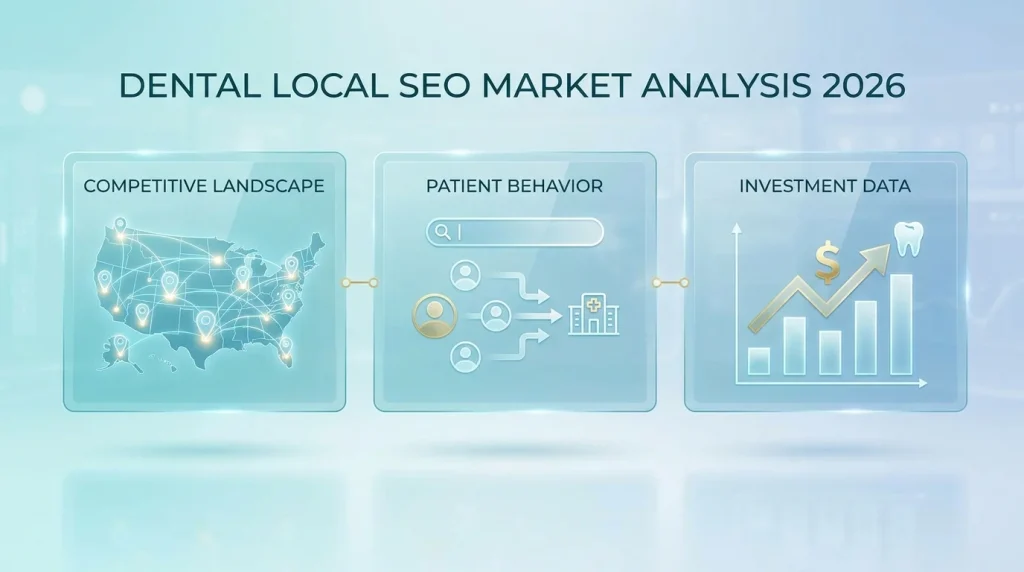
The dental local SEO market analysis framework presented in this guide integrates five dimensions of market intelligence competitive landscape, patient behavior, investment economics, AI search dynamics, and market trend trajectory into a unified strategic reference that any US dental practice can apply to its specific competitive context to understand what effective local SEO investment actually requires, what the competitive environment it is operating in actually looks like, and where the highest-return optimization investments are concentrated for its market size, practice type, and current competitive position.
What is a dental local SEO market analysis? A dental local SEO market analysis is a multi-dimensional intelligence framework describing the competitive landscape, patient behavior, investment economics, AI search dynamics, and market trend data that determine what effective local SEO investment looks like for a specific dental practice in a specific US market context. It is not a universal benchmark. It is a five-dimensional assessment tool that produces a practice-specific picture of the competitive environment and patient acquisition dynamics that calibrates any local SEO investment decision against the actual market the practice operates in, rather than against a generic approximation of an average US dental market.
What this market analysis covers and how to use it
The dental local SEO market analysis framework in this guide is structured around five questions that a dental practice owner or office manager needs to answer to make intelligent local SEO investment decisions.
The first question is competitive: how many practices in my market are actually competing for local pack positions, as opposed to merely being present on Google Maps, and what does that active competitor count tell me about the signal threshold I need to meet and the investment level that threshold requires?
The second question is behavioral: how are patients in my market using search to find and evaluate dental practices, and which GBP signals are they evaluating at each stage of their decision process between search initiation and phone call?
The third question is economic: what is the realistic ROI trajectory of organic local SEO investment in my market relative to the paid advertising spend I am currently allocating to patient acquisition, and what investment allocation framework produces the best long-term patient acquisition economics?
The fourth question is structural: how are AI-powered search tools changing the patient discovery landscape in my category, and what does my current content infrastructure need to look like to capture AI search visibility alongside traditional local pack positions?
The fifth question is strategic: what market forces are actively reshaping the competitive requirements for local pack positioning in my market over the next 12 to 24 months, and where can I concentrate investment now to build a compounding advantage before those forces fully close the available windows?
Each of the five satellite articles in this cluster provides standalone depth on one of these questions. This analysis integrates all five into the unified strategic picture that the individual data layers cannot produce on their own.
The competitive landscape: who is actually competing in your market
The most fundamental market intelligence error in dental local SEO planning is treating the visible count of dental practices in a Google Maps search as a proxy for competitive density. A Google Maps search that returns 54 dental practices within a five-mile radius in Phoenix does not tell a practice that it faces 54 competitors. It is telling a practice that 54 dental practices are present in that geographic area, which, after systematic analysis, may mean that 5 to 8 of them are actively competing for the local pack using systematized optimization programs.
The dental local SEO competitive landscape in every US market follows a three-layer structure. Layer 1 practices are present but not competing: verified GBPs with no Posts in the last 90 days, fewer than 3 new reviews in the last quarter, and service lists with zero to one generic entries. They hold positions based on proximity and historical presence, not active signal generation. Layer 2 practices are partially optimized: they completed initial GBP setup and may have run a review acquisition campaign at some point, but have not maintained systematic ongoing management. They typically occupy positions 4 through 8 in competitive local packs. Layer 3 practices are actively competing: ongoing review velocity at market-appropriate rates, consistent posting cadence, complete GBP signal profiles, and operational infrastructure that sustains signal generation continuously rather than through periodic campaigns.
The proportion of Layer 3 active competitors in any dental market varies by market size. In small markets (population under 75,000), the typical active competitor count is 1 to 5 practices. In mid-sized markets (75,000 to 350,000), it is typically 5 to 20 practices. In large markets and major metro areas, it may range from 20 to 80 or more practices in dense specialty query categories. This does not count the Maps total, which is the number that determines the signal threshold required to reach top-three positions and the investment level that threshold demands.
The practical consequence of accurate competitive density assessment is investment calibration. A practice in a small market that believes it faces 45 active competitors will over-invest in velocity and completeness requirements that its actual competitive context does not demand. A practice in a major metro that assumes most of its 200 visible competitors are not actively optimizing will under-invest in the automation infrastructure required to sustain the velocity benchmarks that major metro Layer 3 competitors are already generating.
For the 20-minute competitive landscape audit protocol that identifies the Layer 3 active competitors in any dental local pack from publicly available GBP data and reveals the specific signal profiles of the practices setting the threshold a practice needs to meet or exceed, the dental local SEO competitive landscape guide covers the complete three-layer competitive model and audit methodology.
The patient journey: how dental patients find and choose practices in 2026
The second intelligence dimension addresses a question that most dental practices have never systematically researched: how are patients actually using search to find and evaluate practices, and which signals in the local pack result and GBP listing are driving the contact decision?
The BrightLocal 2023 Local Business Consumer Survey documents that the Google Business Profile is the primary evaluation interface patients use before contacting a local business, with healthcare providers, including dental practices, among the categories where GBP engagement most directly precedes contact decisions. (Source: BrightLocal Local Business Consumer Survey, 2023.) For a significant proportion of new dental patients, particularly those arriving through planning and urgency searches, the evaluation and contact decision occurs entirely within the GBP listing, without any visit to the practice website. The website redesign that many dental practices invest in serves the minority of patients who reach it. The GBP listing serves the majority.
Dental patient searches fall into three intent patterns. Urgency searches “emergency dentist open now,” “tooth pain dentist near me” carry the highest intent and the shortest evaluation window. Patients in urgent searches evaluate hours, availability, and phone number within seconds of seeing the local pack result. Planning searches “family dentist [city],” “pediatric dentist near me” carry high intent with a longer evaluation timeline. These patients compare two or three practices across rating, review count, photo quality, and service visibility over a period of days before making contact. Referral-validation searches a patient searching the practice name after receiving a recommendation, uses the GBP as a confirmation check rather than a discovery tool, but will not complete the conversion if the GBP’s rating, reviews, or photos are inconsistent with the recommendation they received.
The patient-side evaluation sequence at the local pack result level follows a consistent pattern: star rating acts as the first filter (practices below approximately 4.3 stars are scrolled past without further evaluation for most patient types); review count signals legitimacy and volume of patient experience; and photo quality and recency signal whether the practice environment matches the patient’s expectations for a healthcare provider they would trust. Practices that pass this pre-click evaluation are clicked through to the full GBP, where review content, response behavior, attributes, and services list visibility determine whether the patient calls.
The BrightLocal 2023 Local Consumer Review Survey found that 98% of consumers read reviews before making healthcare provider decisions, and that review recency, or how recently reviews were posted, is a significant factor in the trust assessment patients apply to review corpora. (Source: BrightLocal Local Consumer Review Survey, 2023.) A practice with adequate review volume but stale recency is presenting a review corpus that patients may interpret as representing a past version of the practice, reducing the conversion probability from profile view to phone call, regardless of the average rating.
For the complete patient search behavior data by intent type, including the direct-action search pattern in which mobile patients call from the GBP listing without visiting the website, the dental patient search behavior guide covers the full three-stage patient evaluation journey.
The investment economics: organic local visibility versus paid patient acquisition
The third intelligence dimension answers the economic question that every dental practice facing a budget allocation decision needs to understand: what does the ROI trajectory of organic local SEO investment look like relative to paid advertising, and what investment model produces the best long-term patient acquisition economics?
The fundamental economic distinction is structural, not merely financial. Paid advertising is a rental model: a dental practice rents visibility in search results for as long as its budget is active and its bid remains competitive. The moment the campaign pauses, visibility stops. There is no residual patient acquisition asset. Local SEO is an asset model: the practice builds a Google Business Profile completeness infrastructure, a review corpus, and a local pack position that generates patient acquisition returns at near-zero marginal cost once established and that continues generating returns through periods of reduced management investment.
The cost-per-new-patient comparison between the two models changes substantially over time. In the first three to six months of a local SEO program, the investment-to-return ratio is unfavorable relative to paid search, because organic positions are being built and patient acquisition from organic local is below the eventual steady state. In months six through twelve, as positions stabilize and review velocity compounds, the organic cost-per-patient falls toward and then below the paid search cost-per-patient. Beyond month twelve, the compounding dynamic accelerates: each review adds to a growing corpus that generates both ranking signals and patient-side trust conversion simultaneously, each completeness improvement produces ongoing ranking signal contribution without additional investment, and each increment of review velocity compounds the recency signal advantage the practice holds over competitors with stale review profiles.
The crossover point at which cumulative organic cost-per-patient falls below paid search cost-per-patient typically occurs between months nine and eighteen for most mid-sized US dental practices operating systematic local SEO programs. After the crossover, every additional patient acquired through organic local search improves the cumulative ROI of the local SEO investment further. The practice that evaluates local SEO ROI by its month-three economics will consistently underinvest. The practice that evaluates it by its month-eighteen and month-thirty-six economics will identify it as the most efficient patient acquisition channel it operates.
The optimal investment model is hybrid, not binary: paid advertising covers patient acquisition during the local SEO investment phase while the organic asset is being built, then is proportionally reduced as organic patient volume grows. The economic goal is not to eliminate paid advertising but to progressively reduce the proportion of total patient acquisition that depends on continuous budget allocation, replacing paid dependency with compounding organic asset returns over a 12 to 24-month transition.
For the complete cost-per-patient data, the rental-versus-asset economic model, the compounding return framework, and the three-stage hybrid investment allocation model, the dental local SEO ROI guide covers the full investment economics analysis. The GBP optimization actions that constitute the organic local SEO investment generating those returns are covered in the complete Google Business Profile optimization guide for dental practices.
AI search and the two-track discovery model
The fourth intelligence dimension addresses an emerging structural change in the dental patient discovery landscape that is not yet reflected in most dental local SEO guidance: the growing role of generative AI search tools in mediating how patients find, evaluate, and choose dental practices.
The dental patient discovery landscape in 2026 operates on two partially overlapping tracks. The first is the traditional local pack track: transactional searches with clear geographic intent (“dentist near me,” “orthodontist [city]”) trigger the Google local pack as the primary visibility format, and the GBP optimization framework completeness, review velocity, and category configuration determine which practices appear in the top three results. This track remains dominant for high-intent transactional dental searches, and the local pack continues to be the primary new patient acquisition channel for the majority of US dental practices.
The second track is AI-mediated discovery: evaluative and informational queries, “how to find a good dentist for dental anxiety,” “what should I look for in a cosmetic dentist,” “how long does a dental implant procedure take,” are increasingly being routed by patients to Google AI Overviews, ChatGPT, Perplexity, and other generative AI tools. These queries generate synthesized answers that may name specific practices, describe selection criteria, or provide procedure information, and the practices that appear in these AI-generated answers are those whose GBP descriptions, website content, review corpora, and FAQ sections contain the specific, structured, extractable signals that AI engines can evaluate and present as recommendations.
The signals that make a dental practice citable in AI-generated answers differ from the signals that drive local pack ranking. Local pack ranking is driven by GBP completeness, review recency, proximity, and category configuration. AI citability is driven by content specificity a GBP description that names procedures and patient populations explicitly rather than asserting generic quality; FAQ content with precise, self-contained answers to the questions patients are actually asking AI engines; review texts that contain procedure-specific and experience-specific language that AI engines can extract as recommendation evidence; and LocalBusiness schema markup that gives Google’s Knowledge Graph a machine-readable entity definition to use in AI Overview generation.
The competitive window in AI search visibility is currently open because the adoption of GEO (Generative Engine Optimization) principles among dental practices is low. The majority of dental practice GBP descriptions are generic quality statements. The majority of dental practice websites do not contain FAQ sections structured for AI extractability. The practices that implement GEO optimization now include specific descriptions, FAQ content with FAQPage schema, procedure-level website pages with self-contained definitions, and are establishing AI search visibility, while most competitors remain absent from AI-generated dental recommendations.
For the complete GEO optimization framework for dental practices, including the GBP description audit, FAQ content development protocol, and schema implementation guidance that enable AI search visibility, the AI search and dental local SEO guide covers the full two-track discovery model and GEO signal requirements.
The six market trends: what is changing and what it means for positioning
The fifth intelligence dimension addresses the market forces actively reshaping dental local SEO competitive requirements in 2026, the trends that make current optimization benchmarks moving targets rather than fixed thresholds.
The rising benchmark floor is the most consequential trend for practices holding positions achieved by optimization work completed in 2022 or 2023. As more dental practices adopt systematic local SEO management, the minimum signal quality required for competitive eligibility in each market tier rises. A practice that was competitive with 50 reviews and a 7-entry services list in a mid-sized market in 2023 may find those same signals insufficient to hold position two in the same market in 2026, not because its profile has degraded, but because competitor profiles have improved around it. Maintaining a position requires continuous investment. The practice that treats optimization as completed is drifting toward the competitive threshold at which position movement occurs downward.
Mobile-first search acceleration is intensifying the GBP listing’s role as the primary patient acquisition interface. As the proportion of dental local searches conducted on mobile devices continues to grow, the click-to-call button, booking link, hours visibility, and thumbnail photo in the mobile local pack result become progressively more important than the website, which they often replace in the patient contact journey.
Online booking integration is emerging as both a patient conversion differentiator and a behavioral signal generator. Practices with functional direct booking links in their GBP listings are reducing the friction from local pack discovery to scheduled appointment and generating patient behavioral engagement signals that practices with phone-only contact setup are not producing. The current utilization gap in dental booking integration represents a competitive opportunity for practices that implement it before the majority of their local pack competitors do.
Review velocity escalation in markets where systematic acquisition adoption is growing means that the velocity benchmarks documented in the companion benchmark research 3 to 6 new reviews per month for mid-sized markets, are trending upward as more practices build automated acquisition infrastructure. The practice that invests in review acquisition automation this year is establishing a velocity advantage that will become progressively more expensive for competitors to match as the market average rises toward its current performance level.
DSO competitive pressure is raising the operational sophistication floor in markets where Dental Service Organizations have established a significant presence. DSO-affiliated practices compete with professional marketing infrastructure, centralized local SEO management, systematic review programs, and professional photography that exceeds the resources available to most independently operated practices. The competitive response is not to match DSO budgets but to match DSO operational discipline on the specific high-weight signals that most determine local pack position.
The GBP feature utilization gap, the gap between the features Google has made available in the GBP interface and the features dental practices have actually implemented, represents a narrowing but real competitive window. Practices that systematically audit and implement underutilized GBP features capture both the conversion benefit and the early-adopter signal advantage before broader adoption standardizes the feature as a floor requirement.
For the complete analysis of each trend and its specific competitive positioning implications across 0 to 36-month timeframes, the dental local SEO trends 2026 guide covers the full trend framework.
The complete market intelligence picture
| Intelligence dimension | What it measures | Key finding | Primary implication |
| Competitive landscape | Active competitor count vs. total practice count | Most markets have 5–20 active Layer 3 competitors, not the 40–80 visible on Maps | Calibrate investment to actual competitive density, not visible count |
| Patient behavior | Search intent patterns and GBP evaluation journey | GBP is the primary evaluation interface; majority of calls originate from GBP without website visit | Optimize the GBP listing for patient conversion, not just for ranking |
| Investment economics | Organic ROI vs. paid acquisition cost-per-patient | Organic crossover below paid cost-per-patient at months 9–18; compounds thereafter | Build the organic asset; use paid to bridge the investment phase |
| AI search dynamics | Two-track discovery model | Evaluative queries routed to AI tools; GEO-optimized content captures AI visibility | Apply GEO signals (specificity, FAQ, schema) alongside traditional SEO |
| Market trends | Six forces reshaping competitive requirements | Rising floor, mobile acceleration, velocity escalation, DSO pressure | Build operational infrastructure before these forces fully close the available windows |
Composite case study: applying all five intelligence dimensions
The following case study reflects composite patterns observed across dental practice market analysis and local SEO program implementation in US mid-sized markets. The figures and outcomes are representative of the pattern observed, not drawn from a single identified practice.
Practice profile: General dental practice, mid-sized US city, population approximately 220,000. Approximately 70 dental practices are visible in Google Maps within the primary service radius. Local pack position for primary query (“family dentist [city]”): position 5. Monthly budget allocation: $3,800 total across local SEO and paid search.
Pre-analysis assumptions: The practice manager believed she faced 70 active local SEO competitors, required at least 120 reviews to enter the top three, and needed to increase her paid search budget to generate the patient volume her practice needed in the near term. She was planning to redirect $1,500 per month from local SEO maintenance to Google Ads.
Market analysis findings:
Competitive landscape audit: Of the 70 visible practices, 38 had verified GBPs. Of those 38, 14 had a post published within the last 30 days. Of those 14, 6 had service lists with more than 6 entries, review velocity of 3 or more new reviews per month, and Q&A sections with practice-generated answers. Active Layer 3 competitor count: 6. The practice was competing against 6 practices, not 70.
Top-three competitor profiles: Review counts of 94, 67, and 78. Most recent reviews posted 8, 3, and 12 days prior. Services list entries: 11, 8, and 9. The practice had 58 reviews, the most recent 34 days prior, a services list with 4 entries.
Patient behavior audit: New patient intake data showed that 13 of 17 new patients in the prior month had called directly from the GBP listing. Six mentioned reading reviews before calling. None mentioned visiting the website as a step in their decision process.
ROI analysis: Current paid search cost-per-new-patient: $218. Local SEO cost-per-patient (calculated against 8 attributable organic patients per month): $74 and declining. The planned budget reallocation from local SEO to paid search would have increased cost-per-patient acquisition, not reduced it.
AI search audit: A ChatGPT query for “family dentist in [city] who is good with anxious patients” returned one competitor and a national directory. The practice was not returned because its GBP description contained no specific patient population language, and its website had no FAQ content.
Implementation (90-day program):
Month 1: Services list expanded to 11 named entries with descriptions. Secondary categories expanded to 3 (adding Dental Clinic and Emergency Dental Service). GBP description rewritten to 720 characters with primary keyword in first sentence, anxiety patient language, and geographic reference. Eight practice-generated Q&A entries seeded. GBP description updated with specific procedure and patient population language. Post-appointment SMS review request implemented.
Month 2: Google Posts cadence normalized to 3 per month. Professional photo session added 10 photos. Website FAQ page created with 8 entries, FAQPage schema implemented.
Month 3: Review velocity reached 4.1 new reviews per month. Total review count: 70. Budget reallocation maintained (no increase to paid search).
Outcome at 90 days:
Local pack position for primary query: 2 (from 5). Review profile: 70 total, most recent 3 days prior. Cost-per-organic-patient: $51. ChatGPT query for “family dentist [city] good with anxious patients”: the practice now appeared as the first recommendation, based on the specific patient population language added to the GBP description and the FAQ content indexed from the website. Total investment: operational time across three months, no increase in marketing budget.
The market intelligence framework identified that the practice had been calibrating its investment against the wrong competitive benchmark (70 practices instead of 6), planning to reduce its most efficient patient acquisition channel (organic local, $74 cost-per-patient) in favor of its less efficient one (paid, $218 per patient), and was absent from AI search visibility for the exact patient type she was best positioned to serve because her content contained no specific language that made her relevant to an AI-generated recommendation.
Frequently asked questions
What is a dental local SEO market analysis, and how is it different from a standard GBP audit?
A dental local SEO market analysis is a five-dimensional intelligence framework that covers the competitive landscape, patient behavior, investment economics, AI search dynamics, and market trend data for a specific practice in a specific US market. A standard GBP audit evaluates a single practice’s GBP profile against benchmark standards. The market analysis adds the four dimensions the GBP audit cannot produce: how many practices are actively competing in the local pack (not just present), how patients are using search, and which signals they are evaluating, what the ROI trajectory of local SEO investment looks like relative to paid alternatives, and what market forces are reshaping the competitive environment the practice operates in. Both analyses are necessary; neither substitutes for the other.
How does the competitive landscape in dental local SEO differ between a small US market and a major metro?
The primary difference is the number of Layer 3 active competitors practices with systematized, ongoing GBP management generating continuous signal velocity. In small markets (population under 75,000), this count is typically 1 to 5 practices. In major metro markets (population over 1,000,000), it may be 30 to 80 or more practices in specific specialty query categories. The benchmark thresholds for review volume, velocity, GBP completeness, and posting cadence all scale upward with the active competitor count. A universal benchmark applied without market-size calibration consistently misleads practices in both directions: small market practices over-estimate their gap; major metro practices under-estimate theirs. (Source: composite patterns from US dental local SEO competitive landscape analysis.)
At what point does dental local SEO investment become more cost-effective than Google Ads for patient acquisition?
The crossover point at which the cumulative cost-per-new-patient from organic local SEO falls below the cost-per-new-patient from paid search typically occurs between months nine and eighteen of a systematic local SEO program in mid-sized US dental markets. Before the crossover, paid search produces faster patient acquisition at a higher per-patient cost. After the crossover, organic local produces patient acquisition at a lower and continuing-to-fall cost as the investment amortizes across a growing patient volume. The optimal investment model is a hybrid paid search that bridges patient acquisition during the local SEO investment phase, while the organic asset is being built, with the paid proportion reducing proportionally as organic volume grows. (Source: composite patterns from dental practice, local SEO investment, and patient acquisition analysis.)
How is AI search changing which dental practices patients find first?
AI search tools, Google AI Overviews, ChatGPT, and Perplexity are capturing a growing share of evaluative dental queries that were previously routed entirely to traditional search. For transactional queries (“dentist near me”), the local pack remains dominant. For evaluative queries (“best dentist for dental anxiety,” “how to find a good orthodontist”), AI tools are generating synthesized answers that name specific practices. The practices that appear in AI-generated answers are those with specific GBP description language, FAQ content with structured question-and-answer formatting, procedure-level website content with self-contained definitions, and LocalBusiness schema markup. Practices without these GEO signals are absent from AI-generated recommendations regardless of their local pack strength. (Source: Google Search Central, 2024; composite observations from dental AI search visibility analysis.)
What are the most important dental local SEO trends to act on in 2026?
The five trends with the most direct investment implications in 2026 are: the rising benchmark floor (requires continuous signal investment to hold positions, not one-time optimization); review velocity escalation (practices without systematic acquisition infrastructure will find velocity gaps widening as market averages rise); online booking integration (a conversion differentiator with a narrowing early-adopter window); the GBP feature utilization gap (several high-value features remain underutilized by most dental practices); and AI search GEO optimization (the visibility window for early adopters is open but narrowing as adoption increases). Practices that address all five in the next 12 months establish a compounding competitive advantage over practices that address them reactively. (Source: composite patterns from US dental local SEO market trend analysis; Whitespark Local Search Ranking Factors, 2023.)
How should a dental practice use this market analysis framework in practice?
The five-dimensional framework is most useful as an annual strategic audit that calibrates the practice’s local SEO investment program against its actual competitive environment rather than against generic benchmarks. The competitive landscape audit identifies the active competitor count and their signal profiles. The patient behavior analysis identifies which GBP signals are driving the contact decisions of new patients and where conversion failures are occurring in the evaluation journey. The ROI analysis identifies whether the current investment allocation between organic and paid channels matches the economic model that produces the best long-term cost-per-patient. The AI search audit identifies whether the practice has GEO-optimized content that captures AI-mediated discovery for evaluative queries. And the trend assessment identifies which competitive floor elevations require immediate investment response before the available window closes. Together, the five dimensions produce a prioritized investment roadmap that is specific to the practice’s market context.
Key points
The gap between knowing local SEO matters and knowing what local SEO investment requires in a specific market is the gap this analysis closes. Generic local SEO guidance calibrated for average markets consistently misdirects investment for practices in specific competitive contexts, either over-investing against a gap that does not exist in their market, or under-investing in the signal categories that are actually producing the ranking differential between their current position and the top three. Market-specific intelligence is the prerequisite for investment that produces position movement rather than maintenance.
Most US dental markets have substantially fewer active Layer 3 competitors than Google Maps suggests. The relevant competitive density metric is not the total count of dental practices visible in a Maps search. It is the count of practices with ongoing, systematized GBP management generating continuous review velocity, consistent posting cadence, and complete profile signals. In most mid-sized markets, this count is 5 to 20 practices, not the 40 to 80 that a Maps view suggests. Investment calibrated against the actual active competitor count is more efficient and more accurately targeted than investment calibrated against the visible total.
The GBP listing is the primary patient acquisition interface for the majority of new dental patients, not a gateway to the website. BrightLocal research documents that patients use the GBP as their primary local business evaluation tool, with healthcare, including dental, among the highest-influence categories. A significant proportion of new dental patients evaluate the practice, complete their decision, and call entirely within the GBP listing, without visiting the website. Optimizing the website for patients who are not reaching it before optimizing the GBP for patients who are is the most common dental local SEO investment sequencing error. (Source: BrightLocal Local Business Consumer Survey, 2023.)
Organic local SEO crosses below paid search cost-per-patient between months nine and eighteen of a systematic program, then continues falling as the investment compounds. The practice that evaluates organic local SEO ROI by month-three economics will consistently underinvest in the channel that produces its most efficient long-term patient acquisition. The practice that evaluates it by month-eighteen and month-thirty-six economics will identify it as the highest-ROI patient acquisition channel it operates and will build it accordingly. The compounding dynamic review corpus growth, completeness signal accumulation, and position stability produce increasing returns from the same investment base over time.
AI search is adding a second discovery track that favors content specificity over signal volume. Practices with generic GBP descriptions, no FAQ content, and no procedure-level website content are absent from AI-generated dental recommendations regardless of their local pack strength. Practices with specific GBP language, structured FAQ pages with FAQPage schema, and procedure-level content with self-contained definitions appear in AI recommendations for evaluative patient queries. The GEO optimization window is currently open because adoption among dental practices is low. It will narrow as early adopters establish AI visibility and later adopters find the standard has risen.
The dental local SEO competitive floor is rising, and practices that hold positions on historical optimization work are holding declining relative strength. The practices that build systematic operational infrastructure, automated review acquisition, content calendars, and proactive GBP management in 2026 are building a compounding advantage that will widen as competitors face escalating signal requirements they cannot meet through informal management disciplines. The time to build that infrastructure is before the rising floor reaches the practice’s current signal level.
Your market intelligence audit: where to start
The five-dimensional dental local SEO market analysis framework in this guide produces a single practical output: a prioritized list of the market intelligence gaps that are causing investment misdirection, the competitive signal gaps that are costing local pack position, and the structural content gaps that are making the practice invisible to AI-mediated patient discovery.
The audit sequence that generates this output:
Audit the competitive landscape first. Run the 20-minute active competitor identification protocol from the competitive landscape satellite. Count your confirmed Layer 3 competitors. Compare your current signal profile against theirs, not against a market-size average. The gap between your profile and the profiles of the 3 to 8 practices that are actually competing for the same top-three positions in your market is your optimization roadmap, calibrated to the actual competitive context you are operating in rather than to an average.
Audit the patient behavior alignment second. Review your new patient intake data for the last 30 days and identify what proportion of new patients called from the GBP listing without visiting the website. Check your GBP listing against the three-stage patient evaluation journey: pre-click signals (rating, review count, thumbnail photo), full listing signals (review recency, response behavior, photo set, services visibility), and conversion elements (hours accuracy, phone number, booking link). Any failure in the three-stage sequence is a patient acquisition gap.
Audit the investment allocation third. Calculate your current cost-per-new-patient from paid search and from organic local. If your organic cost-per-patient is above your paid cost-per-patient, your local SEO program has not yet reached the crossover point, but the trajectory, not the current ratio, determines the allocation decision.
Audit the AI search visibility fourth. Test your practice’s presence in ChatGPT and Perplexity for the specific evaluative queries your target patients are asking. Check your GBP description for specificity. Check your website for FAQ content. The presence or absence of AI search visibility is directly observable and directly addressable.
For the benchmark data that defines what signal quality the practices above you in your local pack are actually generating across the completeness, review, market size, specialty, and ranking factor dimensions that determine where you stand relative to the current top-three standards, the dental GBP benchmark report provides the complete multi-dimensional benchmark framework that the market analysis in this guide measures against.