
An orthodontic practice in Seattle was a certified Invisalign Preferred Provider. It had completed over 300 Invisalign cases, owned an iTero scanner, and had a dedicated Invisalign section on its website. The front desk team mentioned Invisalign on every new-patient call. The practice’s Invisalign revenue represented 40% of total production. It was, by any clinical measure, one of the more experienced Invisalign providers in its market.
For “Invisalign Seattle” and “Invisalign provider Seattle,” the two queries that most directly route high-intent adult patients to Invisalign providers, the practice was not in the local pack. It was not on page one of the organic results. A competing practice with 60 fewer completed cases and no iTero scanner was holding position two for both queries. That practice had a standalone Invisalign page with a location-specific title tag, an “Invisalign Provider” secondary GBP category, Invisalign named as a distinct GBP service entry, and three before-and-after smile photos on its GBP photo set. The Seattle practice had none of those signals in place.
Clinical experience with Invisalign does not translate into local search visibility for Invisalign queries. The signals that produce Invisalign local SEO visibility are structural GBP configuration, website architecture, branded keyword targeting, and local content signals, and they are independent of how many cases a practice has treated or what provider tier it has achieved. This guide covers the complete local SEO framework for ranking as an Invisalign provider in a US local market, in the priority order that produces the fastest visibility improvement for Invisalign-specific search queries.
Table of Contents
Why Invisalign queries require a dedicated local SEO strategy
Invisalign searches are structurally different from general orthodontic searches in three ways that determine how Google ranks providers for them.
Invisalign is a brand-specific query. When a patient searches “Invisalign Seattle,” they are not searching for orthodontic treatment in general; they have already made a treatment modality decision and are searching for a local provider of a specific branded product. Google treats brand-specific queries differently from category queries: it looks for explicit brand name signals in the GBP services list, the website title tag, the website body content, and the LocalBusiness schema to determine which providers are eligible for brand-specific local pack results. A practice that offers Invisalign but has not placed the brand name “Invisalign” in any of these signal locations is invisible for brand-specific Invisalign queries, regardless of its certification status.
Invisalign queries have higher commercial intent than generic orthodontic queries. A patient searching “orthodontist near me” is in the early awareness stage; they know they need orthodontic treatment and are identifying providers. A patient searching “Invisalign provider Seattle” is in the late consideration stage; they have decided on Invisalign and are selecting a specific local practice. This difference in intent produces a higher consultation-booking conversion rate for Invisalign-specific queries than for generic orthodontic queries, which means that ranking for “Invisalign [city]” generates a higher-value patient pipeline per click than ranking for “orthodontist [city].”
The Invisalign provider tier is a differentiating local signal. Invisalign’s provider tier system, Gold, Platinum, Diamond, and their Plus variants, creates a publicly visible ranking of provider experience that patients actively research before booking consultations. A practice that has achieved Diamond Provider status and surfaces that status in its GBP description, website, Invisalign page, and GBP posts has a conversion advantage over a practice that has achieved the same tier but has not surfaced it in any patient-facing local SEO signal. Provider tier is not a direct Google ranking factor, but it is a patient conversion signal that turns local pack visibility into consultation bookings at a higher rate for practices that surface it prominently.
The Invisalign GBP signal stack
The GBP signal stack for Invisalign local SEO is the configuration that determines whether a practice is eligible for Invisalign-specific local pack results and how prominently it appears in those results relative to competing providers.
The “Invisalign Provider” secondary GBP category
The secondary GBP category “Invisalign Provider” is the most direct eligibility signal for Invisalign-specific local pack queries. It tells Google’s local ranking algorithm that this practice is a provider of the specific branded product patients are searching for in the same way that “Orthodontist” as a primary category tells Google the practice is eligible for orthodontic category queries.
Adding “Invisalign Provider” as a secondary category does not require changing the primary category. An orthodontic practice with “Orthodontist” as its primary category and “Invisalign Provider” as a secondary category is simultaneously eligible for orthodontic category queries and Invisalign brand-specific queries, the two highest-value local search query types for most US orthodontic practices.
To add the secondary category: open the GBP editor, navigate to the category field, click “Add another category,” and search for “Invisalign Provider.” If the category does not appear in the dropdown, confirm that the GBP is verified and that the primary category is set to “Orthodontist” category availability in the GBP editor, which is sometimes gated by primary category selection.
Invisalign as a named GBP service entry
Beyond the secondary category, “Invisalign” must appear as an explicitly named entry in the GBP services list, not as a subcategory of “Clear Aligners” or a bullet point under “Orthodontic Treatment.” The services list entry should use the exact brand name “Invisalign” as the service name, with a one-to-two sentence description that references the provider tier, the free consultation offer, and the practice’s geographic service area.
Example services entry: “Invisalign Clear aligner treatment for teens and adults from a [Provider Tier] Invisalign provider serving [City] and surrounding communities. Free consultation available.”
This single services entry contains the exact brand name, the patient population, the provider tier signal, the geographic service area, and a conversion prompt, all in under 40 words.
Invisalign Teen should be a separate service entry from adult Invisalign. “Invisalign Teen” is a distinct branded product with its own query volume. Parents searching for clear aligner options for their children use “Invisalign Teen” as a search term independently of adult Invisalign queries. A separate services entry for Invisalign Teen captures this distinct query segment without replacing the adult Invisalign entry.
GBP description Invisalign prominence
The GBP practice description (750 characters maximum) should surface Invisalign in the first sentence if Invisalign represents a significant portion of the practice’s treatment mix. A description that begins “Myers Park Orthodontics is a Charlotte, NC orthodontic practice specializing in Invisalign and clear aligner treatment for teens and adults” leads with the brand name, the location, and the patient population in the opening sentence, establishing Invisalign relevance before the patient reads any further.
The description should also reference the provider tier: “As an Invisalign Diamond Provider, Myers Park Orthodontics has completed over [X] Invisalign cases across the Charlotte metro area.” Provider tier in the GBP description is a trust signal for patients conducting comparison research, and it distinguishes the practice from lower-tier providers in the same geographic market.
GBP photo set Invisalign-specific images
The GBP photo set for an Invisalign-focused practice should include a minimum of three Invisalign-specific photo types:
Before-and-after smile photos from completed Invisalign cases, de-identified, HIPAA-compliant, smile-only format. These are the highest-conversion photo types for Invisalign patient acquisition because they provide visual proof of clinical outcomes for the specific treatment modality the patient is searching for.
iTero scanner photo a photo of the practice’s iTero Element digital impression scanner. The iTero scanner is a visual proxy for Invisalign capability. Patients who have researched Invisalign know that iTero scanning is part of the Invisalign workflow, and a photo of the scanner signals that the practice has the technology infrastructure for Invisalign treatment without requiring the patient to read about it.
Invisalign case tray or aligner photo: a clinical photo of Invisalign aligners in a case tray or on a model. This photo type reinforces the Invisalign brand association in the GBP photo set and appears in Google’s image results for Invisalign-related local searches.
The Invisalign website signal stack
The website signal stack for Invisalign local SEO operates through three layers that work together to confirm the GBP’s Invisalign brand signals and establish the practice’s relevance for Invisalign-specific search queries at the organic and local pack level simultaneously.
The standalone Invisalign page is the foundational website asset
A standalone Invisalign page, a dedicated URL containing only Invisalign content, with its own title tag, its own H1, and its own body text, is the single most important website asset for Invisalign local SEO. It is the page that Google indexes as the practice’s primary Invisalign content, the page that patients land on from Invisalign-specific search queries, and the page that converts Invisalign search intent into consultation bookings.
A standalone Invisalign page is not a section on the treatments page. It is not a tab in a tabbed content layout that shares a URL with brace content. It is a dedicated URL /invisalign/ or /invisalign-charlotte-nc/ that exists independently of every other page on the site and can be optimized independently for Invisalign-specific queries.
The standalone Invisalign page title tag:
Invisalign Provider [City, State] | [Practice Name]
Example: “Invisalign Provider Charlotte, NC | Myers Park Orthodontics”
The Invisalign page H1:
The H1 should closely mirror the title tag while allowing for slight natural variation: “Invisalign in Charlotte, NC Clear Aligner Treatment from a [Provider Tier] Provider” is an H1 that contains the brand name, the city and state, and the provider tier in a patient-facing format that reads naturally while confirming the same signals the title tag sends.
The Invisalign page body content minimum standard:
The standalone Invisalign page should contain a minimum of 600 words covering: what Invisalign treatment involves and how it differs from traditional braces, who is an ideal Invisalign candidate, the practice’s specific Invisalign workflow from iTero scan through final aligner delivery, the provider tier and case volume if competitive, the geographic service area with city and neighborhood references, a patient FAQ section with four to six questions and answers, and a prominent call to action linking to the consultation booking page.
The Invisalign page body content competitive standard:
In markets where competing practices have standalone Invisalign pages meeting the minimum standard, the competitive standard requires additional content depth: a before-and-after case gallery with de-identified smile photos and brief case descriptions, a comparison section addressing the most common Invisalign versus braces decision questions, a provider tier explanation that contextualizes what Diamond or Platinum status means for the patient’s treatment experience, and patient testimonial content referencing Invisalign specifically.
Invisalign keyword targeting across the website
The standalone Invisalign page is the primary keyword target for Invisalign-specific queries, but it is not the only page on the site that should contain Invisalign signals. A deliberate Invisalign keyword presence across the website reinforces the brand association at the domain level, not just the page level.
Homepage body content: The homepage should reference Invisalign explicitly in the services overview section, in a featured case study block, or in the hero section subheading. “Offering Invisalign, traditional braces, and ceramic braces for patients across the Charlotte metro area” as a homepage subheading contains the brand name in the most-crawled page on the site.
Homepage internal link to the Invisalign page: The homepage should contain a contextual internal link to the standalone Invisalign page with anchor text that uses the brand name. “Our Invisalign treatment page” or “learn about our Invisalign process” as anchor text in the homepage body content is a keyword-relevant internal link that distributes homepage authority to the Invisalign page and signals to Google that the Invisalign page is an important destination within the site architecture.
Meta description keyword inclusion: The homepage meta description should include Invisalign if the practice is positioning itself as an Invisalign-focused provider: “Myers Park Orthodontics Invisalign Diamond Provider serving Charlotte, NC and surrounding communities. Free consultations available for braces and Invisalign patients.”
Invisalign-specific LocalBusiness schema extensions
The base LocalBusiness schema implementation for an orthodontic practice covered in the orthodontic practice website local SEO guide uses “@type”: “Orthodontist” with standard NAP fields. For Invisalign-focused practices, the “hasOfferCatalog” schema property allows the structured data to explicitly list Invisalign and Invisalign Teen as named service offerings:
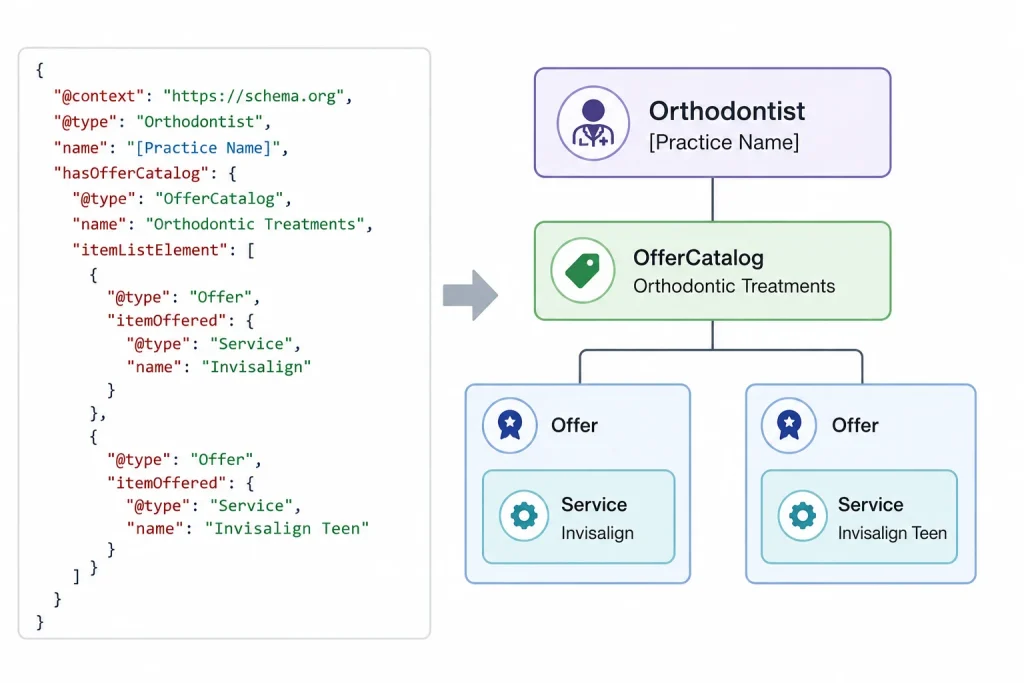
This schema extension names Invisalign and Invisalign Teen as explicit service offerings in the structured data, providing Google’s entity model with machine-readable confirmation of the brand-specific service claims the GBP services list is making.
The Invisalign local content strategy beyond the standalone page
In markets where the top-three local pack positions for “Invisalign [city]” are held by practices with complete GBP Invisalign configurations and standalone Invisalign pages, ranking above them requires a content depth advantage that the standalone page alone cannot produce.
Invisalign comparison content
A page or blog post titled “Invisalign vs. braces in [City]: which is right for you?” targeting the comparison query directly captures a distinct patient segment that the standalone Invisalign page does not address. This comparison content should present the comparison from a patient decision-making perspective, reference the geographic market explicitly, include a consultation call to action, and internally link to both the standalone Invisalign page and the traditional braces page.
Invisalign cost content
“How much does Invisalign cost in [city]” is one of the highest-volume Invisalign-adjacent search queries in most US markets and one that very few orthodontic practices target with dedicated local content. A page addressing Invisalign cost in the local market should explain the factors that determine Invisalign pricing, reference the local market explicitly, address common patient cost concerns (insurance coverage, financing options, cost comparison to braces), and close with a consultation call to action that offers to provide a specific cost estimate based on the individual patient’s case.
Google Posts Invisalign-specific content
Invisalign-specific posts featuring completed case transformations, Invisalign provider tier achievements, free consultation promotions, and Invisalign Teen content for parent audiences reinforce the Invisalign brand association in the GBP activity signal and provide additional indexed content for Invisalign-adjacent queries. A practice that posts one Invisalign-specific GBP update per month generates twelve Invisalign-branded content signals per year in the GBP activity layer.
For the complete GBP optimization framework that integrates Invisalign-specific category, services, and photo signals with the full orthodontic GBP configuration, the Google Business Profile for orthodontists guide covers the complete GBP signal stack.
And for the on-page website framework that provides the structural foundation for the Invisalign-specific content strategy covered in this article, the orthodontic practice website local SEO guide covers the complete website optimization hierarchy.
Key takeaways
Clinical experience with Invisalign does not produce local search visibility for Invisalign queries; structural signals do. A certified Invisalign Diamond Provider with 300 completed cases is invisible for “Invisalign [city]” queries if it has not placed the brand name “Invisalign” in its GBP secondary category, GBP services list, website title tag, and standalone Invisalign page. The signals that determine Invisalign local pack eligibility are configuration decisions, not clinical achievements.
The “Invisalign Provider” secondary GBP category is the single highest-impact Invisalign local SEO change available to any practice that has not already added it. It is a dropdown selection in the GBP editor that takes under sixty seconds and directly determines eligibility for Invisalign brand-specific local pack results. Every other Invisalign local SEO optimization builds on this eligibility foundation.
A standalone Invisalign page has its own URL, its own title tag, and its own body content is the website asset that the GBP Invisalign signals are designed to confirm. A practice with “Invisalign Provider” as a secondary GBP category, but no standalone Invisalign page has a GBP, making a claim that the website does not confirm. Both signals must be present and aligned for the full Invisalign local SEO system to function.
Provider tier surfaces a conversion advantage that most practices leave invisible. Diamond Provider, Platinum Provider, and Gold Provider status are publicly meaningful credentials that patients researching Invisalign providers actively compare. Surface the tier in the GBP description, the Invisalign page H1, and the services entry description in every patient-facing Invisalign signal location.
Invisalign comparison and cost content capture high-intent query segments that the standalone Invisalign page cannot reach. “Invisalign vs braces [city]” and “how much does Invisalign cost in [city]” are distinct queries with distinct patient intents. Dedicated pages targeting these queries capture consideration-stage patients before they become consultation-stage patients, expanding the Invisalign patient pipeline beyond the narrow “Invisalign provider [city]” query that most practices target exclusively.
Your next action this week
Open your GBP editor and check your secondary categories. If “Invisalign Provider” is not listed, add it now before updating any other signal. This single addition changes the query pool your GBP competes in for Invisalign-specific searches and is the foundational eligibility step that every other Invisalign local SEO optimization requires.
Once the secondary category is confirmed, check whether your website has a standalone Invisalign page, a dedicated URL containing only Invisalign content with its own title tag. If your Invisalign content shares a URL with your braces content or lives on a general treatments page, creating the standalone Invisalign page is the highest-leverage website task available to your Invisalign local SEO. Write the page to the minimum content standard: 600 words, location references, provider tier, free consultation call to action, and publish it before adding any supporting content.
Then check the standalone Invisalign page title tag. If it reads anything other than “Invisalign Provider [City, State] | [Practice Name],” rewrite it. This is a single text field change that takes under five minutes and aligns the highest-indexed page element with the exact query string high-intent Invisalign patients are using to find local providers.
For the complete Invisalign local SEO system that integrates every GBP, website, and content signal covered in this guide with the broader orthodontic local SEO framework, the orthodontic local SEO guide is the reference document that connects every element.