
A dental practice in San Antonio had a GBP that was correctly configured, with the right primary category, a complete services list, a consistent NAP, a strong photo set, active posting cadence. It was holding position four for “family dentist San Antonio.” The three practices above had comparable GBP configurations and similar review profiles. The difference the audit surfaced was not in the GBP layer at all. It was in the website layer beneath it.
The position one practice had a homepage title tag that read “Family Dentist San Antonio | Alamo Heights Dental.” Its homepage body content names San Antonio, Alamo Heights, Terrell Hills, and Olmos Park, four geographic signals in the first 200 words. It had individual service pages for dental implants, Invisalign, and pediatric dentistry, each with location-specific content. It had correctly implemented the LocalBusiness schema with the exact NAP matching the GBP. It had internal links connecting every service page to the homepage and the contact page.
Position four practice had a homepage title tag that read “Welcome to Our Dental Office.” Its homepage body content contained no city name in the first 400 words. It had a single “Services” page listing fourteen procedures without geographic context. Its LocalBusiness schema showed a phone number that had been changed eight months earlier. Its service pages had no internal links to the homepage.
Same GBP quality. Dramatically different website local SEO signals. The position difference was the website’s fault, not the GBP’s.
Understanding dental practice website local SEO is the complement to GBP optimization that most dental marketing guides treat as secondary and that most competitive dental markets reward as primary once the GBP foundational layer is correctly configured. This guide covers every on-page website signal layer that contributes to local pack ranking for US dental practices, in the correct priority order.
Table of Contents
Why the website is half of the local SEO equation
Most dental practice owners treat their website and their GBP as two separate marketing assets. The website is for branding and patient education, and the GBP is for local search. This mental model underestimates the degree to which Google’s local ranking algorithm evaluates both simultaneously.
Google’s local pack algorithm does not rank your GBP in isolation. It evaluates your GBP in the context of your website, cross-referencing the signals in your GBP against the signals on your website to build its confidence that the practice it is considering ranking is legitimate, accurately described, and geographically where it claims to be.
Three specific cross-referencing behaviors make the website a direct input to local pack ranking.
Cross-reference 1: NAP consistency between GBP and website. Google compares the Name, Address, and Phone number on your GBP against the NAP signals on your website in the header, footer, contact page, and LocalBusiness schema. Discrepancies between GBP and website NAP are signal conflicts that reduce the trust dimension of your prominence factor.
Cross-reference 2: Category and service consistency. Google evaluates whether your website content confirms the category and service claims in your GBP. A GBP that claims dental implant services, but a website with no dental implant content creates a signal mismatch that reduces your relevance score for implant-related queries.
Cross-reference 3: Geographic signal confirmation. Google uses your website’s geographic content, city names, neighborhood references, and service area mentions to confirm the proximity signals in your GBP. A website with no geographic content provides no website-side confirmation of the location signals your GBP is sending, which weakens the overall proximity signal in competitive markets.
The on-page local SEO hierarchy for dental practice websites
On-page local SEO signals are not equal in weight. The following hierarchy, from highest to lowest impact, determines which optimizations to prioritize when resources for website work are limited.
Tier 1: Title tags and meta descriptions
Title tags are the single highest-weight on-page local SEO signal for dental practice websites. They tell Google and the patient what each page is about and where the practice is located in the most prominent, most-indexed page element available.
Homepage title tag formula:
[Primary Service Type] in [City, State] | [Practice Name]
Example: “Family Dentist in San Antonio, TX | Alamo Heights Dental”
This formula contains the primary service type (Family Dentist), the primary city and state (San Antonio, TX), and the practice name. All three elements are immediately visible in search results and contribute to the relevance and proximity signals that determine local pack eligibility.
Service page title tag formula:
[Specific Service] [City, State] | [Practice Name]
Example: “Dental Implants San Antonio, TX | Alamo Heights Dental”
Each service page title tag should name the specific procedure and the city, not a generic “Services | Practice Name” that provides no procedure-specific or location-specific relevance signal.
What to avoid in dental practice title tags:
Generic welcome language (“Welcome to Our Practice”), practice name only without location or service type, and keyword stuffing that exceeds 60 characters and gets truncated in search results. Title tags over 60 characters display with ellipses in search results. The city and service information that carries the local SEO signal value may be cut off entirely.
Meta descriptions:
While meta descriptions are not a direct ranking signal, they influence click-through rates from search results, which feed back into engagement signals over time. A meta description for a family dental practice homepage should include the practice name, the primary city, one or two specific services or patient population identifiers, and an implicit call to action. Maximum 155 characters. Focus keyword included naturally.
Tier 2: LocalBusiness schema markup
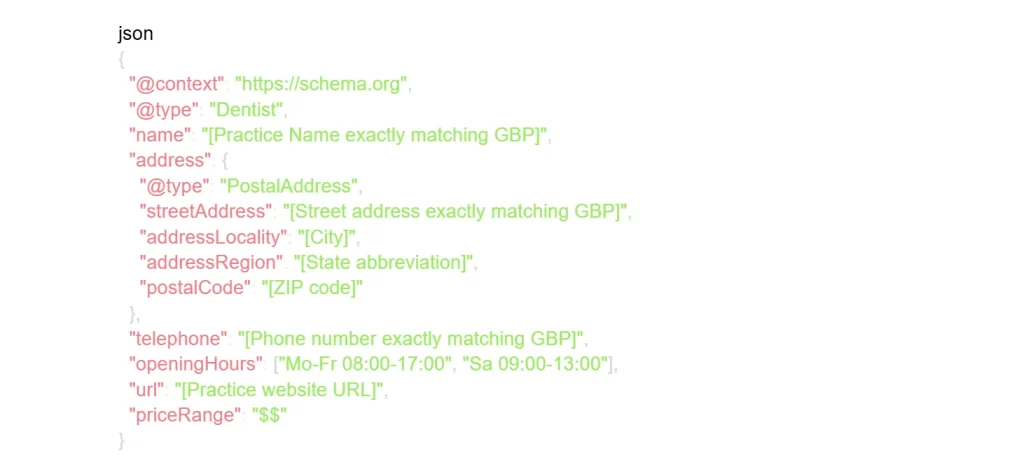
LocalBusiness schema is the structured data markup on your website that tells Google’s systems exactly what your practice is, where it is located, and what it offers in a machine-readable format that is more reliable than Google inferring the same information from unstructured page content.
A dental practice without the LocalBusiness schema is relying entirely on Google to infer its name, address, phone number, hours, and service type from the text on its pages. In competitive markets where other practices have correctly implemented schema, this inference gap is a measurable reliability disadvantage in Google’s entity confidence model.
The minimum required LocalBusiness schema fields for a dental practice:
Critical schema compliance rules:
The name, address, and phone number in the schema must be identical to the GBP, character for character. A phone number in the schema that differs by a single digit from the GBP, even a legitimate call-tracking number that routes to the same line, is a NAP inconsistency in structured data form. It creates a cross-reference conflict that reduces Google’s entity confidence in your practice’s location data.
The schema should be placed on the contact or about page, or on every page via the website footer, so Google can access it from multiple entry points during crawling.
Tier 3: Geographic content in body text
Geographic content in the body text of your homepage and service pages is the website signal that most directly reinforces the proximity claims in your GBP. It is also the signal most commonly absent from dental practice websites because most dental website content is written for patient education rather than local search.
The geographic content minimum for a dental practice homepage:
The homepage body content should include, within the first 300 words: your primary city and state, two to three surrounding communities or neighborhoods you serve, and at least one sentence that explicitly states the practice’s geographic service area.
Example: “Alamo Heights Dental is a family dental practice located in San Antonio, Texas, serving patients from Alamo Heights, Terrell Hills, Olmos Park, and the surrounding North Central San Antonio communities.”
That single sentence contains the practice name, the primary city and state, three surrounding communities, and a broader geographic service area descriptor. It is more of a geographic signal than most dental practice homepages contain in their entire body content.
The geographic content standard for service pages:
Each service page should contain at least one city or neighborhood reference in the body content, connecting the specific procedure to the local geographic context. “Dental implants in San Antonio, TX” as a heading or introductory sentence, “patients from across the San Antonio metro area” in a service description, or “serving implant patients from Alamo Heights, Terrell Hills, and North Central San Antonio” in a service area section, all of these add geographic signal to what would otherwise be procedure-only content.
Tier 4: Individual service pages
A dental website with a single “Services” page listing all procedures in a bulleted list is providing Google with one indexable page for its entire clinical offering. A website with individual pages for each high-value procedure, dental implants, Invisalign, teeth whitening, emergency dental care, pediatric dentistry, and dental veneers provides Google with multiple indexable pages, each targeting a distinct patient search query.
This architectural difference produces measurable local search visibility improvements because each service page can be optimized for a specific procedure-plus-location query: “dental implants San Antonio TX,” “Invisalign family dentist San Antonio,” “emergency dentist San Antonio open now.” A single services page cannot capture multiple distinct queries simultaneously.
The minimum content standard for a dental service page:
Each service page should contain: a title tag with the procedure name and location, a page title (H1) matching or closely mirroring the title tag, 300 to 500 words of original content describing the procedure, its patient benefits, and who it is appropriate for, at least one geographic reference within the body content, a patient-facing FAQ section with two to four questions and answers, and a clear call to action linking to the contact or booking page.
Which service pages to prioritize first:
Not all service pages produce equal local search value. For most general dental practices in the US, the highest-priority service pages are dental implants (high patient value, high search volume), emergency dental care (high patient intent, high “near me” query volume), Invisalign or clear aligner treatment (high patient value, high branded search volume), teeth whitening (high patient interest, high cosmetic search volume), and pediatric or children’s dentistry (high family relevance, high parent search volume).
Build these five pages first. Add additional procedure pages as capacity allows, but the first five produce the most significant visibility lift for the patient acquisition queries that matter most.
Tier 5: Internal linking structure
Internal links, hyperlinks within your website’s body content that connect one page to another, are the structural signals that tell Google’s crawlers how your website’s content is organized and which pages are most important. For dental practice websites, a well-structured internal linking architecture produces two measurable local SEO benefits: it distributes page authority from high-authority pages (e.g., the homepage) to lower-authority pages (e.g., service pages), and it creates clear navigation pathways between related content that Google’s crawlers can follow to index every page.
The minimum internal linking standard for dental practice websites:
Every service page should have at minimum two internal links: one link back to the homepage (in the body text, not just the navigation menu) and one link to the contact or booking page. The homepage should have contextual internal links to each primary service page embedded in the homepage body content, not just in a services menu. A dental implants reference in the homepage body text should be a clickable link to the dental implants service page.
The anchor text standard:
Internal link anchor text should be descriptive and keyword-relevant, not generic. “Our dental implant services” as anchor text is more informative than “click here.” “Book an emergency dental appointment” is more informative than “contact us.” Descriptive anchor text tells Google both the topic of the linked page and the relevance of the connection between the linking page and the destination page.
Location-specific internal linking:
For dental practices with multiple service area pages or location pages, internal links should connect those geographic pages to relevant service pages and back. A “Serving San Antonio” location page that has internal links to the dental implants page, the emergency dentistry page, and the pediatric dentistry page creates a geographic-to-service content connection that reinforces both the geographic relevance and the service relevance signals simultaneously.
Tier 6: Mobile optimization and page speed
Local dental searches are predominantly mobile and “near me” searches, the highest-volume query type for most dental practices, are almost exclusively mobile. A dental website that doesn’t perform well on mobile is failing the primary device type for its primary patient acquisition channel.
The mobile optimization checklist for dental practice websites:
☐ Responsive design that renders correctly on all screen sizes. Test your website on iPhone, Android, and tablet. Elements that appear correctly on a desktop layout, multi-column service grids, wide navigation menus, and full-width hero images often render poorly on mobile screens without responsive design adjustments.
☐ Click-to-call phone number visible above the fold on mobile. The phone number should be the most prominent and immediately accessible element on the mobile homepage, not hidden in a navigation menu or below a hero section that requires scrolling. A tappable phone number above the fold is the single most impactful mobile conversion optimization available to any dental practice website.
☐ Page load time under 3 seconds on mobile. Test your mobile page load speed using Google PageSpeed Insights (pagespeed.web.dev). A score below 50 on mobile indicates performance issues that are likely suppressing both your search visibility and your conversion rate. Common dental website performance issues: uncompressed images (the most common cause of slow load times), render-blocking JavaScript from third-party plugins, and large hero video files that load before any page content is visible.
☐ Online booking integration accessible from the mobile homepage. Patients searching “dentist near me” on a smartphone at 9:00 PM cannot call the practice, as it’s closed. An online booking link visible without scrolling on the mobile homepage converts after-hours intent into scheduled appointments. A patient who can’t immediately book will find a practice that lets them.
☐ Legible font size and tappable button sizing. Mobile web usability standards require a minimum font size of 16px for body text and a minimum tap target size of 44×44 pixels for buttons and links. Dental websites designed for desktop and not properly adapted for mobile frequently fail both standards, producing a user experience that search engines and patients both penalize.
The NAP consistency audit within your own website
The NAP consistency obligation that most dental practices understand as a citation management task also applies within the website itself. A dental website that displays three different phone numbers, a tracking number in the header, the direct line in the footer, and an old number in the schema markup from a pre-tracking setup is sending Google three conflicting phone signals from a single domain.
This internal NAP inconsistency is one of the most common and least audited problems in dental practice website local SEO. Run the following check on your own website before touching anything else.
Header: What phone number appears in the header on desktop? On mobile?
Footer: What phone number appears in the footer? Does it match the header exactly, including format (parentheses, dashes, spaces)?
Contact page: What phone number appears on the contact page? Does the address format match the GBP exactly, “Suite 200” versus “Ste. 200” versus “Suite #200”?
LocalBusiness schema: What phone number and address appear in the schema markup? The easiest way to check: paste your website URL into Google’s Rich Results Test (search.google.com/test/rich-results) and examine the extracted schema data.
All four should be identical to each other and to your GBP. Any discrepancy is an internal NAP conflict that reduces the reliability of your website’s location signals and compounds any external citation inconsistencies the practice may also be carrying.
For the complete external NAP audit methodology, including the specific citation sources to check, the format standardization framework, and the correction submission process, the dental practice NAP consistency guide covers the full external audit in standalone depth.
And for the citation building strategy that extends your NAP footprint beyond the existing citation sources, you’re auditing the dental practice local citations guide gives you the complete directory prioritization framework for US general dental practices.
Key takeaways
The website is half of the local SEO equation, not a secondary asset. Google cross-references your GBP against your website to confirm NAP consistency, category and service relevance, and geographic signals. A correctly configured GBP sitting on top of a poorly optimized website is producing half the local search visibility it’s capable of.
Title tags are the single highest-weight on-page local SEO signal. Every page title tag should follow the formula: [Primary Service or Procedure] in [City, State] | [Practice Name]. A homepage title tag that reads “Welcome to Our Dental Office” is providing Google with zero relevance or proximity signal from the most prominent indexed page element available.
LocalBusiness schema must be character-for-character identical to your GBP. A phone number in the schema that differs from the GBP by even one digit is a structured data NAP conflict. Check your schema with Google’s Rich Results Test and compare it field by field to your GBP before considering the schema signal optimized.
Individual service pages outperform a single services page for local search visibility. Five well-optimized service pages, dental implants, emergency care, Invisalign, teeth whitening, and pediatric dentistry, each targeting a distinct procedure-plus-location query, produce significantly more local search traffic than a single services page listing all fourteen procedures without geographic context.
Mobile optimization is a prerequisite, not an enhancement. Local dental searches are predominantly mobile. A dental website that fails the click-to-call, page speed, and responsive design standards is suppressing the conversion of its own local search visibility ranking for the query, but failing to convert the patient who clicks through.
Your next action this week
Run the four-point internal NAP consistency check on your own website right now. Check the phone number and address in your header, footer, contact page, and LocalBusiness schema, and compare all four against your GBP. If any of the four sources show a different number, a different address format, or a different practice name, that is an internal NAP conflict that is costing you local search signal reliability. Fix it before any other website optimization.
Then check your homepage title tag. Open your website, look at the browser tab that is your title tag. If it reads anything other than “[Service Type] in [City, State] | [Practice Name],” rewrite it. This is a single text field change in your website CMS that takes under five minutes and produces one of the highest-leverage single local SEO improvements available on the website layer.
If both of those checks are clean, open your website on a mobile device and count how many scrolls it takes to reach the phone number from the homepage. If the answer is more than zero, mobile click-to-call placement is your next priority.
To complete your Google Maps presence before working on the website layer, the Google Maps optimization checklist for dental practices gives you the full GBP audit framework that pairs with every on-page fix covered here.
And for the complete local SEO strategy that integrates every website signal layer with GBP optimization, citations, and reviews into a unified competitive framework, the general dentistry local SEO guide is the reference document that connects every element covered in this article.