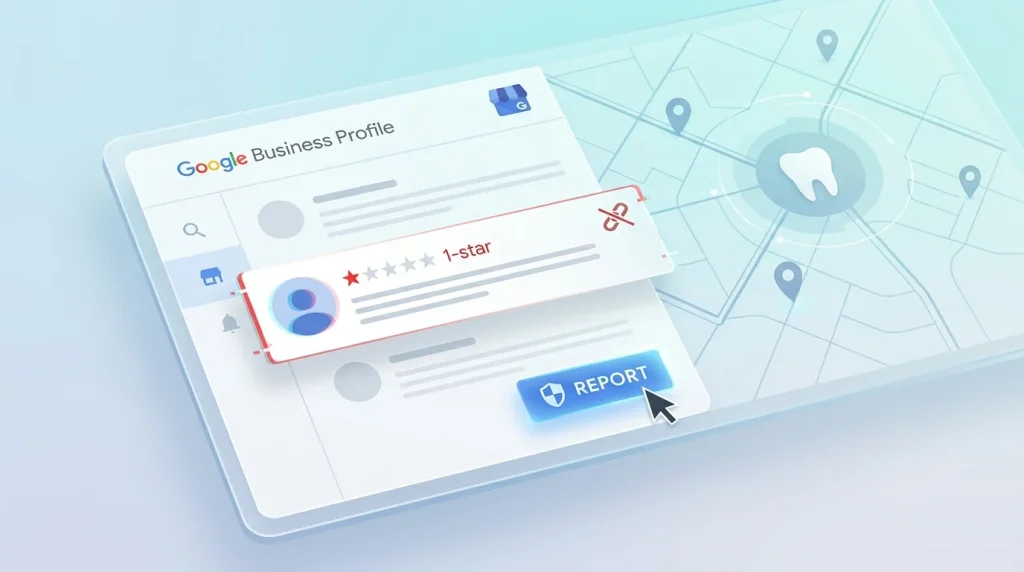
A periodontist in Atlanta woke up one Monday morning to find three one-star reviews posted to her GBP over the weekend. No text. No details. Just three one-star ratings from accounts she didn’t recognize, accounts with no review history, no profile photos, and names that didn’t match any patient in her practice management system.
Her average rating dropped from 4.9 to 4.4 overnight. Her local pack position for “periodontist Atlanta” fell from position 2 to position 4 within 10 days. The reviews stayed live for six weeks while she worked through Google’s removal process.
She was not alone. Fake Google reviews on a dental practice listing are among the top three concerns of practice owners managing online reputation in competitive US markets, according to a 2023 World Dental Federation survey. The challenge is specific to healthcare: dental practices cannot publicly discuss patient details, cannot confirm or deny the existence of a patient relationship without triggering HIPAA exposure, and cannot threaten legal action in public responses without creating additional reputation risk.
The result is a compliance-constrained environment that makes fake Google reviews dental practice management genuinely more complex than for non-healthcare businesses, and that requires a legally aware approach most dental reputation guides don’t adequately cover.
This guide gives you the complete framework for identifying fake Google reviews on a dental practice profile, the definitive resource on fake Google reviews that dental practice owners in competitive US markets face each year, flagging them through Google’s removal process, responding without creating HIPAA exposure, and rebuilding your rating after an attack.
Table of Contents
How to identify fake Google reviews on a dental practice profile
Not every negative review is fake. Not every fake review is obvious. The identification step is the prerequisite for everything that follows because the response strategy for a genuine negative patient experience is entirely different from the strategy for a fabricated or retaliatory fake Google review targeting your dental practice. Misclassifying a fake Google review dental practice attack as a genuine complaint leads to the wrong response framework and compounds the reputational damage.
Signals that a review is likely fake or ineligible
No patient record match. The reviewer’s name does not appear in your practice management system as a current or former patient. Not conclusive on its own, patients may use different names online, but combined with other signals, it is strong evidence of a non-patient reviewer.
No review history on the account. The reviewer’s Google account has no other reviews or has reviews posted in rapid succession across multiple unrelated businesses in a short window, suggesting a coordinated fake review campaign.
No profile photo or biographical detail. Newly created Google accounts with no profile photo, no About section, and no other activity are frequently created specifically for leaving fake reviews targeting dental practices.
Generic or non-specific review content. A one-star review with no specific clinical detail, no mention of a procedure, a team member, a waiting time, or any verifiable element of a dental visit is a strong indicator of a fabricated review. Genuine negative reviews, even unfair ones, typically contain specific details because they reflect a real experience.
Timing correlation with a conflict. A cluster of one-star reviews posted within a short window from accounts with no prior review history is a pattern consistent with a coordinated attack, particularly when it follows a staff departure, a patient dispute, or a period of heightened local competition.
Geographic impossibility. If the reviewer’s Google profile location data shows a location that makes a visit to your practice implausible, this is a strong ineligibility signal.
Signals that a review is likely genuine, even if unfair
Specific clinical or operational details. A negative review referencing a specific procedure, team member, appointment type, or element of the patient experience contains verifiable detail inconsistent with fabrication.
A patient record match or near-match. A reviewer whose name partially matches a patient record may be a genuine patient using a different name online.
A review pattern consistent with a real complaint. A one-star review with specific complaint details, posted once from an account with other reviews across other businesses, is almost certainly a genuine negative review even if the complaint is unfair or based on a misunderstanding.
The distinction matters because the response strategy diverges completely at this point. A fake Google review on a dental practice profile requires a flagging-first approach; the public response, if any, should be brief and professional while the removal process is underway. A genuine negative review requires a service recovery approach a public response that acknowledges the concern, offers to resolve it offline, and demonstrates the practice takes patient experience seriously.
The Google review removal process: what works and what doesn’t
Reviews Google will remove
Spam and fake content. Reviews posted by accounts with no legitimate connection to the business, reviews that appear to be part of a coordinated fake Google reviews dental practice campaign, and reviews from accounts created specifically to leave a single negative review.
Off-topic content. Reviews that discuss a business other than the one listed, or reviews that contain no content related to the patient experience.
Restricted content. Reviews containing personal information, obscene language, threats, or discriminatory language.
Conflict of interest content. Reviews posted by current or former employees, by competitor practice owners, or as part of a documented coordinated campaign.
Reviews Google will not remove
Negative but genuine reviews. A patient who had a bad experience and left a one-star review with specific details is expressing a legitimate opinion. Google’s policies explicitly protect this, even if the review is unfair.
Anonymized genuine reviews. A patient who leaves a review under a username that doesn’t match their legal name is not automatically ineligible. The review is only removable if the content itself violates Google’s policies.
Reviews about resolved complaints. A patient who had a negative experience, was offered a resolution, and still left a negative review cannot have that review removed because the complaint was addressed.
How to submit a removal request for fake Google reviews on a dental practice listing
Step 1. Log into Google Business Manager and navigate to the review in question. Click the flag icon to report it. Select the most accurate policy violation category: “Spam or fake” for fabricated reviews, “Off topic” for misdirected content, “Restricted content” for policy-violating language.
Step 2. Submit the report and note the submission date. Google’s initial review typically takes three to seven business days.
Step 3. If the initial report is rejected, escalate through Google Business Profile support chat or phone and request a manual review by a human moderator. Provide specific evidence: the account creation date, the absence of a patient record match, and the timing correlation with a known conflict.
Step 4. If manual review does not produce removal, consult a legal professional about a formal Google legal removal request citing specific policy violations. This path is slow and not guaranteed, but it is the available escalation when standard processes fail, and fake Google reviews on the dental practice listing are causing documented business harm.
How to respond to fake Google reviews on a dental practice: the HIPAA-constrained framework
The public response to a fake Google review dental practice attack creates the most compliance risk because the instinctive response to a false review is to defend the practice with specifics, and specifics almost always involve patient health information.
A dental practice cannot publicly state that the reviewer was never a patient because doing so confirms the existence or non-existence of a patient relationship, which is itself PHI. A dental practice cannot describe the treatment that was or wasn’t provided, reference appointment dates, outcomes, or any element of the clinical record in a public response.
This constraint doesn’t mean the practice cannot respond. It means the response must demonstrate professionalism and patient-centeredness without disclosing anything that could confirm a patient relationship or reveal clinical detail.
Response template for fake Google reviews on a dental practice profile
“Thank you for bringing this to our attention. We take all feedback seriously and encourage anyone with concerns about their experience to contact us directly at [phone number]. We are committed to providing excellent care to every patient we serve.”
What this response does: it acknowledges the fake Google reviews dental practice listing has received without confirming or denying a patient relationship, provides a direct contact channel that moves the conversation offline, and signals to prospective patients that the practice is responsive and professional without disclosing PHI or creating legal exposure.
What this response does not do: it does not claim the reviewer was never a patient, does not describe what did or didn’t happen clinically, does not accuse the reviewer of lying in a public forum, and does not use language that could be characterized as threatening or retaliatory.
Response framework for genuine negative reviews
Sentence 1: Acknowledge without admitting. “Thank you for sharing your experience. We’re sorry to hear your visit didn’t meet your expectations.”
Do not admit fault, agree with the patient’s characterization of events, or make any statement that could be used as an admission in a subsequent dispute.
Sentence 2: Move the conversation offline. “We’d like to learn more about what happened and make this right. Please contact us directly at [phone number] or [email] and ask to speak with [owner/office manager name].”
This is the most important sentence in any negative review response. Moving the conversation offline prevents a public back-and-forth that amplifies the review’s visibility and creates an opportunity for service recovery that a public thread cannot provide.
Sentence 3: Signal commitment to quality. “Providing a positive experience for every patient is our priority, and we take every piece of feedback seriously.”
This sentence is for the prospective patients reading the review, not the reviewer. It signals that the practice is responsive, professional, and patient-centered.
What to avoid in any public response:
- Do not name the reviewer
- Do not reference the specific procedure, appointment type, or any clinical detail
- Do not include dates, appointment times, or any information that could confirm a patient relationship
- Do not respond with frustration, defensiveness, or any language that could be perceived as hostile
- Do not ignore the review entirely. An unanswered fake Google review on a dental practice profile signals to prospective patients that the practice doesn’t monitor its reputation
Rebuilding your rating after a fake Google reviews dental practice attack
The recovery sequence
Step 1: Pursue removal aggressively but patiently. Submit removal requests for every fake review on day one. Follow the escalation path if initial reports are rejected. Document every step and every response from Google.
Step 2: Accelerate legitimate review acquisition immediately. Do not wait for fake Google reviews on the dental practice listing to be removed before intensifying review acquisition. The fastest path to rating recovery is adding genuine five-star reviews on top of the fake ones, both because they dilute the rating impact and because Google’s systems respond to review velocity as a quality signal that partially offsets rating suppression.
A practice that goes from one new review per week to five per week in response to fake Google reviews on a dental practice profile is demonstrating a genuine patient satisfaction signal that competes directly with the fake signal. Activate every element of the review acquisition framework, chair-side provider requests, automated text follow-ups, and compliant email sequences at maximum output during the recovery period. The guide to asking patients for Google reviews gives you the HIPAA-safe request language and channel guidance for this phase.
Step 3: Monitor the rating recovery trajectory. Track your average rating weekly. A practice with 80 genuine reviews at 4.9 stars that receives three fake one-star reviews drops to approximately 4.7 stars. Each genuine five-star review added during recovery moves the average back toward the pre-attack baseline. At a five-star-per-week acquisition rate, recovery to 4.9 stars takes approximately four to six weeks, with or without removal of the fake reviews.
Step 4: Document the attack for potential legal escalation. If the fake Google reviews dental practice attack appears coordinated, multiple reviews from accounts with similar creation dates, similar language patterns, or timing that correlates with a known conflict, document everything: screenshots of all reviews, account profile details, posting timestamps, and any communications suggesting the source of the attack.
The legal dimension: what dental practices can and cannot do
What dental practices can do legally
Submit a Google legal removal request for reviews containing demonstrably false statements of fact, not opinions, but factual claims that are verifiably false and damaging to the practice.
Pursue a John Doe lawsuit to compel Google to disclose the identity of an anonymous reviewer in jurisdictions where this is legally viable. This is expensive, slow, and appropriate only for cases of severe and documented reputational harm from fake Google reviews on a dental practice profile.
Send a cease-and-desist letter to an identified individual leaving fake reviews as part of a harassment or defamation campaign, most viable when the reviewer’s identity is known and the content constitutes defamation under applicable state law.
What dental practices cannot do legally or ethically
Threaten legal action in a public review response. A response that references attorneys or law enforcement will be perceived as aggressive by prospective patients, and Google can remove the response for it.
Offer to resolve a complaint in exchange for removing a review. Offering anything of value, a refund, a discount, or a complimentary service in exchange for review modification or removal is a Google guideline violation and potentially an FTC endorsement disclosure violation.
Post fake positive reviews to offset fake negative ones. This is a Google guideline violation, a potential FTC regulation violation, and a reputational risk that compounds the original damage if discovered.
Key takeaways
Not every negative review qualifies as a fake Google review dental practice situation, and the identification step determines which response strategy applies. Flagging-first for fabricated reviews; service recovery for genuine complaints.
HIPAA constrains every public response. No patient relationship confirmation, no clinical detail, no appointment dates, regardless of how false or unfair the fake Google review targeting your dental practice is.
The fastest path to rating recovery is genuine review velocity, not waiting for removals. Activate your review acquisition system at maximum output from day one of the attack.
Document every fake Google review dental practice attack for potential legal escalation, especially when the pattern suggests coordination.
Removal is not guaranteed. Build your strategy around recovery in parallel with removal, not removal as a prerequisite to recovery.
For benchmark data on how fake Google reviews dental practice attacks affect local pack rankings, what recovery timelines look like, and what realistic recovery targets look like for your market, the number of Google reviews a dental practice needs provides the framework that contextualizes the acquisition targets your recovery system should be working toward. And for the full picture of how reviews, GBP signals, and local pack eligibility work together, the complete guide to getting more Google reviews for your dental practice is the next read.