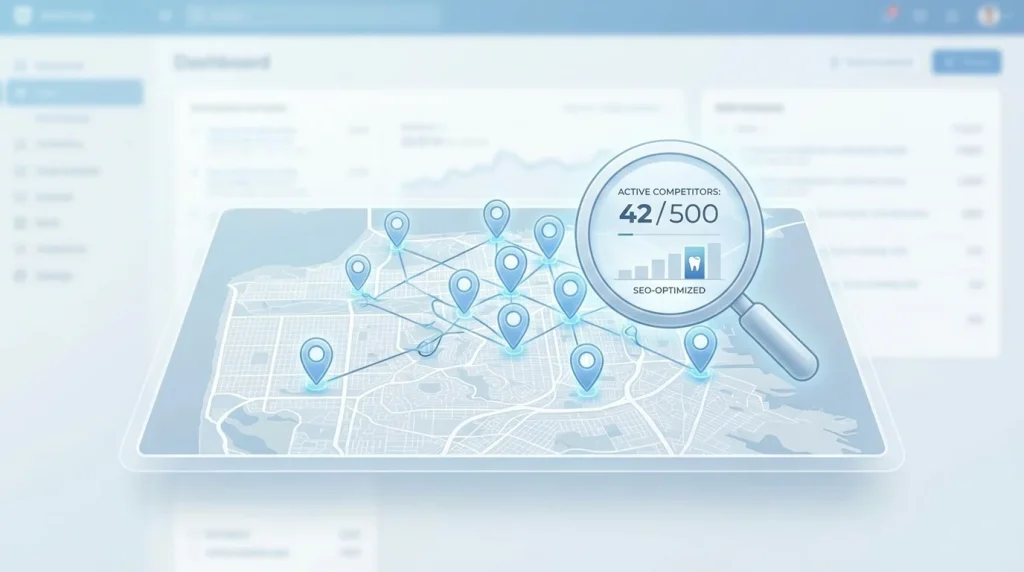
A dental practice manager in Phoenix, Arizona, searched Google Maps and counted 54 dental practices within a five-mile radius of her office. Her marketing consultant described Phoenix as “moderately competitive” for local SEO purposes. Both the Maps count and the consultant’s characterization produced the same error: they treated presence as competition.
A more precise audit of the Phoenix local pack for “family dentist Phoenix” told a different story. Of the 54 practices visible on Maps, 36 had verified Google Business Profiles. Of those 36, 21 had any Google Posts published in the last six months. Of those 21, 9 had a post published within the last 30 days. Of those 9, 5 had service lists with more than 6 named entries, review velocity of 4 or more new reviews per month, Q&A sections with practice-generated answers, and photo sets updated within the last 90 days.
Five practices were actively competing for the Phoenix local pack in any meaningful operational sense. Forty-nine practices were nominally present.
Understanding the dental local SEO competitive landscape in a specific market requires distinguishing between three fundamentally different states of GBP presence: partially optimized, actively competing, and identifying what proportion of the total practice count in a market actually belongs to the third category. That proportion, not the raw count of dental practices in the area, is the competitive density metric that determines what signal threshold is required to reach and hold the top three local pack positions and what sustained investment level that threshold demands.
Table of Contents
The three-layer competitive model
The dental local SEO competitive landscape in US markets consistently follows a three-layer structure based on the degree of active GBP management observable in each practice’s profile. The proportion of practices in each layer varies by market size and geographic context, but the structure itself is consistent across competitive dental markets.
Layer 1: Present but not actively competing. Practices with a verified Google Business Profile that has not been meaningfully managed since initial setup. Identifiable characteristics: no Google Posts in the last 90 days or a historical cluster of posts from one period with a long subsequent gap; fewer than 3 new reviews in the last 90 days; services list with zero or one generic entry; photo set of fewer than 8 images, most or all from the initial GBP setup period; no practice-generated Q&A content; attributes limited to the default accessibility fields Google prompts during initial verification.
These practices appear in Google Maps searches and inflate the visible count of “competitors” in any market. They hold local pack positions where they hold them at all based on proximity to the searcher’s location, legacy domain age, or the absence of active competition in that sub-market, rather than on ongoing optimization. They are not generating ranking signals that compound. They are not the competition.
Layer 2 Present and partially optimized. Practices that completed an initial GBP optimization effort and have maintained elements of ongoing management without sustaining a systematic program. Identifiable characteristics: moderate review counts in the 20 to 80 range with stale recency, last review posted 45 to 90 or more days prior; occasional Google Posts with gaps of 30 to 60 days between publications; services list with 3 to 6 entries; adequate photo count from a single photography effort that has not been updated in 6 to 12 months; some attributes configured.
Layer 2 practices are competitive in low-density small markets where Layer 3 competitors are few or absent. In mid-sized and larger markets, they typically occupy positions 4 through 8 in the local pack, visible but consistently excluded from the top three for primary query categories. They represent the most common profile of a dental practice that has invested in local SEO at some point and allowed the program to drift into maintenance mode.
Layer 3: Actively and systematically competing. Practices with ongoing, systematized GBP management generate continuous ranking signals across all major completeness dimensions. Identifiable characteristics: 3 to 15 or more new reviews per month depending on market size and practice type; Google Posts published within the last 21 to 30 days; services list with 8 to 16 named entries and individual descriptions; photo count updated within the last 90 days; Q&A section with practice-generated answers covering the primary pre-appointment patient questions; attributes fully configured including “Accepts new patients” enabled and online booking link functional; business hours accurately configured with special hours maintained proactively.
These practices are actively competing for top-three local pack positions and are, by definition, the competitive set that determines the signal threshold any practice must meet or exceed to reach the top three. They are the actual dental local SEO competitive landscape, not the 54 practices on the Maps view.
Why the visible practice count overstates real competition
The gap between visible practice count and active competitor count is not a rounding error. In most US dental markets, the number of Layer 3 actively competing practices represents a significantly smaller share of the total visible practice count than most dental practice owners assume.
Three structural factors produce this gap.
GBP verification does not imply ongoing management. Google’s GBP verification process has a low friction threshold. A practice that verifies its GBP and completes the initial setup fields has cleared the eligibility requirement for local pack appearance without making any commitment to ongoing management. A significant proportion of verified dental GBPs in any market have not been actively managed since the month of verification. (Source: composite patterns observed across dental market competitive landscape audits in the US markets.)
Initial optimization campaigns lose momentum without systematic follow-through. Many dental practices invest in local SEO during a practice launch or following a marketing consultation, generate an initial burst of reviews and GBP content, and allow the program to drift without a systematic maintenance workflow. The result is a Layer 2 profile: enough historical optimization to appear in the local pack, not enough ongoing signal generation to compete for the top three. This drift pattern is the most common competitive landscape dynamic in mid-sized US dental markets.
Active management requires an operational infrastructure that most practices have not built. The characteristics of a Layer 3 active competitor include consistent monthly review velocity, regular posting cadence, proactively updated photo sets, and maintained special hours require operational systems: automated review request workflows, a content calendar, and a staff responsibility assignment for GBP maintenance. Practices that have not built this infrastructure cannot sustain Layer 3 activity regardless of their initial optimization investment.
The BrightLocal 2023 Local Consumer Review Survey documents that 98% of consumers read reviews for local businesses before making a selection decision for healthcare providers, including dental practices. (Source: BrightLocal Local Consumer Review Survey, 2023.) The practices that consumer behavior systematically follows are the Layer 3 active competitors. They are a minority of the visible market in most US dental markets.
Competitive density by market size: what the data shows
The proportion of Layer 3 active competitors relative to the total dental practice count varies systematically by market size. The following competitive density patterns are derived from a composite analysis of dental local pack competitive landscapes across US markets.
Small market competitive density (population under 75,000)
In small US markets, the typical competitive landscape contains 10 to 25 dental practices within the primary local pack service radius. Layer 3 active competitors in these markets: typically 1 to 5 practices. The competitive density is low enough that a practice entering Layer 3 active management from a Layer 2 state can produce top-three local pack movement within 30 to 60 days in most small market contexts, because the signal threshold required to differentiate from existing top-three practices is achievable with a basic, systematic optimization program.
The most common competitive landscape pattern in small markets: one or two practices with strong review volume and adequate completeness holding the top two positions, a Layer 2 practice holding position three on proximity and legacy factors, and the remaining local pack positions occupied by practices cycling between Layer 1 and Layer 2. A new Layer 3 entrant typically displaces the proximity-based Layer 2 holder at position three within the first optimization cycle.
Mid-sized market competitive density (population 75,000 to 350,000)
In mid-sized US markets, the competitive context for the majority of US dental practices, the typical competitive landscape contains 30 to 100 practices within the primary service radius. Layer 3 active competitors: typically 5 to 20 practices, representing 10 to 25% of the total practice count in most mid-sized markets observed.
The mid-sized market competitive landscape has a critical structural characteristic: the practices holding the top-three local pack positions for primary query categories in mid-sized markets almost universally have implemented systematized review acquisition workflows. The review velocity and completeness thresholds required for top-three positions in these markets are 3 to 6 new reviews per month, and 7 to 12 named services list entries cannot be produced by informal, memory-dependent processes. This means the threshold for entering effective Layer 3 competition in mid-sized markets is not just a matter of completing GBP fields once. It requires building operational infrastructure that produces ongoing signal generation.
Large market and major metro competitive density (population 350,000+)
In large markets and major metro areas, the total practice count within a given local pack service radius may range from 100 to 800 or more. Layer 3 active competitors: typically 20 to 80 practices in large markets, with higher concentrations in specialty query categories in major metro areas where specialty practices have invested more heavily in systematic local SEO.
The major metro competitive landscape differs from mid-sized markets not just in the number of active competitors but in the sophistication of their operational infrastructure. Major metro Layer 3 practices have typically implemented automated multi-touchpoint review acquisition systems, professional GBP photography programs, and posting calendars with pre-approved content. The floor of effective competition has risen: what is a differentiating investment in a small market is a minimum requirement in a major metro.
The competitive landscape audit: identifying your real competitors in 20 minutes
The following protocol identifies the Layer 3 active competitors in any dental local pack, the practices whose signal profiles set the threshold that must be met or exceeded for the top-three position in approximately 20 minutes using publicly available GBP data.
Step 1: Identify the local pack for your primary query category (3 minutes). Open an incognito browser window and search your primary query “family dentist [your city],” “pediatric dentist [your city],” or the appropriate specialty query from your practice’s location. Note the three practices in the local pack. These are your current top-three Layer 3 competitors. Also note the practices at positions 4 through 8 in the expanded local results.
Step 2: Score each top-three practice against Layer 3 criteria (10 minutes). For each of the three local pack practices, open their GBP listing and record: date of most recent Google Post, total review count, and date of most recent review, number of named services list entries visible in the profile, and photo count. A practice meeting four of these five criteria post within the last 30 days, review within the last 30 days, 6 or more service entries, and 10 or more photos is a confirmed Layer 3 active competitor.
Step 3: Identify practices approaching Layer 3 at positions 4 through 8 (5 minutes). Apply the same scoring to the next five practices in the expanded local results. Practices at positions 4 through 8 that score 3 to 4 out of 5 Layer 3 criteria are approaching active competition and represent your near-term competitive pressure. The practices most likely to displace a top-three position if their optimization program advances before yours does.
Step 2 output: The number of confirmed Layer 3 active competitors in your local pack tells you precisely what signal quality you need to reach and sustain to enter and hold top-three positions. It also tells you whether the top-three positions are held by highly systematized competitors with deep optimization infrastructure or by Layer 2 practices that have drifted to the top on legacy factors, a distinction with direct implications for how quickly your optimization investment can produce position movement.
What competitive density tells you about your investment
The competitive density of your specific local pack calibrates every other local SEO investment decision in ways that a universal framework cannot.
Low-density competitive landscape (1 to 5 Layer 3 active competitors in market): The top-three positions in a low-density market are reachable from a Layer 2 baseline within 30 to 60 days of entering Layer 3 management. The signal quality required is lower, the review velocity required is lower, and the sustained investment required to maintain position is lower. The risk in low-density markets is not the competitive threshold; it is the absence of systematic operational discipline that causes a practice to drift from Layer 3 back to Layer 2 after an initial optimization effort, losing the position to the next practice that builds consistent management infrastructure.
Moderate-density competitive landscape (5 to 20 Layer 3 active competitors in mid-sized market): The top-three positions in a moderate-density market require sustained Layer 3 management infrastructure, systematic review, acquisition workflows, consistent posting cadence, proactively maintained GBP completeness over a 60 to 120 day timeline before consistent top-three positioning becomes stable. Individual optimization sessions produce partial position movement. Sustained operational discipline produces stable top-three positioning.
High-density competitive landscape (20+ Layer 3 active competitors in a large market or major metro): The top-three positions in a high-density market require automation. Manual processes front desk review requests that depend on staff memory, ad hoc GBP updates when someone remembers, cannot generate the signal velocity required to compete with practices running automated post-appointment SMS workflows, professional GBP photo programs, and scheduled content calendars. The competitive threshold has risen above what informal management disciplines can sustain.
For the benchmark data that defines what signal quality those Layer 3 active competitors are actually generating, review volume by market size, GBP completeness scores, photo counts, and posting cadence, the dental GBP benchmark report provides the complete multi-dimensional benchmark framework that the competitive landscape audit in this article measures against.
For the patient behavior data that explains what those Layer 3 competitors are capturing from the local pack, how patients search, how they evaluate practices, and what GBP signals drive their final selection decision, the (dental patient search behavior guide) (→ Cluster 11 Satellite 11.2) covers the patient side of the competitive landscape picture.
Key takeaways
The number of dental practices visible on Google Maps is not the competitive density metric that calibrates local SEO investment. The relevant competitive density metric is the number of Layer 3 active competitors practices with ongoing, systematized GBP management generating continuous review velocity, consistent Posts cadence, and complete profile signals. In most US dental markets, this number is substantially smaller than the total visible practice count, and identifying it precisely is the prerequisite for calibrating any other investment decision accurately.
The three-layer competitive model is present, partially optimized, and actively competing is observable in every US dental market and predictable by market size. Practices in Layer 1 inflate visible counts without competing for ranking signals. Practices in Layer 2 hold positions based on historical optimization and proximity. Practices in Layer 3 hold top-three positions based on continuously generated signals. Only Layer 3 practices set the threshold that new entrants must meet.
In small US markets, the typical active competitor count is 1 to 5 practices, making the top-three position achievable from a Layer 2 baseline within 30 to 60 days of systematic optimization. The risk in small markets is not competitive density; it is the drift from Layer 3 back to Layer 2 after an initial optimization effort, which surrenders position to the next practice that builds consistent operational infrastructure.
In major metro markets, Layer 3 competition requires automation infrastructure that manual processes cannot replicate. Post-appointment SMS review automation, scheduled content production, and proactive GBP maintenance programs are minimum requirements for sustained top-three position in high-density markets to differentiate investments. A manual process that works in a small market cannot sustain the review velocity and posting cadence required in a major metro competitive context.
The 20-minute competitive landscape audit in this article produces two actionable outputs: the number of Layer 3 active competitors in your specific local pack, and an identification of the Layer 2 practices approaching active competition at positions 4 through 8 that represent your near-term competitive pressure. Both outputs are derived from publicly available GBP data, require no paid tools, and directly inform the investment level and operational infrastructure required to reach and hold top-three positions in your specific market.
Your next action this week
Run the 20-minute competitive landscape audit for your primary query category right now. Open an incognito browser, search your primary dental query from your practice location, and apply the Layer 3 scoring criteria to the three practices in your local pack and the next five in the expanded results.
Count your confirmed Layer 3, active competitors. If the count is 1 to 3, your competitive threshold is achievable with a basic systematic optimization program, and your top-three position timeline is 30 to 60 days. If the count is 5 to 15, your competitive threshold requires sustained operational infrastructure over a 60 to 120-day timeline. If the count exceeds 15, your competitive context requires automation.
Then score your own practice against the same Layer 3 criteria. The gap between your current score and Layer 3 status, not the gap between you and a universal benchmark, is your highest-priority local SEO investment target this week.