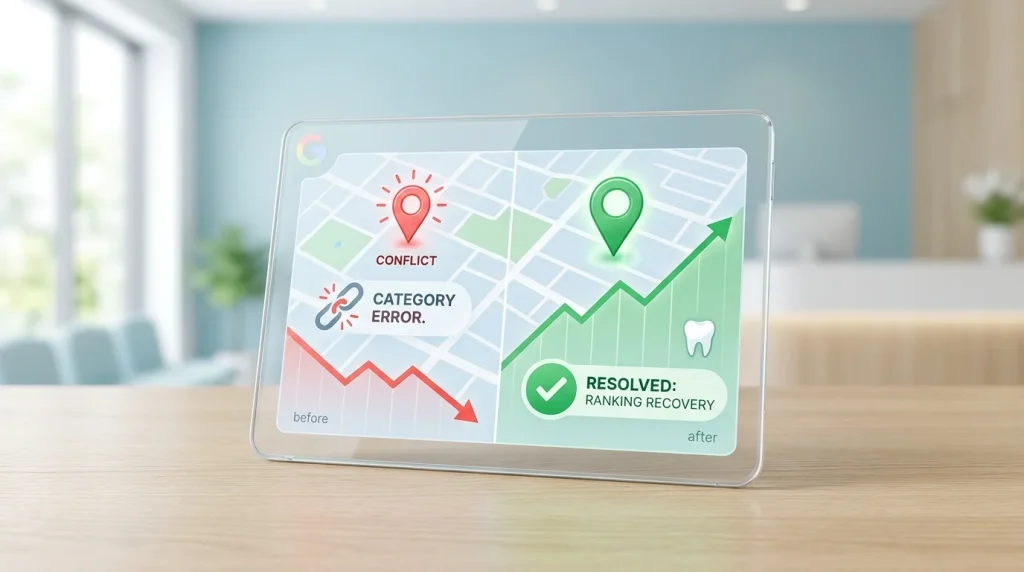
In March 2024, a periodontal practice in Phoenix, Arizona, completed a rebrand. New practice name. New logo. New website. The office manager updated the GBP to reflect the new name and uploaded the new logo. The website went live. The rebrand was considered complete.
Within three weeks, the practice had disappeared from Google Maps for every non-branded query it had previously ranked for. “Periodontist Phoenix.” “Gum disease treatment Phoenix.” “Dental implants periodontist near me.” All gone. The practice still appeared when patients searched for its exact new name, but the name was new, so almost no patients were searching for it yet.
The practice had gone from holding a stable position two in the local three-pack for “periodontist Phoenix”, a position it had built over four years, to functional invisibility in the space of a single month. Revenue from new patient inquiries via Google Maps dropped by an estimated 70% in the six weeks following the rebrand.
The cause was not the rebrand itself. Rebrands are a normal business event that GBPs navigate successfully every day. The cause was two specific errors made during the rebrand GBP update, errors that compounded each other in a way that neither would have produced alone, and one pre-existing configuration issue that the rebrand update accidentally activated.
This dental GBP ranking recovery case study documents all three causes, the recovery sequence that resolved them, and the ranking timeline from disappearance to full recovery.
Table of Contents
The practice profile before the rebrand
Practice type: Periodontal specialty practice, two periodontists, urban Phoenix. Years in operation at rebrand: Nine years under the original name, four years at the current address. GBP status pre-rebrand: Verified, active, stable. Position two in the local three-pack for “periodontist Phoenix.” Position one to two for “gum disease treatment Phoenix.” Review count and average: 87 reviews, 4.8 stars. GBP update history: Regular, new photos quarterly, posts monthly, hours updated for holidays. A well-maintained profile by any standard. Website pre-rebrand: Established domain with four years of local SEO authority. LocalBusiness schema is correctly implemented.
The practice had done almost everything right before the rebrand. Its GBP was well-maintained, its review signal was strong, and its website authority was solid. None of that protected it from what happened during the rebrand update.
The three causes of post-rebrand suppression
Cause 1: Name change without re-verification
When the office manager updated the practice name in Business Manager, from “Desert Ridge Periodontics” to “Phoenix Perio and Implant Center”, the change triggered Google’s re-verification requirement. A prompt appeared in Business Manager asking the practice to verify the updated profile. The office manager, focused on the rebrand launch, dismissed the prompt without completing the re-verification process.
Within ten days of the name change, the profile had slipped into an effectively unverified state. It continued to appear in Business Manager as active, the verification prompt had been dismissed, not failed, but Google’s systems had downgraded its local pack eligibility pending re-verification. The profile appeared for branded searches of the new name because Google could still match the query to the listing. It disappeared for competitive non-branded queries because unverified profiles are suppressed in competitive ranking calculations.
This is one of the least documented behaviors in GBP management: a dismissed verification prompt after a core field change does not result in an explicit suspension warning. The profile continues to look active in Business Manager. The suppression is only visible in search results, and it is indistinguishable, from the practice owner’s perspective, from a competitive ranking loss rather than a verification failure.
Cause 2: Practitioner profile conflict activated by the name change
Both periodontists at the practice had individual practitioner GBP profiles, “Dr. Amanda Chen, DDS” and “Dr. Marcus Webb, DDS”, that Google had auto-generated years earlier and that the practice had never claimed or managed. These profiles listed the practice address and had each accumulated a small number of reviews from patients who had found them through Maps.
Before the rebrand, these practitioner profiles coexisted with the practice profile at the same address without causing significant suppression, a common but imperfect situation that Google tolerates when the business name is clearly distinct from the practitioner names.
When the practice name changed to “Phoenix Perio and Implant Center,” Google’s systems re-evaluated the three profiles at that address: one business profile under the new name, one practitioner profile for Dr. Chen, and one practitioner profile for Dr. Webb. The re-evaluation coincided with the verification flag from the name change. The combination, an unverified business profile plus two unclaimed practitioner profiles at the same address, triggered the multiple-profiles-at-one-address suppression logic that Google applies to prevent profile stacking. All three profiles saw reduced visibility. The business profile bore the greatest suppression impact.
Cause 3: Website domain authority temporarily disrupted
The rebrand included a domain change from the original practice domain to a new domain matching the new practice name. The redirect from the old domain to the new one was implemented correctly, but the new domain had no established authority, and the redirect had not been in place long enough for Google to fully transfer the link equity from the old domain at the time of the GBP update.
The website that Google’s systems cross-referenced when evaluating the updated GBP was a new domain with minimal authority, a mismatch with the established, high-authority website that had supported the pre-rebrand profile. This mismatch reduced the website’s contribution to the practice’s prominence signal at precisely the moment when the profile needed maximum prominence to compensate for the verification and practitioner conflict issues.
The audit: identifying the causes before beginning recovery
The practice’s marketing consultant conducted a full GBP audit two weeks after the visibility collapse became apparent. The audit sequence followed the standard diagnostic framework: branded name search, Business Manager status check, address search for competing profiles, and incognito device verification.
The verification issue was identified on day one; a check of Business Manager settings revealed the dismissed verification prompt still visible in the account notifications. The practitioner profiles were identified on day two through a Maps search of the practice address, which returned three distinct listings. The domain authority disruption was identified on day three through a comparison of old and new domain authority scores and a review of the redirect implementation.
All three causes were identified before any recovery actions were taken, a critical sequencing discipline that prevented the common error of fixing the most visible problem first without addressing the underlying causes.
For practices experiencing post-rebrand or post-update visibility collapse, the complete seven-cause diagnostic framework, including the specific symptoms that distinguish verification failure from suspension from ranking displacement, is documented in the guide to fixing a dental GBP not showing on Google Maps.
The recovery sequence: what was fixed and in what order
As with the Columbus case documented in the dental practice local pack case study, the recovery sequence was governed by a strict priority rule: resolve the issues that block all other signals before investing in the signals themselves.
Priority 1: Re-verification
The verification prompt was located in the Business Manager account notifications and completed using the video verification method. The office manager recorded a two-minute walkthrough showing the exterior signage with the new practice name, the reception area, and the treatment rooms. The video was submitted on day three of the recovery sequence.
Google’s review of the video verification submission took six business days. During that window, no other core field changes were made to the profile, changing name, address, category, or phone number, while a verification review is pending, resets the review queue, and extends the waiting period. The six-day window was used to prepare the practitioner profile resolution and the website authority recovery work, both of which could proceed in parallel without touching the primary GBP.
Re-verification was confirmed on day nine. Within 48 hours of confirmation, the profile resumed appearing in Maps results for branded queries at full visibility.
Priority 2: Practitioner profile resolution
The two practitioner profiles for Dr. Chen and Dr. Webb were claimed through the standard “Claim this business” flow, using Google accounts controlled by the practice rather than the individual providers, to ensure ongoing ownership regardless of future staff changes.
Once claimed, both practitioner profiles were evaluated against Google’s guidelines for practitioner listings at a business address. For a two-provider practice where neither provider is the sole practitioner, the guideline-compliant resolution is to mark the practitioner profiles as permanently closed and consolidate all visibility signals into the primary business profile.
Both practitioner profiles were marked as permanently closed on day ten. Google processed the closure within 72 hours. The reviews accumulated on the practitioner profiles, eleven total across both, were not transferred to the business profile, but the suppression effect of the competing profiles at the same address was eliminated.
Priority 3: Website authority and cross-signal alignment
The practice’s top five citation sources were updated to reflect the new practice name and new website domain. The LocalBusiness schema on the new website was updated to match the GBP exactly, new practice name, same address, same phone, same primary category. Schema consistency between the GBP and the website reduced the authority gap between old and new domains in Google’s entity evaluation from the earliest possible date.
Priority 4: Profile optimization layer
Once the three foundational issues were resolved, the optimization layer was addressed in a single focused week. The business description was updated to reflect the new practice name and brand positioning, 731 characters with nine indexable signals. The services list was audited and expanded, restoring entries that the rebrand update had inadvertently reset.
Two Google Posts were published in the first week after re-verification: one announcing the rebrand explicitly, connecting the old and new practice names in indexed content, and one spotlighting same-day implant consultations. The rebrand announcement post provided indexed content connecting the old and new practice names, giving existing patients who searched the old name a content anchor confirming the practice had not closed or relocated.
The ranking recovery timeline
Days 1 to 9: Verification pending, no ranking movement
The profile remained suppressed for the full duration of the verification review. Any attempt to accelerate recovery by making additional field changes would have reset the verification queue. This period required patience, not optimization.
Days 10 to 20: Re-verification confirmed, practitioner profiles closed
Within 48 hours of re-verification confirmation, branded search returned to full visibility. Non-branded queries began showing the profile at positions six to eight. The practitioner profile closures were processed on day thirteen, and within five days of closure, the business profile moved to positions four to five for “periodontist Phoenix.”
Days 21 to 45: Profile optimization indexed, steady recovery
The description update, services expansion, and Google Posts are indexed within 72 hours of publication. The profile moved to positions three to four for “periodontist Phoenix” and entered the local three-pack for “gum disease treatment Phoenix” at position three by day thirty.
Days 46 to 90: Full recovery and position stabilization
By day sixty, the practice held position two for “periodontist Phoenix”, one position below its pre-rebrand baseline. By day ninety, it had returned to position two to three for “periodontist Phoenix” with occasional position one appearances, and held position two for “gum disease treatment Phoenix” consistently.
New patient inquiry volume from Google Maps at day ninety was estimated at 85% of pre-rebrand baseline, a near-full recovery from the 70% drop experienced during the suppression period, with the remaining 15% gap attributable to competitive position changes during the suppression window rather than any residual technical suppression.
What this dental GBP ranking recovery case study reveals about rebrand-triggered suppression
Rebrand updates require a verification checkpoint before any other update. The correct rebrand GBP sequence is: complete the name update, immediately complete the verification that follows, and make no other core field changes until verification is confirmed. Everything else, logo, description, photos, and posts, can wait one to two weeks for verification to complete. Core field changes before verification confirmation cannot.
Unclaimed practitioner profiles are a latent suppression risk that rebrands activate. The practitioner profiles for Dr. Chen and Dr. Webb had coexisted with the business profile for years without causing measurable suppression. The name change triggered a re-evaluation that activated the suppression logic that those profiles had always been capable of triggering. Claim and resolve practitioner profiles proactively, not in response to a suppression event.
Domain changes during rebrands create a temporary authority gap that compounds GBP signal disruption. If a rebrand requires a domain change, stagger the GBP update and the domain launch by at least thirty days where possible, complete the domain transition, and allow authority to begin transferring before triggering the GBP name change and its associated verification requirement.
For the complete picture of how these patterns appear across different practice types and intervention scenarios, the GBP photo results case study documents a third scenario, a cosmetic practice that experienced no technical suppression but significant competitive displacement, showing how the same diagnostic and recovery framework applies to a fundamentally different visibility problem.
Key takeaways
- Rebrand-triggered GBP suppression follows a distinct pattern from setup-error suppression. A dismissed verification prompt after a name change produces invisible suppression; the profile looks active in Business Manager while being functionally invisible in competitive search results.
- Complete re-verification before making any other GBP changes after a core field update. The verification prompt that follows a name, address, or category change is the gate that determines whether your profile retains local pack eligibility. Dismiss it, and the gate closes silently.
- Unclaimed practitioner profiles are a latent suppression risk that activates during re-evaluation events. A rebrand, an address change, or a re-verification review can trigger the multiple-profiles-at-one-address suppression logic. Claim and resolve them proactively.
- Domain changes during rebrands create a compounding authority gap. Stagger GBP name updates and domain launches by at least thirty days where possible. Allow the domain authority transfer to begin before triggering the verification sequence a GBP name change requires.
- Near-full recovery is achievable within ninety days, but competitive position losses during the suppression window require sustained prominence building to reclaim. The technical suppression resolves in four to six weeks. The competitive ground lost to rivals who accumulated review velocity during the suppression period takes longer and requires a different strategy than technical correction alone.
Your next action this week
If your practice has undergone a rebrand, an address change, or a name update in the past twelve months, check your Business Manager account notifications right now for any pending verification prompts. A dismissed prompt does not expire and does not trigger a warning. It simply sits in the queue while your profile loses competitive ranking eligibility day by day.
If you find a pending prompt, complete it immediately using the video verification method. Prepare a two-minute walkthrough showing your current exterior signage, your reception area, and one treatment room. Submit the video and make no core field changes until verification is confirmed, typically six to ten business days.
Then search your practice address in Google Maps and identify any practitioner profiles for individual providers at your location. If they exist and are unclaimed, claim them and evaluate whether to mark them as permanently closed based on Google’s current practitioner profile guidelines. Do this before your next core field change, not after the suppression it can trigger has already begun. For the complete recovery framework covering all seven causes of dental GBP invisibility, the full diagnostic and fix sequence is in the guide to fixing a dental GBP not showing on Google Maps. And for the pillar that synthesizes all case study findings into a single reference framework, the GBP case studies for dental practices are the logical next step once you’ve identified which scenario most closely matches your own situation.