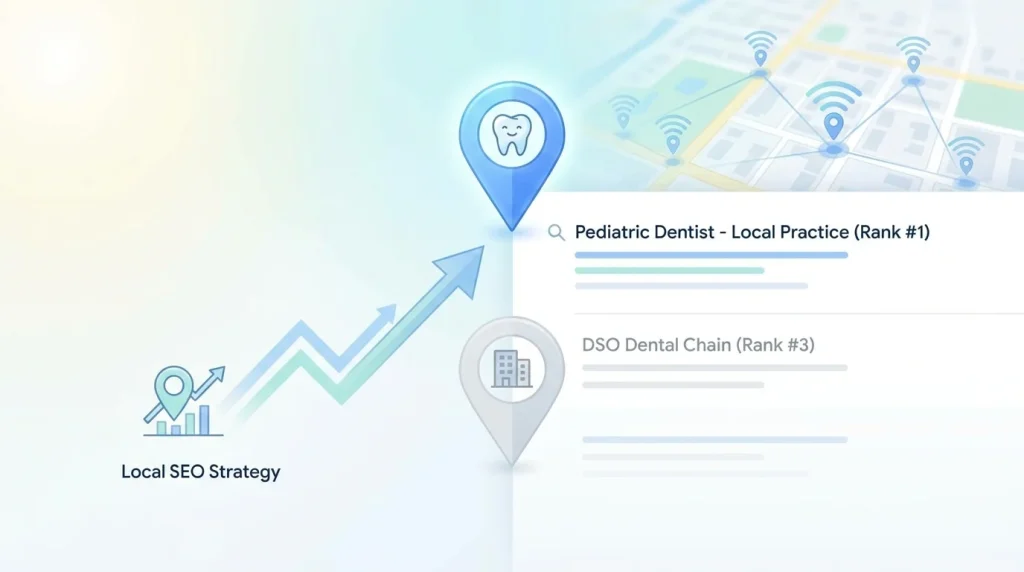
By February 2024, five months after a systematic GBP optimization intervention, the solo practice held position one for “pediatric dentist Seattle Capitol Hill,” position two for “pediatric dentist Seattle,” and position one for “kids dentist Seattle”, a query the DSO location had previously owned outright. The optimization sequence also reflected many of the local ranking best practices described in Google’s guidance on improving local ranking.
The DSO location had not lost reviews. Its marketing budget had not been cut. Its GBP had not been penalized or suppressed. It had simply been outmaneuvered on the specific signal layers where an independent practice with a deeply local focus and correctly configured GBP can consistently outperform a chain competitor whose profiles are managed at scale and optimized to a group standard rather than a location-specific one.
This pediatric dental GBP case study documents every configuration advantage the solo practice exploited, the specific signal layers where independent practices outperform DSOs, and the optimization sequence that moved a position three result to position one in five months.
Table of Contents
The competitive landscape at the start of the intervention
Solo practice profile: Practice type: Solo pediatric dental practice, one provider (Dr. Priya Nair, DMD), Capitol Hill, Seattle. Years in operation: six. GBP ranking: position three for “pediatric dentist Seattle,” position four to five for “kids dentist Seattle.” Review count and average: 67 reviews, 4.9 stars. Primary category: “Pediatric dentist” is correct. GBP update history: sporadic last photo upload four months prior, last post three months prior, no video. Website: active, mobile-responsive, LocalBusiness schema present, but showing a transposed phone number, one digit incorrect from the original schema implementation.
DSO Capitol Hill location profile: Review count and average: 214 reviews, 4.6 stars. Primary category: “Dentist,” secondary: “Pediatric dentist,” a group-wide category standard that prioritized general dental query eligibility over pediatric-specific query eligibility. GBP update history: consistent new photos monthly, posts weekly, professionally produced video. Website: professionally managed group site with a location-specific page. LocalBusiness schema is present and accurate.
The DSO’s category configuration was its critical vulnerability. The centralized GBP management team had applied a group-wide standard optimized for general dental query coverage, correct for its general practice locations, but suboptimal for a location whose primary patient population was children. The solo practice, correctly configured with “Pediatric dentist” as its primary category, had a structural ranking pool advantage for every pediatric-specific query, an advantage it had not yet fully capitalized on because its profile completeness, photo coverage, and activity signals were below the DSO’s standard on every other dimension.
The audit: identifying the exploitable gaps
Solo practice audit findings
Category configuration: Correct “Pediatric dentist” as primary, “Dentist” as secondary. No changes needed.
Schema error: The LocalBusiness schema on the practice website showed a transposed phone number with one digit incorrect. This single character error was creating a NAP inconsistency between the website’s structured data and the GBP phone number, reducing Google’s entity confidence despite otherwise consistent NAP across citations.
Photo set: 23 photos from the initial practice build four years earlier. No team headshots. Dr. Nair had no individual provider photo on the profile. No equipment photos. No waiting area photos that reflected the practice’s child-friendly environment, the existing photos showed a generic reception setup rather than the practice’s actual pediatric waiting area, which featured a dedicated play area, child-height furniture, and themed treatment rooms that were among the most frequently cited differentiators in patient reviews.
Attributes: “Accepting new patients” enabled. “Online appointments” are disabled despite an active booking system. “Pediatric dental care” and “treats children with special needs” are both absent despite being accurate for this practice, and both are absent from the DSO competitor’s profile as well.
Description: 312 characters. Contained the practice name, one city reference, and two service names. No patient population identifiers. No mention of the child-friendly environment, themed treatment rooms, or the specific age ranges served.
Posts: Last published three months prior. Generic back-to-school reminder with no service-specific signal and no call to action.
Video: None.
DSO competitor audit findings
Category vulnerability: “Dentist” as primary deprioritizing pediatric-specific query eligibility for this location. The solo practice’s “Pediatric dentist” primary gave it a structural advantage for every query containing “pediatric,” “kids,” “children’s,” or “child.”
Description weakness: A lightly customized group template primarily focused on general dental services, with “pediatric dentistry” mentioned once in the third sentence. No child-specific environmental signals, no patient population identifiers beyond the generic category reference.
Photo gap: Professionally produced and well-maintained, but the waiting area photos showed a standard clinical reception environment rather than a child-specific one. No before-and-after photos for any pediatric-relevant treatment category. No team photos showing provider-child interactions that communicate approachability to parent patients.
Review sentiment gap: The DSO location’s 214 reviews averaged 4.6 stars, solid, but 0.3 stars below the solo practice’s 4.9 average. A review sentiment analysis of the most recent fifty reviews revealed a recurring theme: parents citing long wait times and impersonal interactions. The solo practice’s reviews consistently cited Dr. Nair by name, referenced her approach to anxious children, and described the themed treatment rooms as a differentiator that made children look forward to dental visits. That sentiment gap represented an exploitable conversion advantage; if the solo practice’s GBP content could surface the environmental and personal differentiators its reviews already documented, the conversion gap would widen in the independent’s favor.
The intervention: exploiting the configuration advantages
Phase 1: Schema correction and foundational alignment
The transposed phone number in the LocalBusiness schema was corrected on day one. The schema was also updated to add the practice’s pediatric-specific service types and the “medicalSpecialty” field set to “Pediatric Dentistry,” a schema property that Google’s entity model uses to confirm specialty category alignment between the website’s structured data and the GBP’s primary category selection.
“Online appointments” was enabled and connected to the practice’s existing booking system. “Pediatric dental care” and “treats children with special needs” attributes were enabled, both accurate for the practice and both absent from the DSO competitor’s profile.
Phase 2: Description rewrite targeting pediatric-specific signals
The business description was rewritten from 312 characters to 748 characters using a pediatric-specific adaptation of the four-part signal density framework.
Sentence one named the practice, its specialty, and four geographic signals: Capitol Hill, Central District, First Hill, and Madison Valley. Sentences two and three named six pediatric-specific services and three patient population identifiers: children with dental anxiety, special needs patients, and infants through age 18. Sentence four named three operational differentiators: themed treatment rooms, Saturday hours, and Medicaid acceptance. Sentence five closed with a new patient signal and same-day emergency availability for children.
Final character count: 748. Indexable signals: eleven more than twice the DSO competitor’s description for the same location type, and specifically targeting the search behaviors of parents choosing a pediatric dentist rather than the general dental query patterns the DSO template was optimized for.
Phase 3: Photo rebuild targeting pediatric conversion signals
The photo priority order for a pediatric practice differs from every other practice type because the patient decision is made by a parent, and the parent’s conversion decision is driven by two questions above all others: will my child feel safe here, and will the people treating my child be warm and patient?
Waiting area and child-friendly environment photos: Three photos of the practice’s actual pediatric waiting area play corner, child-height furniture, and themed décor replaced the generic reception shots. These directly surfaced the environmental differentiator that reviews cited most frequently, but that the GBP had never visually confirmed.
Themed treatment room photos: Two photos of the practice’s themed operatories, a space exploration theme and a marine biology theme, were uploaded. These are the rooms parents read about in reviews but had never been able to see before booking.
Provider headshot and team photos: A professional-quality headshot of Dr. Nair was uploaded as the first provider photo the practice had ever added to its GBP. A team photo showing Dr. Nair and her two dental assistants in a warm, approachable pose in the waiting area was added. For a pediatric practice where provider personality is the primary booking variable, a provider headshot is not optional; it is the single image most likely to convert a hesitant parent into a booked appointment.
Before and after photos: Two early orthodontic evaluation cases, space maintainer outcomes were added with explicit written patient consent, documenting the practice’s early intervention capability.
Cover photo updated to the best themed treatment room photo centered, well-lit, surviving the 4:3 crop with the themed environment clearly visible.
Total new photos uploaded: fourteen, spaced over nine days.
Phase 4: Video production
Practice walkthrough: 27 seconds, starting at the exterior entrance, moving through the child-friendly waiting area with a pause on the play corner, then into one of the themed treatment rooms. The waiting area’s child-friendly environment, invisible in static photos taken from the entrance, was visible in motion for the first time in the practice’s GBP history.
Provider introduction: Dr. Nair spoke directly to the camera without a script: “I’m Dr. Priya Nair, and I’ve been taking care of kids’ teeth in Capitol Hill for six years. My practice is designed for children who are nervous about the dentist. We go at their pace, every time.” Trimmed to 29 seconds, landscape orientation, verified from mobile incognito browser.
Phase 5: Pediatric-specific posting calendar
The posting calendar was adapted for the pediatric practice’s patient population and seasonal search patterns, including children’s dental health month in February, Halloween candy tips in October, Medicaid acceptance reminders before year-end, and new year first-visit framing in January. The first four posts were drafted and published in the first two weeks of the intervention, establishing the cadence signal immediately.
The ranking progression at 60, 90, and 150 days
At 60 days
The practice moved from position three to position two for “pediatric dentist Seattle,” displacing the DSO’s non-Capitol Hill location that had previously held that position. For “kids dentist Seattle,” the practice moved from position four to five to position two.
GBP insights at day sixty showed a 34% increase in profile views, a 61% increase in website clicks, and a 78% increase in direction requests compared to the equivalent prior period.
At 90 days
The practice entered position one for “pediatric dentist Seattle Capitol Hill,” the most geographically specific high-intent query for its location. Position two for “pediatric dentist Seattle,” one position behind the DSO’s flagship Capitol Hill location. Position one for “kids dentist Seattle” displaces the DSO location that had previously owned that query.
The “kids dentist” result confirmed that the practice’s description, which included both “pediatric” and “children” multiple times, was capturing both the clinical and colloquial linguistic variants of the parent patient search behavior, while the DSO’s group template description captured neither as effectively.
At 150 days
The practice achieved position one for “pediatric dentist Seattle,” the city-wide category query the DSO had held for over two years. The DSO’s Capitol Hill location dropped to position two for that query for the first time in its operating history.
The position one result was not driven by review count; the DSO still had 214 reviews to the solo practice’s 89. It was driven by the combination of primary category structural advantage, description signal density targeting pediatric-specific queries, child-environment photo coverage confirming the practice’s differentiators, and five months of consistent posting cadence.
New patient inquiry volume from Google Maps at day 150 had increased by an estimated 140% compared to the equivalent period one year prior, the largest percentage increase of any case study in this cluster, driven by a combination of ranking improvement and conversion improvement.
What this pediatric dental GBP case study reveals about competing against DSOs
Finding 1: A DSO’s group-wide category standard is its most exploitable vulnerability
A regional chain applying “Dentist” as the primary category across all locations, including its pediatric locations, is systematically deprioritizing pediatric-specific query eligibility at every location where “Pediatric dentist” would be the stronger primary. An independent practice correctly configured for its specialty has a structural ranking pool advantage for every specialty-specific query in its market, regardless of review count differential.
This finding applies across all specialty practice types. An orthodontic-only practice correctly configured with “Orthodontist” as its primary has the same structural advantage over a DSO location using “Dentist” as its primary for a location that primarily offers orthodontic services. The group standard that makes a DSO’s general practice network efficient is the configuration vulnerability that its specialty locations carry by default.
Finding 2: Medicaid acceptance is an underused signal in the pediatric dental category
The DSO competitor’s profile made no reference to Medicaid in its description or attributes. The solo practice’s explicit Medicaid signal in its description and attribute panel captured a patient segment actively filtering for this, a high-volume, low-competition signal in the pediatric dental category that most practices leave unclaimed. For practices that accept Medicaid, enabling the corresponding attribute and including it explicitly in the business description is one of the highest-return, lowest-effort optimizations available, particularly in markets where DSO competitors don’t mention it.
Finding 3: Review sentiment is a conversion variable that photo content can amplify
The solo practice’s reviews consistently described Dr. Nair and the themed treatment rooms as specific differentiators. The GBP had never been visually confirmed either. Adding a provider headshot and themed room photos converted review-generated patient intent into booking action by removing the uncertainty that exists when a profile can’t show what its reviews describe. The relationship between review content and photo content is bidirectional: reviews that describe specific environmental or personal differentiators create a patient expectation that photos either confirm or leave unresolved. Confirmed expectations convert. Unresolved ones send patients to the next result.
For the multi-location variant of competitive displacement, where the same configuration advantages and disadvantages multiply across an entire network of profiles, the multi-location dental GBP case study. documents how a dental group exploited the same internal configuration inconsistencies that DSO networks carry at scale. And for the full synthesis of all five case study findings across practice types and intervention scenarios, the GBP case studies for dental practices consolidate every pattern into a single diagnostic and optimization reference.
Key takeaways
- A DSO’s group-wide GBP category standard is its most exploitable vulnerability for independent competitors. A regional chain applying “Dentist” as the primary across all locations, including its pediatric and specialty locations, is deprioritizing specialty-specific query eligibility everywhere. An independent practice correctly configured for its specialty has a structural ranking pool advantage for every specialty-specific query, regardless of review count differential.
- Description signal density targeting the specific patient decision context outperforms a generic group template. Eleven indexable signals targeting parent patient search behavior, child anxiety, special needs, Saturday hours, Medicaid acceptance, and age range served produced a keyword relevance gap that compounded into a city-wide query position one result over five months.
- Environmental and provider photos close the gap between what reviews promise and what the profile confirms. Adding a provider headshot and themed room photos converted review-generated patient intent into booking action by removing the uncertainty that exists when a profile can’t show what its reviews describe.
- Medicaid acceptance is an underused attribute and description signal for pediatric practices. The DSO competitor’s profile did not refer to Medicaid. An explicit Medicaid signal captured a high-volume, low-competition patient segment that most practices leave unclaimed.
- Position one for a city-wide specialty query is achievable for an independent practice against a well-resourced DSO competitor through GBP optimization alone, without review count parity. The solo practice reached position one for “pediatric dentist Seattle” with 89 reviews against the DSO’s 214, driven by category configuration, description signal density, photo coverage, and five months of consistent posting cadence.
Your next action this week
If you operate a pediatric dental practice or any specialty practice competing against DSO or chain competitors, open your GBP and check three things right now.
First: Is your primary category the correct specialty designation for your practice type? If a chain competitor in your market is using “Dentist” as its primary for a location that primarily serves your patient type, you have a structural ranking pool advantage, but only if your primary category is correctly configured to claim it.
Second: Does your business description contain patient population identifiers specific to your practice type? Age ranges served. Insurance types accepted, including Medicaid if applicable. Specific patient populations your practice actively serves and wants to attract. These are the signals that differentiate your description from a chain competitor’s group template.
Third: Does your photo set show what your reviews describe? If your reviews cite a specific environmental feature, a themed treatment room, a panoramic view, a particularly modern operatory, and your GBP photos don’t show it, you have a confirmation gap that is reducing the conversion rate of every positive review you’ve earned.
For the complete GBP signal architecture that governed every decision in this intervention, the complete Google Business Profile optimization guide for dental practices defines the optimization standard for any specialty practice competing against better-resourced chain competitors. And for the full synthesis of all five case study findings across practice types and intervention scenarios, the GBP case studies for dental practices consolidate every pattern into a single diagnostic and optimization reference.