A dental practice in Cleveland had spent four months building citations from a general dental citation list. By the end of the campaign, it had listings on Yelp, Yellow Pages, Healthgrades, the Better Business Bureau, Foursquare, and fifty-six additional directories. The campaign produced clean NAP data across a broad footprint. It did not move the local pack for “emergency dentist Cleveland” or “dentist open now Cleveland.”
The audit identified the structural problem immediately. The citation campaign had built authority signals appropriate for a general dental practice competing for “family dentist Cleveland.” It had not built the specific citation signals that determine emergency dental local pack visibility. The practice had no listing on 1-800-DENTIST, a high-authority dental emergency referral platform that routes patients in acute pain to available providers. It had not claimed its profile on Zocdoc with emergency appointment availability configured. It had not verified its Apple Maps listing with Saturday hours, producing a data conflict between the GBP Saturday hours (correctly configured) and the Apple Maps Saturday hours (blank, displaying as closed). It had not submitted to the healthcare urgent care aggregator platforms that populate emergency provider results in voice search and navigation systems.
Four months of citation building. Complete general dental citation authority. Zero emergency dental citation authority.
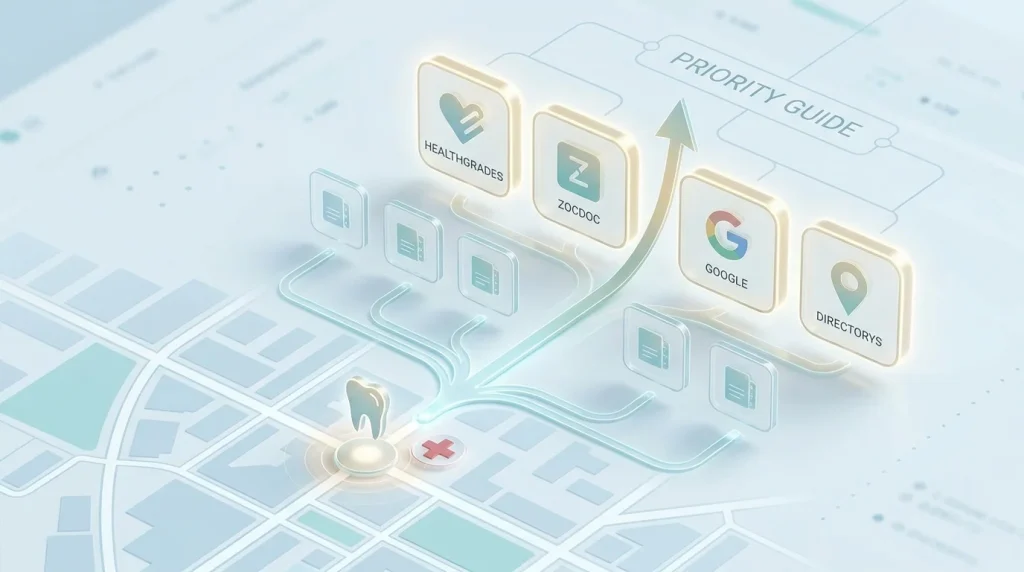
Emergency dental local citations require a directory priority framework built around three citation source categories that general dental citation lists do not include: urgent care and emergency healthcare platforms, real-time availability aggregators, and navigation system data suppliers that specifically power “open now” and “near me” voice search results. This guide covers the complete citation-building system for US emergency dental practices, the directories to build first, the emergency-specific sources that general dental lists miss entirely, and the NAP and hours consistency standards that emergency citation accuracy requires.
Table of Contents
Why emergency dental citation building differs from general dental
The foundational citation authority principle, domain authority plus topical relevance, determines citation weight, applies to emergency dental practices as it does to all dental specialties. But emergency dental practices have two citation authority dimensions that general dental practices do not share, and both require citation sources that do not appear on standard dental citation lists.
Real-time availability as a citation signal dimension. Emergency dental patients are not making week-in-advance research decisions. They are making immediate availability decisions. The citation sources that carry the highest topical relevance for emergency dental queries are not simply the highest-domain-authority healthcare directories. They are the platforms that patients and referral systems consult specifically to find immediately available dental care: emergency dental referral services, urgent care dental directories, same-day appointment booking platforms, and the data aggregators that power “open now” filter results in Google Maps, Apple Maps, and voice search. A citation on these platforms carries both a domain authority signal and a real-time availability relevance signal that standard healthcare directories cannot replicate.
Navigation and voice search are primary emergency discovery channels. A patient in acute dental pain driving to the nearest available dental practice is not browsing a desktop search results page. They are using voice search (“Hey Siri, find an emergency dentist near me”), Google Maps navigation, or Apple Maps navigation to find and route to an available provider. The citation sources that determine visibility in these navigation and voice search channels, Neustar Localeze, Apple Maps, Google Business Profile, and Foursquare, carry higher emergency patient acquisition weight than the same sources carry for general dental practices, because navigation-based emergency dental patient acquisition represents a distinct and high-volume patient segment.
The emergency dental citation priority framework, four tiers
Tier 1: Data aggregators and navigation system suppliers
For emergency dental practices, Tier-1 data aggregators carry higher individual importance than for general dental practices, because these sources directly power the navigation and voice search channels that emergency patients use to find immediately available care.
Data Axle (data-axle.com) supplies NAP data to hundreds of secondary directories, local search apps, and mapping platforms automatically. For an emergency dental practice, a correct Data Axle listing means correct NAP data propagating to the secondary directories and apps that emergency patients use across multiple platforms simultaneously. An incorrect Data Axle listing, particularly an incorrect phone number or address, propagates the error into the emergency patient discovery ecosystem at the same scale.
Neustar Localeze (neustar.biz/business-listings) is the primary data supplier for navigation systems, including Garmin and TomTom, and a significant supplier for voice search platforms, including Alexa. An emergency patient asking Alexa, “Find a dentist open near me,” or using a Garmin device to navigate to the nearest open dentist is drawing on data that flows through Neustar Localeze. A practice with an incorrect or missing Neustar Localeze listing is providing inaccurate location data to the navigation ecosystem at the exact moment emergency patients are most likely to use navigation-based provider search.
Foursquare (foursquare.com) remains a major data supplier for app developers, mapping platforms, and location intelligence systems. Foursquare’s business data flows into Uber, Snapchat, Apple, and dozens of platforms that represent emergency patient touchpoints in the digital ecosystem. For emergency dental practices specifically, Foursquare’s data influences the “open now” provider results that appear in multiple consumer apps when a patient searches for immediately available dental care.
Apple Maps (mapsconnect.apple.com) directly controls how the practice appears in Apple Maps, Siri local search results, and Safari local search on iOS devices. For emergency dental practices, Apple Maps carries higher per-listing importance than for general dental practices because Siri voice search is a primary emergency dental discovery channel for iPhone users. An Apple Maps listing with incorrect Saturday hours, producing a “closed Saturday” display when the practice is actually open, is suppressing Saturday morning emergency patient acquisition from the dominant US smartphone platform at the highest-volume emergency search period of the week.
Critical emergency-specific requirement for Tier-1 aggregators: Every Tier-1 aggregator listing must accurately reflect the practice’s emergency availability hours, including Saturday hours, Sunday hours where applicable, and extended evening hours. The hours data that flows from Tier-1 aggregators into downstream directories and navigation systems determines whether the practice appears as “open” or “closed” in real-time availability filtered results across the entire downstream ecosystem. An incorrect hours entry at the Tier-1 level propagates the incorrect “open now” status to every downstream platform that pulls from that aggregator.
Tier 2: Emergency dental and urgent care directories
Tier-2 sources for emergency dental practices are categorically different from Tier-2 sources for general dental practices. This tier contains the emergency-specific patient referral platforms, urgent care dental directories, and same-day appointment booking platforms that carry the highest topical relevance for emergency dental queries and that general dental citation lists do not include.
1-800-DENTIST (1800dentist.com) is the largest dental emergency referral service in the US, connecting patients in acute dental pain with available providers in their geographic area. A 1-800-DENTIST provider profile carries both a high-authority citation signal and a direct patient referral function. Patients who call 1-800-DENTIST in a dental emergency are routed to participating providers based on location and availability. A practice without a 1-800-DENTIST profile is invisible to the largest dental emergency referral channel in the US market. Claim and complete the provider profile at 1800dentist.com/dentist-signup.
Zocdoc (zocdoc.com) for emergency dental practices carries a higher priority than for general dental practices because Zocdoc’s same-day appointment availability directly serves the emergency patient’s primary decision criterion. Zocdoc allows practices to configure real-time appointment availability, including same-day emergency slots, that appear to patients searching for immediately available dental care. A Zocdoc listing with same-day appointment slots actively displayed converts emergency patient search intent into confirmed appointments without a phone call, capturing the after-hours emergency patient segment that cannot reach the practice by phone.
Healthgrades (healthgrades.com) maintains a healthcare provider directory that is crawled by Google and used by patients conducting emergency dental research. For emergency dental practices, the Healthgrades profile should surface emergency care availability in the specialties and services section, with same-day appointment information and emergency condition coverage listed explicitly.
WebMD / Vitals (doctor.webmd.com / vitals.com) is a high-crawl-frequency healthcare citation source. For emergency dental practices, the WebMD provider profile services section should name emergency dental care, same-day appointments, and walk-in availability as explicitly listed offerings.
Yelp (biz.yelp.com) for emergency dental practices carries a specific additional function beyond its general dental citation authority: Yelp’s “open now” filter is frequently used by emergency dental patients to identify immediately available providers. A Yelp listing with correctly configured hours, including Saturday hours and evening hours, appears in “open now” Yelp filter results during the exact periods when emergency dental patient search volume is highest. The Yelp category for an emergency dental practice should be set to “Emergency Dental Service” or “Dentists” with emergency services listed in the business attributes.
Tier 3: High-authority general directories with emergency-specific configuration
Tier-3 sources for emergency dental practices are the same high-authority general directories that anchor the general dental citation framework, with emergency-specific configuration requirements that determine whether each listing contributes to the emergency dental signal stack or defaults to the general dental signal stack.
Facebook Business (business.facebook.com) carries an emergency-specific function: Facebook’s “open now” indicator, driven by the business hours configured in the Facebook page settings, appears to patients who search for the practice on Facebook during an emergency and check availability before calling. A Facebook business page with correctly configured hours, including Saturday and evening hours matching the GBP exactly, appears as “open” in Facebook’s display during the practice’s actual availability hours. The Facebook page category for an emergency dental practice should reflect the emergency dental designation, and the page services section should surface emergency dental care and same-day appointment availability explicitly.
Better Business Bureau (bbb.org) carries a high domain authority and functions as a trust signal for patients who are conducting rapid due diligence before calling an unfamiliar practice for emergency care. An emergency patient who has never heard of the practice, found it through a local pack result, and wants a quick credibility check before calling will often check the BBB rating. A claimed, up-to-date BBB profile with emergency dental services listed reduces the patient’s hesitation at this rapid due diligence step.
Bing Places for Business (bingplaces.com) feeds Microsoft’s search ecosystem, including Edge browser search, Cortana voice queries, and Windows search. For emergency dental practices, Cortana voice queries represent a distinct emergency discovery channel from Siri and Google Assistant. The Bing Places profile should be configured with the emergency dental service category and complete hours matching the GBP, including Saturday and evening availability.
Chamber of Commerce directories carry strong local geographic relevance signals and function as a community establishment signal that reduces patient hesitation about presenting to an unfamiliar emergency provider.
US News Health (health.usnews.com/doctors) maintains a healthcare provider directory with significant domain authority. Claiming and completing the US News Health listing with emergency dental services listed in the specialties section adds a high-authority general healthcare citation with emergency dental topical relevance.
Tier 4: Supplementary directories, build last or deprioritize
Yellow Pages (yellowpages.com) has moderate domain authority and adequate crawl frequency. The Yellow Pages category should reflect the emergency dental service designation. A residual patient segment, primarily older demographics, still consults the Yellow Pages for emergency provider search.
MapQuest (mapquest.com) retains a meaningful user base among older demographic segments. For emergency dental practices serving patient populations skewing older, MapQuest citation accuracy has a measurable impact on navigation-based emergency patient acquisition.
Local newspaper business directories carry geographic specificity and local domain authority. For emergency dental practices in urban markets, a listing contributes geographic signal depth and local community establishment credibility.
Hospital and healthcare system provider directories are relevant for emergency dental practices that have established referral relationships with hospital emergency departments. Hospital emergency departments frequently encounter patients presenting with dental emergencies outside the scope of medical emergency care and refer those patients to available dental providers. A listing in a hospital system’s provider directory positions the practice as the preferred dental referral destination for that hospital’s emergency department, functioning simultaneously as a citation source and a referral channel.
What to skip entirely: generic coupon sites, home and garden services aggregators, event directories, foreign-language directories with no US geographic relevance, and any directory with a domain authority below 20 that lacks emergency healthcare or dental topical relevance.
NAP and hours consistency standards specific to emergency dental practices
Emergency dental practice citation audits reveal a distinct set of NAP and hours inconsistency patterns that do not appear at the same frequency in general dental or specialty dental citation audits.
The hours data fragmentation problem. Emergency dental practices frequently update their GBP hours when seasonal schedule changes occur, when evening hours are extended, or when Saturday availability is added, without updating the corresponding hours data in citation sources. Every citation source that displays practice hours, Yelp, Facebook, Apple Maps, Zocdoc, and every navigation system data supplier must reflect the current GBP hours exactly, including Saturday hours, Sunday hours where applicable, and any extended evening availability.
The hours audit protocol for emergency dental practices is more comprehensive than for general dental practices: check the standard weekly hours in every citation source, check the special hours or holiday hours section in every platform that supports it, and verify the “open now” display by visiting the GBP, Yelp, Facebook, and Apple Maps pages from a mobile device during actual operating hours to confirm the “open now” indicator is displaying correctly.
The emergency phone number is split. Some emergency dental practices maintain a separate after-hours emergency triage line in addition to the main practice number. When the after-hours number is listed in citation sources instead of the main practice line, or when some citation sources show the main line, and others show the after-hours line, Google’s entity model encounters a phone signal split that reduces entity confidence. The main practice line should be the NAP phone number across all citation sources. The after-hours triage number should appear in the GBP description, the emergency page body content, and the after-hours content sections as a supplementary availability signal rather than a NAP field.
The multi-location emergency practice address split. Emergency dental practices that operate multiple locations must maintain separate GBP listings and separate citation footprints for each location, each with its own location-specific NAP and location-specific hours. A citation footprint where multiple locations share a single phone number, where one location’s address appears in another location’s citation sources, or where different locations use identical names without location-specific differentiators creates entity fragmentation that reduces Google’s confidence in every location’s NAP data simultaneously.
For the complete NAP audit methodology that identifies every existing inconsistency before new citations are built, including the four-layer audit framework from internal website NAP through Tier-3 external directories, the dental practice NAP consistency guide covers the complete correction protocol applicable across dental specialty practices.
And for the general dental citation priority framework that covers the foundational Tier-1 through Tier-4 directory sequence in full detail, the dental practice local citations guide covers the complete citation building system that underpins the emergency-specific framework in this article.
Key takeaways
1-800-DENTIST and Zocdoc, with same-day availability configured, are the two highest-priority emergency dental citation sources that most practices have never claimed, and the two that carry the highest direct patient acquisition function alongside their citation authority. A 1-800-DENTIST profile routes patients in acute dental pain to the practice through the largest dental emergency referral channel in the US. A Zocdoc listing with same-day appointment slots actively displayed converts after-hours emergency search intent into confirmed morning appointments without a phone call. Neither source appears on standard general dental citation lists. Both should be claimed before any Tier-3 or Tier-4 directory submission.
Hours data accuracy across every citation source is the most consequential citation consistency requirement for emergency dental practices, and the most commonly neglected. An incorrect hours entry in any citation source that displays “open now” status creates a false “open now” display failure that loses emergency patients at the highest-intent search moment. The hours audit for emergency dental practices is more comprehensive than for any other dental specialty: check standard weekly hours, special hours, and the live “open now” display on every platform from a mobile device during actual operating hours.
Tier-1 data aggregators carry higher individual importance for emergency dental practices than for general dental practices because these sources directly power the navigation and voice search channels that emergency patients use to find immediately available care. Neustar Localeze feeds Garmin, TomTom, and Alexa. Foursquare feeds Uber, Snapchat, and Apple. Apple Maps feeds Siri. An incorrect hours entry or address at the Tier-1 level propagates incorrect emergency availability data to the navigation and voice search ecosystem at a scale that no downstream citation correction can fully offset.
The emergency phone number split is the most common NAP inconsistency pattern specific to emergency dental practices. When after-hours triage numbers appear in citation sources instead of the main practice line, Google’s entity model encounters a phone signal conflict that reduces entity confidence. The main practice line is the NAP phone number across all citation sources. The after-hours number belongs in the GBP description and emergency page content, not in citation NAP fields.
Audit before building, always, and audit hours separately from NAP. An emergency dental practice with correct NAP data but incorrect hours data across citation sources has a citation footprint that confirms entity identity but produces incorrect “open now” eligibility. Both dimensions of citation accuracy must be audited and corrected before new citation building begins.
Your next action this week
Go to 1800dentist.com/dentist-signup and check whether your practice has an active 1-800-DENTIST provider profile. If no profile exists, create one now. If a profile exists but is unclaimed or incomplete, claim it and complete the provider profile with your emergency availability hours, same-day appointment information, and the emergency conditions you treat. This is the emergency-specific citation source with the highest direct patient referral function of any directory available to an emergency dental practice, and it is the most commonly unclaimed high-priority emergency dental citation in most US markets.
Then go to zocdoc.com and check your practice profile. If same-day emergency appointment slots are not actively displayed in the Zocdoc availability calendar, configure real-time emergency slot availability. A Zocdoc listing with same-day slots converts after-hours emergency search intent into confirmed appointments for patients who cannot reach the practice by phone.
Then run a live “open now” check on your four highest-authority citation sources. During your actual Saturday operating hours, visit your GBP, Yelp, Facebook, and Apple Maps pages from a mobile device and confirm that each one displays the “open now” indicator. If any source shows “closed” or no hours during a period when the practice is actually open, that source has a hours data conflict that is suppressing emergency patient acquisition during your highest-intent search window.
For the complete emergency dental local citations framework integrated with GBP optimization, website signals, review management, and competitive positioning into a unified local SEO system for US emergency dental practices, the emergency dental local SEO guide is the reference document that connects every element.