An orthodontic practice in Scottsdale, Arizona, spent fourteen months building what it believed was a competitive Google Business Profile. It accumulated 94 reviews, published twelve photos covering the reception area and clinical environment, and configured its GBP categories with “Dentist” as the primary category and “Teeth Whitening” as its single secondary category. By any general dentistry benchmark, the profile looked competitive.
It was not appearing in the top three for “orthodontist Scottsdale” or “Invisalign Scottsdale” queries. The three practices holding those positions had 61, 88, and 110 reviews, respectively, all below or comparable to the Scottsdale practice’s review count. The difference was not the review volume. The difference was that all three top-ranking practices had “Orthodontist” as their primary GBP category, specialty-specific secondary categories extending their query pool eligibility, and photo sets built around documented treatment outcomes rather than clinical environment photography.
As explained in Google Business Profile’s official guidance on business categories, the primary category is one of the strongest relevance signals used to determine when a profile is eligible to appear for specialty searches.
The category configuration error cost the practice fourteen months of organic visibility in its target specialty query pool. Its 94 reviews and substantial time investment produced rankings in a local pack it had no commercial interest in.
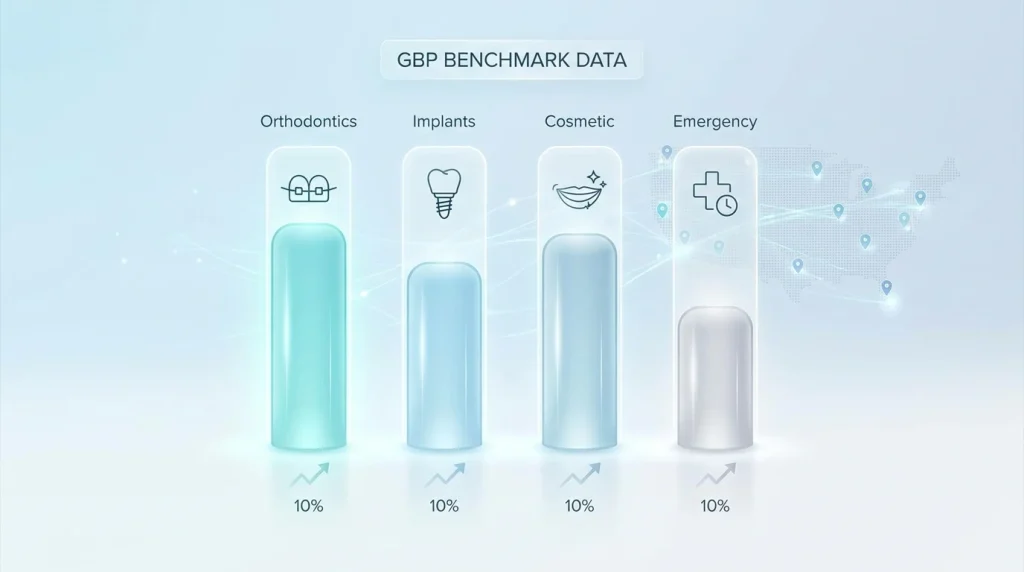
Dental specialty GBP benchmarks operate by a different logic than general dentistry benchmarks across four variables: the primary and secondary category configuration that determines query pool eligibility, the photo strategy that demonstrates specialty competence to pre-consultation patients, the review velocity ceiling that patient volume and treatment duration impose, and the services list architecture that generates procedure-level relevance signals for specialty queries. This article covers the dental specialty GBP benchmarks for four distinct practice types: orthodontics, dental implants, cosmetic dentistry, and emergency dental, each competing in a structurally separate local pack environment with distinct threshold requirements.
Table of Contents
Why specialty GBP benchmarks diverge from general dentistry standards
Local pack competition in dentistry is not one competition. It is several simultaneous competitions, each operating in a query-specific pool populated by practices whose GBP primary category makes them eligible for that pool. A patient searching “family dentist Chicago” and a patient searching “orthodontist Chicago” are accessing different local packs, generated by different category eligibility logic, populated by different practices with different benchmark thresholds.
Three structural factors drive the divergence between specialty and general dentistry GBP benchmarks.
Patient volume per unit time determines the achievable review velocity ceiling. A high-volume general dental practice seeing 25 patients per day generates a categorically different review acquisition ceiling than an orthodontic practice managing active treatment cases over 18 to 24 months. The monthly review velocity benchmarks for specialty practices are not simply scaled-down versions of general dentistry benchmarks; they reflect the underlying structural ceiling that patient volume and treatment duration impose on each practice type.
Patient journey length shapes optimal review acquisition timing. An emergency dental patient’s relationship with the practice begins and ends in a single appointment. An orthodontic patient’s relationship spans two years of recurring appointments, with distinct emotional peaks at treatment start, visible progress milestones, and completion. These journey differences produce different review request timing requirements and different conversion rates at each touchpoint. A request strategy designed for one practice type produces suboptimal results when applied to another.
Query intent differs by specialty, and so do the GBP signals that convert pre-consultation patients. A patient evaluating orthodontic practices is comparing treatment outcomes before committing to a multi-year relationship. A patient evaluating emergency dental practices is assessing immediate availability and pain relief capability. The photo strategy, services list architecture, and attribute configuration that converts one patient type do not convert the other.
Orthodontic practice GBP benchmarks
Review benchmarks for orthodontic practices
Top-three local pack positions for “orthodontist [city]” queries in mid-sized US markets typically require 60 to 120 reviews with a monthly velocity of 3 to 5 new reviews. Average rating range at top-three positions: 4.7 to 5.0. Practices with fewer than 45 reviews rarely hold top-three positions for competitive orthodontic query categories in mid-sized markets.
The review acquisition structure for orthodontic practices has three distinct high-conversion moments that most practices reduce to one. The treatment start appointment, when a patient has made a significant financial and emotional commitment to the practice, is a high-conversion review request moment that most orthodontic practices never capture because staff attention is directed at records and administrative setup. The midpoint adjustment appointment, typically 8 to 12 months into treatment, is the moment when visible progress is apparent, and patient satisfaction is at a peak before the final-stretch frustration that sometimes accompanies the last months of treatment. And the debonding appointment, when treatment completes, and the patient sees the final result for the first time, is the moment most orthodontic practices treat as their only review request opportunity.
A three-moment review request workflow applied consistently to an average completion rate of 10 to 15 cases per month produces a monthly velocity of 3 to 5 new reviews at a conservative 20% conversion rate per request, sufficient to sustain top-three positions in most mid-sized markets without requiring higher patient volume. (Source: composite patterns observed across orthodontic practice GBP audits in competitive US markets.)
GBP completeness benchmarks orthodontic practices
Primary category: Orthodontist. This is the non-negotiable prerequisite for top-three local pack eligibility for orthodontic specialty queries. A practice with “Dentist” as its primary category is competing in the general dentistry pool and will not appear in the specialty pool for “orthodontist [city]” queries, regardless of review volume or services list content.
Secondary categories at top-three positions: 2 to 3 specialty-specific secondary categories. The highest-value secondary categories for orthodontic practices are Dental Clinic, Teeth Whitening (for practices offering whitening post-treatment), and Invisalign Provider, where Google recognizes this category in the practice’s market. The absence of secondary categories is the second most consequential category configuration gap for orthodontic practices, after the primary category error.
Services list benchmark: 6 to 10 named entries covering the specific treatment modalities offered. Top-ranking orthodontic practices name individual entries for traditional braces, clear aligners (by specific system name where trademark considerations allow), lingual braces where offered, retainers and post-treatment maintenance, adult orthodontics, and teen-specific treatment programs. Grouping all services under a single “Orthodontic Treatment” entry provides Google with one procedure-level relevance signal when the practice could be generating six to eight.
Photo strategy: Orthodontic treatment outcome documentation before-and-after smile photography with appropriate patient consent and HIPAA-compliant protocols is the highest-conversion photo category for orthodontic GBP profiles. Top-ranking orthodontic practices have 4 to 6 documented treatment outcome images in their GBP set alongside the standard exterior, interior, and team photo categories. The absence of outcome photography is consistently observable in orthodontic practices competing below position three: their GBP photo sets document the environment rather than the specialty competence that pre-consultation patients are specifically evaluating.
High-impact attributes: “Free consultations” enabled is the highest-impact orthodontic-specific attribute for patient conversion. “Accepts new patients” enabled and online appointment booking with a functional link are table-stakes requirements. For practices treating younger patients, accurate configuration of “Treats children” where this attribute is available in the GBP interface extends query pool eligibility.
Dental implant and cosmetic practice GBP benchmarks
Implant and cosmetic dental practices share several GBP benchmark characteristics because they serve overlapping patient populations pursuing elective, high-value procedures with extended decision timelines. The benchmark data covers both practice types with specialty-specific variations noted where the data diverges.
Review benchmarks, implants, and cosmetic practices
Top-three local pack positions for “dental implants [city]” queries in mid-sized markets typically require 50 to 100 reviews with a monthly velocity of 2 to 4 new reviews. Top-three positions for “cosmetic dentist [city]” queries in mid-sized markets typically require 50 to 100 reviews with a monthly velocity of 2 to 4 new reviews. Average rating range at top-three positions for both practice types: 4.7 to 5.0.
The lower velocity ceiling relative to general dental and emergency practices reflects the patient volume structural constraint. An implant practice completing 8 cases per month, applying a three-moment review acquisition workflow at post-consultation, post-placement, and final restoration delivery, generates approximately 24 review opportunities per month across all three touchpoints. At a 15 to 25% conversion rate lower than emergency practices because high-investment patients deliberate longer before committing to public reviews, this produces 3 to 6 new reviews per month in a well-executed acquisition workflow.
Cosmetic practices have a review timing dynamic that distinguishes them from implant practices. The social integration period following treatment completion, the first time a patient receives external validation of their new smile from colleagues, family, or friends, is a high-conversion review moment that occurs 10 to 21 days after the final appointment. A two-moment review request workflow combining an immediate delivery-appointment request with a two-week follow-up message achieves meaningfully higher combined conversion rates than single-moment requests for cosmetic patients, because it captures both the immediate post-treatment satisfaction peak and the socially validated satisfaction peak that follows. (Source: composite patterns observed across cosmetic dental practice review acquisition data in competitive US markets.)
GBP completeness benchmarks implant and cosmetic practices
Primary category: Dental Implants Provider for implant-focused practices; Cosmetic Dentist for cosmetic-focused practices. The category selection is the eligibility gate for specialty query pools: neither category cross-populates the other’s local pack.
Secondary categories: For implant practices, Dentist, Oral Surgeon, where applicable, Dental Clinic. For cosmetic practices, dentists, as an Invisalign Provider where offered. The most common secondary category error in both practice types is including “Dentist” as a secondary category without including the specialty-adjacent categories that extend eligibility to related high-value query sets.
Services list benchmark: 6 to 10 named entries for implant practices, covering single implants, implant-supported crowns, All-on-4 or full-arch restoration where offered, bone grafting, implant-supported dentures, and tooth extraction as a preparatory procedure. For cosmetic practices: 7 to 12 entries covering porcelain veneers, composite bonding, in-office teeth whitening, take-home whitening, smile makeover (named as a procedure, not a category), Invisalign or clear aligner therapy, gum contouring where applicable, and full-mouth rehabilitation for practices offering it.
Photo strategy: Before-and-after procedure documentation is the primary conversion-driving photo category for both practice types. Top-ranking implant and cosmetic practices have 4 to 8 documented treatment outcome images in their GBP photo set, selected to demonstrate the scope and quality of the transformation achievable. The correlation between outcome photo presence and consultation booking rate from GBP listing views is consistently observable in competitive market audits: practices without outcome photography rely on review volume and rating alone to convert the pre-consultation patient, while practices with outcome photography convert at the patient’s first visual evaluation of specialty competence.
Emergency dental practice GBP benchmarks
Emergency dental practices occupy a structurally unique position in the dental specialty GBP benchmarks framework because they have the highest achievable monthly review velocity of any dental practice type and because the patient decision process operates under time pressure that no other dental specialty experiences. A patient searching “emergency dentist open now” is not evaluating practices for a future appointment; they are making a real-time decision about where to go within the next hour.
Review benchmarks of emergency dental practices
Top-three local pack positions for “emergency dentist [city]” and “emergency dental care [city]” queries in mid-sized markets typically require 60 to 150 reviews with a monthly velocity of 5 to 8 new reviews. Average rating range at top-three positions: 4.6 to 5.0. The slightly wider acceptable rating floor (4.6 versus the 4.7 floor for other specialties) reflects the emergency context: patients who receive pain relief sometimes leave reviews that describe a difficult clinical experience alongside strong satisfaction with the outcome, producing natural rating variation that Google’s entity model associates with authentic high-volume patient populations.
The two-hour post-appointment SMS review request is the single highest-converting review acquisition mechanism for emergency dental practices. The conversion window for emergency patients is narrowest and most intense in the immediate post-treatment period, when pain relief is recent, and gratitude is at its highest. A review request delivered two hours after appointment completion captures this window. A request delivered 48 hours later, after the patient has returned to normal daily routine, converts at a fraction of the two-hour rate.
A practice treating 15 emergency patients per week that implements an automated two-hour SMS review request generates 60 review opportunities per month. At a 20 to 25% conversion rate achievable for emergency practice contexts where pain relief is the treatment outcome, this produces 12 to 15 new reviews per month, exceeding the major metro velocity benchmark without additional patient volume or manual process burden. (Source: composite patterns observed across emergency dental practice review acquisition systems in competitive US markets.) The Whitespark Local Search Ranking Factors Report consistently identifies review recency as a primary short-term local pack signal, making this velocity compoundingly valuable for emergency practices serving high-acuity patient demand. (Source: Whitespark Local Search Ranking Factors, 2023.)
GBP completeness benchmarks emergency dental practices
Primary category: Emergency Dental Service. This is the primary category that determines query pool eligibility for “emergency dentist” and “emergency dental” query sets. Secondary categories: Dentist, Dental Clinic, Oral Surgeon for practices offering surgical emergency services.
Business hours accuracy is the most consequential GBP completeness field for emergency dental practices and the field most frequently misconfigured. A practice representing itself as offering emergency dental services must have business hours that accurately reflect its actual availability, including evening hours, Saturday hours, and Sunday hours where the practice is genuinely available. The “hours may differ” warning in Google search results is a patient conversion-destroying signal in emergency contexts, specifically because emergency patients are making immediate availability decisions in real time. A patient who sees “hours may differ” on an emergency dental listing will typically click to the next listing rather than call to verify. The competitive consequence of this warning is immediate and measurable.
Special hours configuration for holidays must be updated in advance. An emergency dental practice with Christmas hours not configured until December 26 loses emergency patient conversions on the highest-acuity date of the year.
Services list benchmark: 5 to 8 named entries covering same-day appointments, tooth extraction, emergency root canal, cracked or broken tooth repair, dental abscess treatment, and tooth pain relief as distinct named service entries. Practices that list only “Emergency Dental Care” as a single entry are generating one relevance signal when they could be generating six to eight procedure-specific signals that match the specific query variants patients use when searching for emergency care.
Google Posts cadence for emergency practices: A minimum of one post published per week, with at least one post per month explicitly referencing same-day availability or extended hours. The Posts recency signal contributes to the prominence dimension of local pack ranking, with particular relevance for emergency query categories where operational currency is part of the conversion decision.
The specialty benchmark comparison at a glance
| Benchmark dimension | Orthodontics | Implants / Cosmetic | Emergency |
| Review range, top-3, mid-sized market | 60–120 | 50–100 | 60–150 |
| Monthly velocity target | 3–5 | 2–4 | 5–8 |
| Primary category | Orthodontist | Implants Provider / Cosmetic Dentist | Emergency Dental Service |
| Secondary categories, top-3 | 2–3 | 2–3 | 1–2 |
| Services list entries, top-3 | 6–10 | 6–12 | 5–8 |
| Outcome photo requirement | Treatment results | Before/after transformations | Not applicable |
| Highest-impact attribute | Free consultations | Online appointments | Hours accuracy |
| Review acquisition structure | Three-moment (start, midpoint, debonding) | Three-moment (consult, placement, delivery) + 2-week follow-up | Two-hour post-appointment SMS |
For the market-size calibration layer that determines which end of each specialty benchmark range applies to your competitive context, the dental local SEO benchmarks by market size guide provides the four-tier market framework that calibrates every benchmark in this article to your specific competitive environment.
For the complete review acquisition workflows that enable the specialty velocity benchmarks above, the getting more Google reviews for your dental practice guide covers the full systematic acquisition framework applicable to each specialty practice type.
Key takeaways
Primary category configuration is the prerequisite that determines which competition a practice enters. A specialty practice with “Dentist” as its primary GBP category is competing in the general dentistry local pack pool rather than the specialty pool. Ninety-four reviews, a complete services list, and a well-managed posting cadence produce no ranking advantage for specialty queries the profile is categorically ineligible to target. Primary category correction is the highest-priority action for any specialty practice not appearing in its target query pool.
Orthodontic practices have three distinct high-conversion review request moments, and most systematically capture only one. The treatment start appointment, the midpoint visibility milestone, and the debonding completion are three separate emotional peaks in the patient journey, each generating a distinct review conversion window. Practices that request reviews only at debonding are capturing 30 to 40% of the available conversion opportunities from a treatment timeline that stretches 18 to 24 months.
Emergency dental practices have the highest achievable monthly review velocity of any dental specialty, and the majority never systematize it. A two-hour post-appointment SMS review request captures the highest-converting window in the emergency patient journey. A practice treating 15 emergency patients per week with this single automated touchpoint generates 12 to 15 new review opportunities monthly at standard conversion rates exceeding the major metro velocity benchmark without any additional patient volume.
Treatment outcome photography is the highest-conversion GBP photo category for orthodontic, implant, and cosmetic practices, and is absent from the GBP photo sets of the majority of practices competing outside the top three. Pre-consultation patients evaluating specialty practices assess clinical competence before booking. Reception photography documents the environment. Outcome photography documents the specialty result. Top-ranking practices in all three elective specialty categories have 4 to 8 outcome images in their GBP set; their below-top-three competitors typically have none.
Business hours accuracy is a competitive differentiator for emergency dental practices in a way that it is not for any other specialty. The “hours may differ” warning in Google search results is an immediate conversion signal failure for emergency patients making real-time availability decisions. Accurate hours configuration, including evening hours, Saturday hours, and preemptive holiday special hours, is a prerequisite for emergency dental practice competitiveness that functions as a conversion gate before any other GBP signal reaches the patient.
Your next action this week
Open your GBP and confirm your current primary category. Compare it against the specialty benchmark primary category for your practice type. If there is a mismatch in any specialty practice listed as “Dentist” rather than its specific specialty category, correct it now. The correction takes two minutes in the GBP editor and changes the local pack pool your practice competes in for every specialty query.
After confirming the primary category, count your secondary categories. If the count is zero or one, add the specialty-relevant secondary categories identified in this article for your practice type. Then open your services list and count named entries. If the count is below the specialty benchmark floor, the services list gap is your second-priority configuration task.
For the full GBP benchmark picture that integrates specialty data with completeness, review volume, and ranking factor benchmarks across all practice types, the dental GBP benchmark report covers the complete multi-dimensional benchmark framework that the specialty data in this article contributes to.