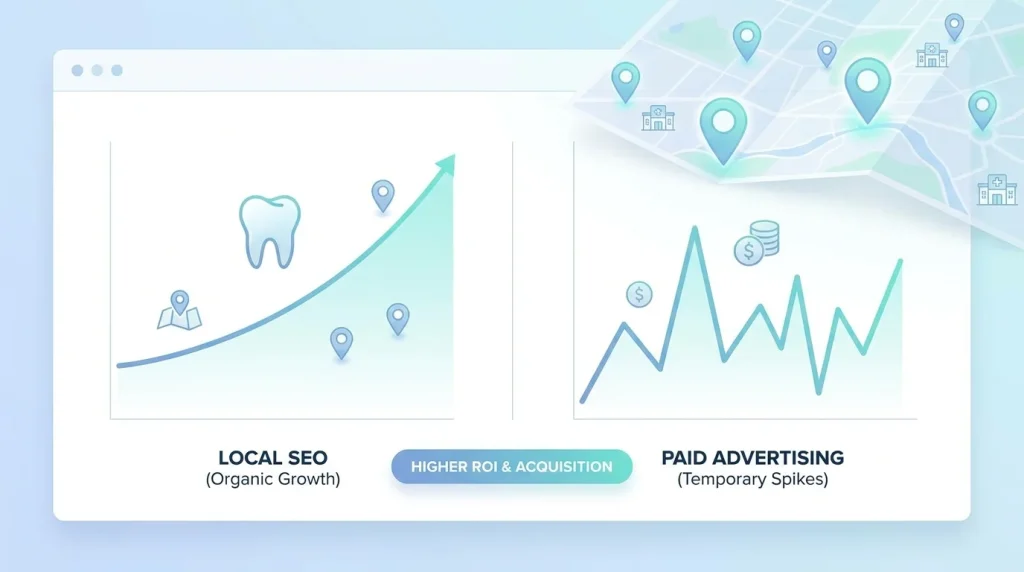
Two general dental practices in the Denver metro area started 2023 with comparable new patient volumes, approximately 18 to 20 new patients per month, and comparable marketing budgets of $4,000 per month. Practice A allocated its entire budget to Google Ads. Practice B allocated $1,200 per month to Google Ads and $2,800 per month to local SEO investment: GBP optimization, systematic review acquisition infrastructure, and content development.
Eighteen months later, the economics of the two practices had diverged substantially.
Practice A was generating 22 new patients per month from paid search at a cost of approximately $182 per acquired patient. Its Google Ads cost-per-click had increased by 31% over the 18 months as competitor practices entered and raised bids on the same keywords. When the practice manager paused the campaign for three weeks during a billing dispute, new patient volume from paid search dropped to zero within 10 days.
Practice B was generating 19 new patients per month from organic local search and 6 from its reduced paid search budget. Its cost per organically acquired patient had fallen to approximately $28 as the local SEO investment was amortized over an increasing patient volume. When the practice reduced its local SEO budget by 40% in Month 14 to redirect funds to equipment, its local pack positions held for the subsequent four months. The organic patient flow continued without interruption.
The comparison is not presented to argue that paid advertising is wrong for dental practices. It is presented because dental local SEO ROI cannot be evaluated accurately without understanding the fundamental economic model difference between the two patient acquisition approaches, a difference that the monthly cost figure alone does not capture.
Table of Contents
The Rental vs Asset Economic Model in Dental Local SEO ROI
Paid advertising and local SEO are not two versions of the same thing at different price points. They are structurally different economic models that produce different types of returns over different time horizons.
Paid advertising is a rental. A dental practice running Google Ads is renting visibility in search results. The practice appears at the top of the results page while the campaign is funded and the bid is competitive. The moment the budget runs out, the bid drops below competitors, or the campaign is paused, the visibility stops. There is no residual asset. The clicks, impressions, and patient calls generated by the campaign leave no lasting equity in the practice’s search presence. The practice has paid for patient access, not patient acquisition infrastructure. From the day paid advertising stops, the practice’s paid search presence returns to zero.
This is not a deficiency; it is the design. Paid advertising is intended to produce immediate, scalable, controllable results. It delivers on that design. The economic risk is not that paid advertising fails to work. It is that the practice builds patient acquisition dependency on a channel that requires continuous funding to maintain any output, with costs that scale upward as market competition increases. You can learn more about how the system works directly from Google Ads documentation: Google Ads Help Center
Local SEO is an asset. A dental practice investing in local SEO is building an asset: a Google Business Profile with accumulated completeness signals, a review corpus with established volume and ongoing velocity, an on-page citation footprint with verified NAP consistency, and a local pack position that reflects the cumulative investment of the optimization program. This asset generates patient acquisition returns without a cost-per-click. Once the top-three local pack positions are established and the review velocity is producing an ongoing signal, the marginal cost of each additional patient acquired through organic local search approaches zero.
The asset does not maintain itself without management; review velocity requires operational workflow, posts cadence requires consistent content production, and GBP completeness requires periodic updates as the practice’s services and details evolve. But the maintenance investment required to sustain an established position is substantially lower than the investment required to build it, and the patient acquisition output of the established position does not stop when the management investment temporarily pauses.
The Cost-Per-New-Patient Data in Dental Local SEO ROI: Paid Search vs Organic Local
What do dental Google Ads actually cost per patient acquired
Dental is among the highest-cost-per-click categories in Google Ads for local services. The competitive bidding dynamics of local dental advertising practices bidding against each other for visibility on the same query set in the same geographic area produce CPC ranges that are substantially higher than most local service categories. (Source: composite patterns observed across dental practice paid search analysis in competitive US markets.)
The cost-per-acquired-patient calculation for dental Google Ads requires three inputs: cost-per-click for the target keywords, click-to-call conversion rate from the landing page, and call-to-appointment conversion rate from the front desk. For a mid-sized market dental practice with competitive keyword CPCs, a landing page conversion rate of 8 to 12%, and a front desk call-to-appointment rate of 60 to 70%, the resulting cost per new patient from paid search commonly falls in the range of $150 to $350 or more, depending on the competitive density of the market and the efficiency of the conversion funnel.
Two factors consistently increase this cost over time for practices that rely on paid search as their primary patient acquisition channel. First, keyword auction dynamics: as more dental practices in a market increase their paid search investment, CPCs rise for all participants. A practice that calculated its paid search economics at Year 1 CPC levels will find those economics degraded at Year 2 and Year 3 as market competition intensifies the auction. Second, ad fatigue and quality score dynamics: campaigns that run continuously without creative refresh and landing page optimization see declining click-through rates and rising effective CPCs over time.
What dental local SEO cost per patient acquired over time
The cost-per-patient-acquired calculation for dental local SEO operates on a different economic model because the input costs are front-loaded and the output compounds over time.
The investment phases of a dental local SEO program in a mid-sized market follow an approximate pattern. In months 1 through 3, the optimization phase, the investment produces GBP completeness improvements, initial review velocity establishment, and on-page and citation foundation work. Position movement may be partial, and patient acquisition from organic local is typically lower than the eventual steady state. The investment-to-return ratio is unfavorable in this phase relative to paid advertising.
In months 4 through 9, the stabilization phase, local pack positions begin reflecting the accumulated signal improvements. Review velocity is generating ongoing recency signals. The practice is appearing more consistently in the top three for primary query categories. Patient acquisition from organic local is growing. The investment-to-return ratio is improving as the accumulated assets begin producing returns.
In months 10 through 18 and beyond the compounding phase, the local pack position is established, the review corpus is generating both ranking signals and patient trust conversion simultaneously, and the monthly maintenance investment is producing continuing patient acquisition at near-zero marginal cost per patient. The cost-per-patient acquired from organic local at this stage, calculated by dividing total accumulated local SEO investment by total accumulated organic patient acquisitions, has typically fallen well below the paid search cost-per-patient and continues falling as the asset generates additional patients without proportional additional investment.
The crossover point, the month at which the cumulative cost-per-patient from local SEO falls below the cost-per-patient from paid search, typically occurs between months 9 and 18 for most mid-sized market dental practices, depending on the competitive density of the local pack and the systematic consistency of the optimization program. After the crossover, every additional patient acquired through organic local search improves the cumulative ROI of the local SEO investment further. (Source: composite patterns observed across dental practice local SEO investment and patient acquisition analysis in US markets.)
The compounding return model for dental local SEO
The economic model that distinguishes local SEO from paid advertising most significantly is not the cost comparison at any single point in time. It is the compounding dynamic that produces increasing returns from the same investment base over time.
The review corpus compounds. A practice with 45 reviews that generates 4 new reviews per month will have 93 reviews at the end of 12 months. Each new review improves both the ranking signal contribution of the review corpus and the patient-side trust evaluation of the listing. The 93-review practice at Month 12 is generating higher organic patient volume from the same local SEO infrastructure that was producing lower volume at Month 1. The investment did not increase; the asset matured.
The completeness signals compound. A GBP completeness improvement adding secondary categories, expanding the services list, and seeding the Q&A section produces an ongoing ranking signal contribution from the moment of implementation. Unlike a paid click that generates one impression and one conversion opportunity, a completeness improvement generates continuous ranking signal contribution without additional investment.
The local pack position compounds. A practice that reaches position two in the local pack for its primary query category has acquired a visibility asset that generates patient impressions continuously every time a patient searches the relevant query from the relevant geographic area. The cost of generating those impressions is effectively zero after the position is achieved. The cost of the equivalent impression volume through paid advertising scales linearly with impression count. At high impression volumes, the economic advantage of the organic position over the paid placement becomes pronounced.
The Whitespark Local Search Ranking Factors 2023 survey places GBP signals at approximately 36% of local pack ranking influence signals that are built through investment in GBP optimization, not purchased per impression. (Source: Whitespark Local Search Ranking Factors, 2023.) The BrightLocal 2023 Local Consumer Review Survey documents that 98% of consumers read reviews for local businesses, with healthcare, including dental, among the highest-influence categories. (Source: BrightLocal Local Consumer Review Survey, 2023.) Both of these data points describe asset review corpora, GBP completeness that compounds without incremental cost once established.
The dependency risk of paid advertising for dental patient acquisition
The economic risk of building dental patient acquisition primarily on paid advertising is not that paid advertising is ineffective. It is that effectiveness creates dependency, and dependency creates structural vulnerability.
Budget dependency. A dental practice whose primary new patient channel is Google Ads has a patient acquisition volume that is directly and immediately responsive to its advertising budget. Budget increases produce more patients; budget decreases produce fewer; budget pauses produce zero. The practice has no patient acquisition equity that persists through budget interruptions. For practices in high-growth phases or with stable cash flows, this dependency may be acceptable. For practices navigating equipment purchases, staffing changes, or revenue seasonality, the absence of a patient acquisition asset that functions independently of the monthly budget is a structural risk.
Auction inflation. The CPC auction dynamics of local dental advertising mean that the cost of maintaining the same paid search visibility increases as market competition intensifies. A practice that established its paid search economics at 2022 CPC levels in a mid-sized market may find those economics substantially degraded by 2026 as additional practices have entered the paid search market for the same keywords. There is no equivalent inflation dynamic for established local SEO positions. A position earned through GBP optimization and review velocity does not become more expensive to maintain because a competitor has also started optimizing their GBP.
Platform dependency. Google Ads policy changes, algorithm updates affecting Quality Scores, and interface changes in the Google Ads platform represent risks that affect paid search performance in ways that are outside the practice’s control. Local SEO is also subject to Google algorithm changes, but the ranking factors that produce top-three positions (GBP completeness, review recency, NAP consistency) are stable enough that established positions are less volatile than paid search performance under platform-side changes.
When to use both: the hybrid investment model
The most effective dental patient acquisition economics are not produced by choosing between paid advertising and local SEO. They are produced by using both in the right proportion for the practice’s current stage of local SEO asset development.
The hybrid model allocates paid advertising to cover patient acquisition during the local SEO investment phase when organic positions are being built, and patient flow from organic local is below the eventual steady state while building the local SEO asset that will eventually replace a substantial portion of the paid acquisition dependency.
For a practice with zero local SEO investment and high paid search dependency, the transition to a hybrid model follows three stages: an initial phase of continued high paid investment while establishing the local SEO foundation (GBP completeness, review acquisition workflow, citation coverage); a rebalancing phase as organic positions stabilize and organic patient volume grows, allowing proportional reduction of paid search spend without total patient volume decline; and a steady-state phase where organic local is the primary patient acquisition channel and paid search serves as a tactical supplement for specific campaigns, new service launches, or seasonal demand.
For the GBP optimization actions that produce the organic patient acquisition returns documented in this article, the complete Google Business Profile optimization guide for dental practices covers the full configuration protocol that the dental local SEO ROI model depends on.
For the patient behavior data that explains what organic local search visibility is actually worth in terms of patient evaluation and conversion, the dental patient search behavior guide covers the patient-side dynamics that produce new patient acquisitions from local pack positions.
For the complete market intelligence framework that integrates ROI data with competitive landscape and patient behavior analysis, the dental local SEO market analysis covers the full strategic context.
Key takeaways
Paid dental advertising and local SEO are not competing budget line items; they are different economic models that produce different return profiles over different time horizons. Paid search produces immediate, scalable, controllable patient flow that stops the moment spend stops. Local SEO produces a compounding asset that generates patient acquisition returns at near-zero marginal cost once established, and that continues generating returns through periods of reduced investment. Evaluating them against each other on a monthly cost basis misframes the comparison.
The cost-per-new-patient from dental local SEO typically falls below the cost-per-new-patient from Google Ads between months 9 and 18 of a systematic optimization program, and continues falling as the asset compounds. A practice that evaluates the ROI of local SEO by its Month 3 economics will conclude that it is an expensive patient acquisition channel. A practice that evaluates it by its Month 18 and Month 36 economics will find that it is the lowest-cost patient acquisition channel it operates. The time horizon of the ROI calculation determines the conclusion. (Source: composite patterns observed across dental practice local SEO investment and patient acquisition analysis.)
Review corpus growth is the most persistently compounding local SEO asset in dental patient acquisition. Each additional review improves both the ranking signal contribution of the profile and the patient-side trust evaluation that converts profile views to phone calls. The BrightLocal 2023 data showing 98% of patients reading reviews for healthcare providers means the review corpus is functioning simultaneously as a ranking asset and a patient conversion tool, a dual-return investment that paid advertising cannot replicate. (Source: BrightLocal Local Consumer Review Survey, 2023.)
Google Ads CPC inflation is a structural cost risk that increases over time for practices in competitive dental markets. As more practices in a market invest in paid search for the same keyword set, auction dynamics raise CPCs for all participants. There is no equivalent inflation in the cost of maintaining an established local SEO position. The practice that has built a compounding local SEO asset becomes progressively less vulnerable to paid search cost inflation over time, while the practice with a paid-first acquisition model becomes progressively more exposed.
The optimal dental practice patient acquisition model is hybrid, not binary. Paid search provides immediate patient flow during the local SEO investment phase. Local SEO builds the long-term patient acquisition asset that reduces paid dependency. The economic goal is not to eliminate paid advertising; it is to reduce the proportion of total patient acquisition that depends on continuous budget allocation, replacing paid dependency with organic asset returns over a 12 to 24-month transition.
Your next action this week
Calculate your current cost-per-new-patient from paid advertising using your actual numbers: total paid search spend last month divided by new patients who identified paid search as their acquisition channel. Compare that figure against the benchmark range of $150 to $350 for dental paid search in competitive US markets.
Then estimate your cost-per-new-patient from organic local search: total local SEO investment last month divided by new patients who identified Google search (non-paid) as their acquisition channel. If your organic local SEO cost-per-patient is already below your paid search cost-per-patient, your asset is producing returns. If you have no measurable organic local patient flow, your local SEO investment phase has not yet been initiated, and the paid search dependency risk documented in this article applies fully to your current patient acquisition model.
The investment allocation decision that follows from this calculation is straightforward: the practice with high paid dependency and low organic local visibility has the clearest economic case for initiating a systematic local SEO program and beginning the transition to a hybrid acquisition model.