An orthodontic practice in Charlotte had its GBP correctly configured, primary category set to “Orthodontist,” services list populated with Invisalign, ceramic braces, and early orthodontic treatment, 112 reviews averaging 4.8 stars. It was holding position five for “orthodontist Charlotte” and not appearing at all for “Invisalign provider Charlotte.” The three practices above it had comparable GBP configurations and similar review profiles. The gap the audit identified was not in the GBP layer.
The position one practice had a homepage title tag reading “Orthodontist in Charlotte, NC | Myers Park Orthodontics.” Its homepage body content is named Charlotte, Myers Park, Ballantyne, and SouthPark, four geographic signals in the first 250 words. It had individual pages for Invisalign, traditional braces, ceramic braces, and early orthodontic treatment, each with location-specific content and a procedure-specific title tag. Its LocalBusiness schema used the “Orthodontist” type, not the generic “Dentist” type, with NAP identical to the GBP. Its Invisalign page title tag reads “Invisalign Provider Charlotte NC | Myers Park Orthodontics.”
The position five practice had a homepage title tag reading “Welcome to Our Orthodontic Office.” Its homepage body content contained no city name in the first 500 words. It had one “Treatments” page listing six procedures in a tabbed layout with no geographic context. Its LocalBusiness schema used “@type”: “Dentist”, the wrong schema type for a specialist orthodontic practice. Its Invisalign content lived on the same page as its braces content, sharing one URL, one title tag, and zero location references.
Same GBP quality. Dramatically different website local SEO signals. The website was the gap, and it was a fixable one.
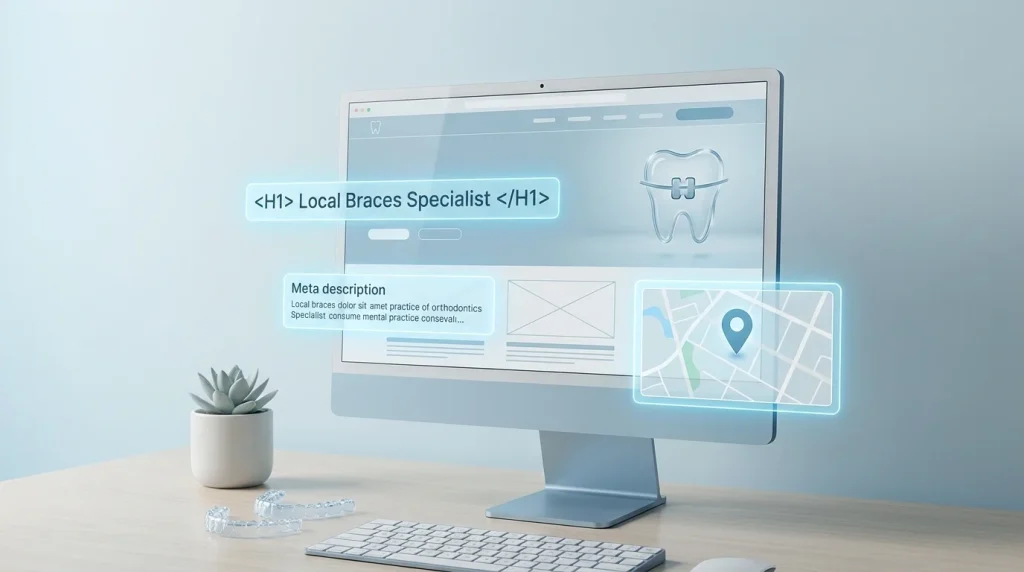
Orthodontic practice website local SEO is the on-page signal layer that confirms, reinforces, and amplifies every relevance and proximity claim the GBP makes. This guide covers the complete on-page optimization framework for US orthodontic practice websites, from schema type selection through individual treatment pages ,in the priority order that produces the most measurable local pack impact.
Table of Contents
Why orthodontic website optimization differs from general dental
The on-page local SEO principles that apply to general dental websites apply to orthodontic websites, but the implementation differs in three structural ways that matter for local pack performance.
Schema type specificity. The correct LocalBusiness schema type for a general dental practice is “Dentist.” The correct schema type for a specialist orthodontic practice is “Orthodontist”, a distinct schema.org subtype that carries higher category confidence for orthodontic-specific queries than the generic “Dentist” type. An orthodontic practice implementing “Dentist” schema on its website is sending Google a category signal that conflicts with the “Orthodontist” primary category in its GBP. Schema type and GBP primary category must match, and for a specialist orthodontic practice, both must say “Orthodontist.”
Treatment page architecture. A general dental practice serving patients across ten procedure categories benefits from individual service pages for its five highest-value procedures. An orthodontic practice serving patients across four or five treatment modalities, Invisalign, traditional braces, ceramic braces, lingual braces, and early treatment, needs individual pages for every treatment it offers, not just the top five. The query volume distribution in orthodontic search is narrower and more procedure-specific than in general dental search: “Invisalign Charlotte NC” and “ceramic braces Charlotte NC” are distinct queries with distinct patient intents that a combined “Treatments” page cannot capture simultaneously.
Conversion architecture for long-cycle patients. An orthodontic patient converting from a local search query is at the beginning of a multi-year treatment relationship, not booking a cleaning. The website’s job is not just to confirm local SEO signals but to move the patient from search query to consultation booking in a single session. Every on-page optimization decision, title tag, treatment page content, call to action placement, and online booking integration is made in the context of a patient who is evaluating two or three practices and will book a consultation with the one whose website best answers the question “why should I trust this practice with my smile for the next two years?”
Tier 1: Title tags for orthodontic practice websites
Title tags are the single highest-weight on-page local SEO signal for orthodontic websites, and the field where the gap between optimized and unoptimized orthodontic sites is most consistently wide.
Homepage title tag formula:
Orthodontist in [City, State] | [Practice Name]
Example: “Orthodontist in Charlotte, NC | Myers Park Orthodontics”
This formula contains the specialty type (Orthodontist), the primary city and state (Charlotte, NC), and the practice name. All three are immediately visible in search results and contribute directly to the relevance and proximity signals that determine orthodontic local pack eligibility.
What not to write: “Welcome to Myers Park Orthodontics,” “Myers Park Orthodontics, Braces and Invisalign,” or any title tag that leads with the practice name rather than the specialty and location. A practice name in the title tag provides zero local SEO signal for a patient who has not yet heard of the practice. A specialty and location in the title tag answer the patient’s search query before they click.
Invisalign page title tag formula:
Invisalign Provider [City, State] | [Practice Name]
Example: “Invisalign Provider Charlotte, NC | Myers Park Orthodontics”
The Invisalign page requires its own dedicated title tag, not a shared title tag with other treatments. “Invisalign Provider Charlotte NC” is the exact query string a high-intent adult patient types when they have already decided on Invisalign and are selecting a local provider. A title tag that matches this query string exactly captures that patient’s intent at the highest relevance level available.
Individual treatment page title tag formula:
[Treatment Name] [City, State] | [Practice Name]
Examples:
- “Ceramic Braces Charlotte NC | Myers Park Orthodontics”
- “Braces for Kids Charlotte NC | Myers Park Orthodontics”
- “Early Orthodontic Treatment Charlotte NC | Myers Park Orthodontics”
Each treatment page title tag names the specific treatment type and the city, producing a distinct, query-matched title tag for each procedure the practice offers. A “Treatments | Myers Park Orthodontics” title tag shared across all treatment content produces no procedure-specific or location-specific signal for any individual treatment query.
Tier 2: LocalBusiness schema for orthodontic practices
LocalBusiness schema for an orthodontic practice follows the same implementation principles as the general dental schema, NAP character-for-character identical to the GBP, placed in the website footer or on the contact page, verified via Google’s Rich Results Test, with one critical difference: the schema type.
The correct schema implementation for a specialist orthodontic practice:
The “@type”: “Orthodontist” declaration, not “@type”: “Dentist”, is the schema field that aligns the website’s structured data signal with the GBP’s “Orthodontist” primary category. Using “@type”: “Dentist” in the schema of a practice whose GBP primary category is “Orthodontist” creates a category type mismatch between the two highest-authority structured signals Google reads for the practice. That mismatch reduces entity confidence in precisely the query category, orthodontic searches, where the practice most needs Google’s confidence to be high.
The “medicalSpecialty”: “Orthodontics” field is an additional schema property available in the MedicalBusiness schema hierarchy that reinforces the specialty classification at the structured data level. It is not required for valid schema implementation, but it adds a second, schema-level specialty confirmation signal that the “@type” declaration alone does not provide.
Tier 3: Geographic content for orthodontic websites
Geographic content in the body text of an orthodontic website homepage and treatment pages is the signal that most directly confirms the proximity claims in the GBP, and the signal most consistently absent from orthodontic practice websites, because orthodontic website content is almost universally written by clinical communications teams focused on treatment explanation rather than geographic signal density.
The geographic content minimum for an orthodontic practice homepage:
The homepage body content should include, within the first 300 words: the primary city and state, two to three surrounding neighborhoods or communities the practice draws patients from, and at least one sentence that explicitly states the practice’s geographic service area.
Example: “Myers Park Orthodontics is a specialist orthodontic practice located in Charlotte, North Carolina, serving patients from Myers Park, Ballantyne, SouthPark, Dilworth, and the surrounding greater Charlotte communities.”
That single sentence contains the practice name, the specialty type, the primary city and state, four surrounding neighborhoods, and a broader geographic service area descriptor. It is more of a geographic signal than most orthodontic practice homepages contain in their entire body content.
The geographic content standard for Invisalign pages:
The Invisalign page carries the highest individual treatment page query volume for most orthodontic practices, and therefore warrants the most deliberate geographic content strategy of any treatment page on the site. The Invisalign page body content should include: a city and state reference in the opening paragraph or H1, at least one neighborhood or community reference in the body content, and a service area statement in the closing section or call-to-action block. “Invisalign treatment in Charlotte, NC, serving patients from Myers Park, Ballantyne, and across the greater Charlotte metro area” as a page section heading or introductory sentence contains three geographic signals on a single page that would otherwise contain zero.
The geographic content standard for other treatment pages:
Each treatment page, traditional braces, ceramic braces, early orthodontic treatment, lingual braces, should contain at a minimum one city or neighborhood reference in the body content. This does not require manufacturing geographic context where none exists; it requires that the natural service area language every orthodontic practice uses in patient conversations (“we serve families from across the Charlotte area”) appears in written form on the website pages where Google looks for geographic confirmation signals.
Tier 4: Individual treatment pages, the orthodontic architecture advantage
An orthodontic website with a single “Treatments” page listing all procedure types is providing Google with one indexable URL for its entire clinical offering. An orthodontic website with individual pages for Invisalign, traditional braces, ceramic braces, early orthodontic treatment, and lingual braces is providing Google with five indexable URLs, each optimized for a distinct procedure-plus-location query, each eligible to rank independently for its specific query type.
This architectural difference is not a minor technical refinement. It is the structural decision that determines whether the practice is visible for five distinct high-value patient search queries or one generic query. In orthodontic local search, where the procedure-specific queries, “Invisalign Charlotte NC,” “ceramic braces Charlotte NC,” “braces for teens Charlotte NC”, generate more patient intent than the generic “orthodontist Charlotte” query, the treatment page architecture is often the highest-leverage single website optimization available.
The minimum content standard for an orthodontic treatment page:
Each treatment page should contain: a title tag with the treatment name and location, an H1 matching or closely mirroring the title tag, 400 to 600 words of original content describing the treatment, its patient benefits, ideal candidates, and the practice’s specific approach, at least one geographic reference in the body content, a patient-facing FAQ section with three to five questions and answers, and a prominent call to action linking to the consultation booking page.
The Invisalign page, expanded content standard:
The Invisalign page warrants a higher content investment than other treatment pages because it targets the highest-volume individual treatment query in most US orthodontic markets. Beyond the minimum content standard, the Invisalign page should include: the practice’s Invisalign provider tier or certification status (Preferred Provider, Diamond Provider, or equivalent), the number of Invisalign cases the practice has completed if this figure is competitive, the iTero digital scanning process explained in patient-friendly terms, before-and-after case examples with de-identified smile photos where HIPAA-compliant authorization exists, and an explicit free consultation call to action that names the city. A 600 to 800-word Invisalign page with all of these elements is appropriately matched to the patient’s decision depth for a treatment they are seriously evaluating.
The early orthodontic treatment page, parent-specific content:
The early orthodontic treatment page targets a distinct patient segment, parents of children aged 7 to 10 who are researching Phase 1 orthodontic intervention. This page’s content should be written for the parent decision-maker, not the child patient: what signs indicate a child needs early evaluation, what Phase 1 treatment involves, how early treatment differs from comprehensive treatment, and what outcomes early intervention can achieve that waiting until full eruption cannot. Geographic content on this page should reference the local school districts, pediatric dental referral relationships, or community contexts that make the practice locally relevant to the parent audience.
Tier 5: Internal linking for orthodontic websites
Internal linking for an orthodontic practice website follows the same foundational principles as general dental internal linking, every treatment page links back to the homepage and to the consultation booking page, the homepage links contextually to each treatment page, descriptive anchor text throughout, with one orthodontic-specific addition: the Invisalign page and the braces pages should cross-link to each other with anchor text that reflects the patient’s decision context.
A patient landing on the Invisalign page who is still deciding between Invisalign and ceramic braces is served by an internal link to the ceramic braces page, positioned as a “compare your options” resource rather than a competing destination. “Comparing Invisalign to ceramic braces? See our ceramic braces page for a side-by-side treatment overview. As an inline link within the Invisalign page body content keeps the patient on the website during their comparison research, reducing bounce to competitor sites during the highest-intent phase of the decision process.
The consultation booking page has an internal link destination:
Every treatment page on an orthodontic website should have at a minimum one internal link to the consultation booking page, in the body text, not just in the navigation header or footer. The consultation booking page is the conversion destination for every orthodontic patient acquisition journey that begins with a local search. An internal link from the Invisalign page body text, “schedule your free Invisalign consultation in Charlotte”, is both an internal link that distributes page authority to the booking page and a conversion prompt placed at the point in the patient’s research journey where booking intent is highest.
Tier 6: Mobile optimization and consultation booking UX
Orthodontic local searches are predominantly mobile, and the patient conducting an orthodontic search on a smartphone at 9:00 PM, after researching providers for an hour, has the highest consultation booking intent of any patient at any stage of the decision process. A mobile orthodontic website experience that fails at the conversion moment, slow load time, buried booking link, non-tappable phone number, loses that patient to the next practice in the local pack whose mobile experience does not fail.
The mobile optimization checklist for orthodontic practice websites:
☐ Click-to-call phone number above the fold on mobile. The practice phone number should be the most immediately accessible element on the mobile homepage, tappable without scrolling. An orthodontic patient calling to ask about Invisalign pricing or consultation availability is in the highest-intent pre-booking state. A phone number buried below a hero image and a services overview loses that call.
☐ Online consultation booking accessible from the mobile homepage without scrolling. A “Book a Free Consultation” button visible above the fold on mobile, linking to a functional online booking system, converts after-hours search intent into scheduled consultations. Orthodontic consultations are the entry point to a multi-year patient relationship. A patient who cannot book at 9:00 PM will find a practice that lets them.
☐ Invisalign page load time under 3 seconds on mobile. The Invisalign page is the highest-traffic individual treatment page for most orthodontic practices, and the page most likely to be overloaded with before-and-after image galleries, video embeds, and third-party Invisalign badge scripts that collectively suppress load speed. Test the Invisalign page specifically on Google PageSpeed Insights (pagespeed.web.dev). A mobile score below 50 on this page is suppressing both search visibility and consultation conversion on the highest-value individual treatment page the practice has.
☐ Consultation form optimized for mobile input. Consultation request forms with more than four fields, name, phone, email, preferred contact time, create mobile friction that reduces form completion rates. An orthodontic consultation booking form that asks for insurance provider, date of birth, referring dentist, and preferred treatment type before the practice has spoken with the patient is a form that loses mobile patients to competitors with shorter forms. Collect clinical information after the consultation is booked, not before.
For the complete on-page website optimization framework that covers the foundational signal layers shared between orthodontic and general dental websites, the dental practice website local SEO guide covers the full on-page system in standalone depth.
And for the GBP optimization layer that the website signals in this article are designed to confirm and reinforce, the Google Business Profile for orthodontists guide covers the complete GBP configuration framework.
Key takeaways
The schema type for a specialist orthodontic practice is “Orthodontist”, not “Dentist.” Using “@type”: “Dentist” in the LocalBusiness schema of a practice whose GBP primary category is “Orthodontist” creates a category mismatch between the two highest-authority structured signals Google reads for the practice. Schema type and GBP primary category must match, and for a specialist orthodontic practice, both must say “Orthodontist.”
Individual treatment pages are not optional for orthodontic websites; they are the architectural decision that determines query-level visibility. A single “Treatments” page cannot simultaneously rank for “Invisalign Charlotte NC,” “ceramic braces Charlotte NC,” and “braces for kids Charlotte NC.” Each of those queries requires its own dedicated page with its own title tag, its own geographic content, and its own procedure-specific body text.
The Invisalign page warrants a higher content investment than any other treatment page on the site. It targets the highest-volume individual treatment query in most US orthodontic markets, serves the highest-value patient segment, and is the page most likely to be the final research stop before a consultation is booked. A 600 to 800-word Invisalign page with provider tier, case volume, digital scanning explanation, before-and-after examples, and a city-specific consultation call to action is appropriately matched to the patient’s decision depth.
Geographic content on orthodontic websites is almost universally absent, which makes it a high-leverage competitive gap. Most orthodontic website content is written for patient education, not local search. Adding one geographic service area sentence per page closes a gap most competing practices have not closed.
Mobile consultation booking conversion is the final test of every on-page optimization. An orthodontic website that ranks for the right queries but fails to convert the patient who clicks through, because the booking link requires scrolling, the consultation form has eight fields, or the Invisalign page takes six seconds to load on mobile, is generating search visibility without generating consultations.
Your next action this week
Open your website and check one field: the LocalBusiness schema type. Paste your website URL into Google’s Rich Results Test (search.google.com/test/rich-results) and look at the “@type” field in the extracted schema output. If it reads “Dentist” rather than “Orthodontist,” update the schema before touching any other on-page element. This is a single string change in your website’s structured data, and it closes a category signal mismatch that may be suppressing your local pack visibility for every orthodontic-specific query you are trying to rank for.
Once the schema type is confirmed, check your homepage title tag. Open your website and look at the browser tab. If it reads anything other than “Orthodontist in [City, State] | [Practice Name],” rewrite it. This takes under five minutes in your website CMS and is the second-highest-impact single on-page change available to an orthodontic practice website.
Then count your individual treatment pages. If your Invisalign content, braces content, and ceramic braces content all share one URL, separating them into individual pages is the highest-leverage website architecture change available to your local search visibility. Start with the Invisalign page, build it first, optimize it to the expanded content standard, and add the city-specific consultation call to action.
For the complete orthodontic practice website local SEO system that integrates every website signal layer covered here with GBP optimization, citation authority, and review management into a unified ranking framework for US orthodontic practices, the orthodontics local SEO guide is the reference document that connects every element.