A dental practice in Seattle received a two-star review from a patient who claimed the practice overcharged her and that a procedure was performed without her consent. The office manager, furious at what she knew to be a false account, drafted a response detailing exactly what had happened during the appointment, the consent form that had been signed, the insurance breakdown that had been explained, the specific procedure that had been performed, and why.
The response was accurate. It was also a HIPAA violation.
By describing the specific procedure performed, the insurance situation, and the clinical context of the appointment in a public response, the office manager had disclosed protected health information in a public marketing context. The patient’s attorney cited the response in a subsequent complaint. The practice faced regulatory review and significant reputational damage, not from the original negative review, but from the response to it.
This is the specific danger of negative review responses for dental practices that no general reputation management guide adequately addresses: the most natural, most human, most defensively correct response to a false or unfair negative review, providing the accurate factual account, is the response most likely to create HIPAA exposure.
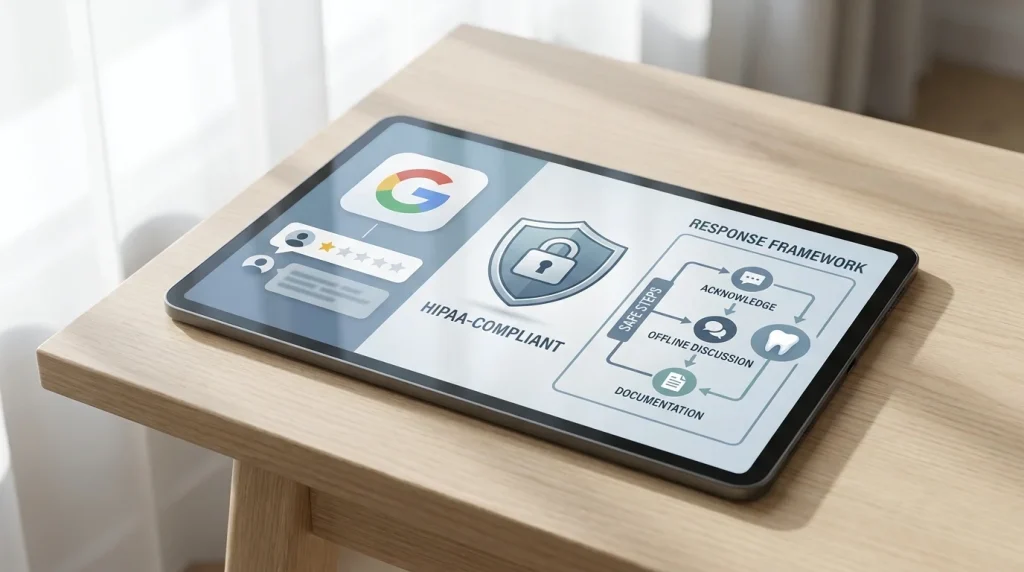
Understanding how to respond to negative Google reviews and dental HIPAA compliance requires simultaneously protecting the practice’s reputation and its regulatory standing, is the most complex response management challenge in dental marketing. This guide gives you the complete framework for every negative review scenario, with specific compliant templates that demonstrate professionalism without creating compliance exposure.
Table of Contents
The HIPAA constraint on negative review responses: what it means in practice
The HIPAA Privacy Rule’s core principle is straightforward: covered entities cannot use or disclose protected health information without patient authorization except in specific, defined circumstances. Public review responses are not among those circumstances.
Protected health information in the context of a negative review response includes: the patient’s name in combination with any clinical information, the specific procedure or treatment that was performed or not performed, appointment dates or types, diagnoses, treatment plans, insurance information, billing details, consent discussions, and any other individually identifiable health information.
The constraint this creates is specific and severe: the practice cannot confirm that the reviewer was a patient, cannot describe what happened clinically, cannot reference the consent process, cannot address billing specifics, and cannot provide any factual account that involves clinical detail, even when that account would accurately refute the reviewer’s claims.
The two violations that most commonly occur in dental negative review responses
Violation 1: Confirming or denying the patient relationship. A response that says “We have no record of this patient in our system” or “This reviewer has never been treated at our practice” is a HIPAA disclosure. It uses protected information, the existence or non-existence of a patient relationship, in a public marketing context. Even a denial is a disclosure of patient relationship status.
Violation 2: Providing clinical context to refute the review. A response that says “The patient signed a consent form before the procedure was performed” or “The treatment described was recommended based on the patient’s clinical presentation” discloses specific clinical information in a public context, the fact that a procedure was performed, the consent process, and the clinical reasoning. Even when accurate and well-intentioned, this constitutes PHI disclosure.
Both violations are more common than most dental practices realize, because both feel like the correct defensive response to an unfair review, and because the compliance implications are not obvious without specific HIPAA training in the marketing communication context.
The three-sentence response framework for negative dental reviews
The framework that satisfies all constraints simultaneously, HIPAA compliance, Google guideline compliance, and the conversion function of demonstrating professionalism to prospective patients, has three sentences. Each sentence has one specific job. None involves clinical detail.
Sentence 1: Acknowledge without admitting
Acknowledge the reviewer’s experience without confirming a patient relationship, without admitting fault, and without agreeing with their characterization of events.
Correct: “We’re sorry to hear that your experience didn’t meet your expectations.”
Incorrect: “We’re sorry your appointment went badly.” (Confirms a patient relationship and implies a clinical event.)
Incorrect: “We’re sorry you feel this way.” (Perceived as dismissive, the word “feel” implies the reviewer’s concern is subjective rather than real. This framing generates additional negative reactions from prospective patients who read it as defensive.)
The correct formulation acknowledges a subjective experience without confirming its factual basis or admitting responsibility.
Sentence 2: Move the conversation offline
Provide a direct contact mechanism, a phone number, an email address, and a named point of contact, and invite the reviewer to discuss their concerns privately.
Correct: “We’d genuinely like to learn more about what happened and see how we can make this right. Please contact us at [phone number] and ask to speak with [Name].”
The named point of contact is important. “Please contact us” is impersonal. “Please ask to speak with [Name]” creates accountability and signals that a real person with decision-making authority is available.
Sentence 3: Signal commitment to quality
The third sentence is for the prospective patients reading the exchange, not for the reviewer. It signals that the practice takes every patient’s experience seriously.
Correct: “Providing a positive experience for every patient is our priority, and we take every piece of feedback seriously.”
Correct: “Every patient’s experience matters to us, and we want the opportunity to address any concerns directly.”
The complete negative review response: assembled
“We’re sorry to hear that your experience didn’t meet your expectations. We’d genuinely like to learn more about what happened and see how we can make this right. Please contact us at [phone number] and ask to speak with [Name]. Providing a positive experience for every patient is our priority, and we take every piece of feedback seriously.”
That response: acknowledges without admitting, moves the conversation offline with a specific contact mechanism, signals commitment to quality for prospective patients, contains zero clinical detail, contains zero confirmation or denial of a patient relationship, and is under 75 words.
Adapting the framework for specific negative review scenarios
Scenario 1: Review alleging overcharging or billing dispute
Incorrect approach: “Our billing team follows standard insurance protocols, and the patient was informed of her out-of-pocket costs before treatment began.” Discloses billing event, insurance involvement, and pre-treatment discussion.
Correct approach: “We’re sorry to hear you have concerns about your billing experience. We’d welcome the opportunity to review this with you directly. Please contact us at [phone number] and ask to speak with [Name], who handles all billing inquiries. Patient satisfaction is our priority, and we want the chance to address your concerns.”
Scenario 2: Review alleging a clinical error or poor treatment outcome
Incorrect approach: “The procedure performed was the clinically appropriate treatment for the patient’s condition and was completed according to standard of care.”, Discloses that a procedure was performed, its clinical appropriateness, and implies a diagnosis.
Correct approach: “We’re sorry to hear that your experience fell short of your expectations. Patient care and clinical quality are the foundations of everything we do, and we take concerns like this very seriously. Please contact us at [phone number] and ask to speak with Dr. [Name] directly. We’d truly like the opportunity to understand your concern and to make this right.”
Scenario 3: Review alleging poor customer service or communication
Incorrect approach: “We spoke with this patient after her appointment and addressed her concerns at that time.”, Confirms a patient relationship and a post-appointment communication event.
Correct approach: “We’re sorry to hear about your experience with our team; that is not the standard we hold ourselves to. We’d genuinely like to learn more and to make this right. Please contact us at [phone number] and ask to speak with [Name]. Your feedback matters to us, and we want the opportunity to address it directly.”
Scenario 4: Review from a patient who appears to have the wrong practice
Incorrect approach: “We have no record of this patient or this experience in our system.” Uses patient record information in a public context.
Correct approach: “We’re sorry to hear about this experience; it doesn’t reflect the standard of care we’re committed to providing. We’d appreciate the opportunity to speak with you directly to understand your concerns and to clarify any confusion. Please contact us at [phone number] and ask to speak with [Name].”
Scenario 5: Review containing demonstrably false factual claims
Public response for a false-claim review: “We take the concerns raised in this review seriously and are committed to addressing them through the appropriate channels. We’d invite you to contact us at [phone number] and ask to speak with [Name] so we can understand your experience fully. Patient care and accuracy are both priorities for us.”
The phrase “through the appropriate channels” signals to prospective patients that the practice is pursuing the matter beyond the public response, without disclosing any removal request or legal process.
What never belongs in a negative review response
Clinical details of any kind. Any reference to a specific procedure, treatment outcome, diagnosis, consent process, clinical recommendation, or patient condition is PHI in a public context, even when accurate, even when the reviewer mentioned the procedure themselves.
The reviewer’s name combined with any health reference. “Sarah, we’re sorry your root canal experience wasn’t what you hoped for” combines a name with a clinical reference. “Sarah, we’re sorry your experience didn’t meet your expectations.” does not.
Admission of fault or agreement with the reviewer’s characterization. “We’re sorry we made a mistake” or “You’re right that your experience should have been better” are admissions that can be used in subsequent legal or regulatory proceedings.
Defensive or combative language. “This review is completely false and defamatory,” or “We’ve never had a complaint like this in twenty years of practice,” are responses that prospective patients will perceive as aggressive regardless of their accuracy.
References to legal action. “We are consulting with our attorney about this review” is a threat that Google can remove the response for, and that prospective patients will find alarming. Legal action is pursued through separate channels.
Multiple responses to the same review. Write the response correctly once. Post it once. Move the conversation offline. Do not return to the public thread.
The service recovery opportunity: what happens after the public response
The public response is the beginning of the resolution process, not the end of it. Its primary function is to move the conversation offline, where the clinical defense, the factual clarification, and the genuine service recovery can occur without PHI implications.
When a reviewer contacts the practice through the number or email provided in the public response, the conversation that follows can include everything the public response could not: the clinical record, the consent documentation, the billing breakdown, and the specific account of what happened.
The practice that responds professionally in public and follows through with genuine resolution in private produces better long-term reputation outcomes than the practice that wins the public argument. Prospective patients watching the exchange over time see a practice that handles adversity with professionalism. Former patients who had concerns see a practice that took their experience seriously. Both perceptions compound into a reputation that review count and star rating alone cannot build.
The template library that makes this response strategy operational at scale, including ready-to-use templates for every scenario covered in this article, organized by review type, complaint category, and practice specialty, is in the dental Google review response template library. And for the system that ensures these responses are written and posted within the 48-hour standard, the dental review response system guide covers the workflow, ownership, and cadence framework that makes consistent response behavior a practice-level standard.
For the positive review counterpart to this framework, the response strategy that converts five-star reviews into new patient bookings, the guide to responding to positive Google reviews for dental practices covers the complete positive response framework.
Key takeaways
- The instinctive response to a negative dental review, defending the practice with clinical specifics, is almost always a HIPAA violation. The clinical defense belongs in a private conversation. The public response is the invitation to have that conversation.
- The three-sentence framework satisfies all constraints simultaneously. Acknowledge without admitting. Move the conversation offline with a specific named contact. Signal commitment to quality for prospective patients reading the exchange. Three sentences. Zero clinical detail. Zero patient relationship confirmation.
- Specific named contact points outperform generic contact invitations. “Please ask to speak with [Name]” creates accountability, signals that a real person with decision-making authority is available, and converts more reviewers into actual offline conversations.
- The response is marketing copy for prospective patients, not a legal defense for the reviewer. Prospective patients are evaluating the practice’s character, not adjudicating the dispute. A professional, empathetic, offline-directed response demonstrates that character more effectively than any factual rebuttal.
- Service recovery happens in the private conversation, not in the public response. The public response is the door. Service recovery is what happens when the reviewer walks through it.
Your next action this week
Open your GBP review panel and identify every negative review, one, two, or three stars, that currently has no public response or has a response that includes clinical detail, patient relationship confirmation, or defensive language.
For unresponded negative reviews: write a response using the three-sentence framework today. Acknowledge without admitting. Provide a specific contact with a named point of contact. Signal commitment to quality. Post it. A professional response to an old negative review is still visible to every prospective patient who opens your knowledge panel; it is never too late.
For responses that already exist but contain clinical detail or HIPAA-risk language, you cannot edit an existing Google review response; you can only delete it and replace it. If an existing response contains clinical specificity, evaluate whether the response is creating more compliance risk than the review itself, and replace it with a compliant version if necessary.
For the complete ready-to-use template library that covers every negative review scenario without requiring you to write from scratch each time, the dental Google review response template library gives you the full operational toolkit. And for the complete picture of how to respond to negative Google reviews, dental HIPAA compliance requirements fit into your broader GBP review management framework, the complete guide to responding to Google reviews for dental practices integrates every element into a single operational reference.