A family dental practice in Charlotte was getting a new Google review roughly once every three weeks despite seeing forty patients per day, averaging 4.8 stars on existing reviews, and having a front desk team that genuinely liked their patients. The practice had a review request card that it handed out at checkout. Most patients took it politely and left it on the passenger seat of their car.
A competing practice two miles away, with the same patient volume, same review score, and same market, was getting three to five new reviews per week. The difference was not the quality of the ask. It was the timing of it.
The Charlotte practice was asking for reviews at the wrong moment in the patient journey, a moment when the patient’s attention was divided, their cognitive load was high, and their emotional connection to the positive experience they’d just had was already competing with the practical demands of getting back to their day. The competing practice had identified the specific windows within the appointment sequence where review intent peaks and had built its request process around hitting those windows consistently.
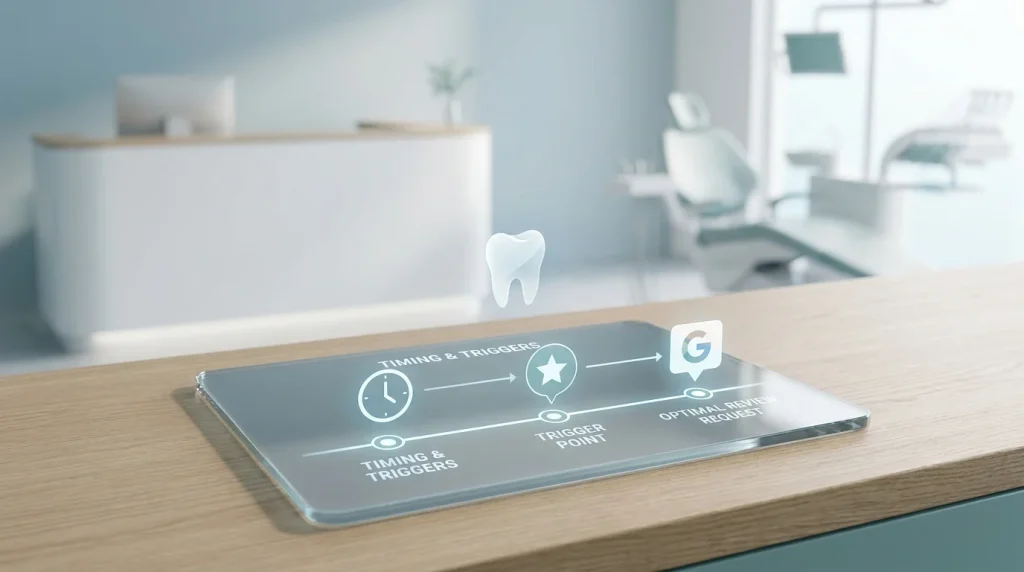
Understanding the best time to ask for a dental Google review is not a minor optimization. It is the variable with the highest leverage on review acquisition volume for practices that already have a compliant request process in place because the same request, sent at the right moment versus the wrong one, can produce conversion rate differences of two to three times.
According to BrightLocal’s 2024 Local Consumer Review Survey, 57% of patients say they would leave a review if asked, but fewer than 10% actually do so when asked through low-conversion channels at suboptimal timing. The gap between intent and action is a timing and friction problem, not a willingness problem.
This guide identifies the specific timing windows and appointment-type triggers that produce the highest review acquisition rates for US dental practices and the moments that look intuitive but consistently underperform.
Table of Contents
Why timing matters more than most practices realize
Review intent is not a stable psychological state. It is a spike, a brief window of elevated motivation that occurs immediately after a positive experience and decays rapidly as time passes and competing priorities take over.
The mechanism is well-documented in consumer psychology research: positive emotional experiences generate an impulse to share a social instinct that peaks within minutes to hours of the experience and diminishes over the following 24 to 72 hours as the emotional salience of the event fades into routine memory. A patient who leaves a dental appointment feeling relieved, comfortable, or genuinely pleased with the outcome is in a state of peak review intent. That patient, who asked for a review at the right moment, will act. The same patient, asked three days later via email, has returned to baseline the emotional trigger for the action impulse is gone.
This decay curve has practical implications for every review acquisition decision a dental practice makes. A review request sent within two hours of appointment completion captures the peak of the intent spike. A request sent the following day captures the tail end of the decay. A request sent three days later captures effectively nothing beyond patients who were already inclined to leave reviews independently.
The two-hour window is not an arbitrary rule; it is the empirically documented boundary within which the conversion rate difference between text and email review requests is most pronounced. After two hours, the conversion advantage of text over email narrows significantly. After 24 hours, both channels converge toward low conversion rates that no amount of message optimization can fully recover.
The appointment type framework: when review intent is highest
Not all dental appointments produce equal review intent. The emotional state a patient leaves with, and therefore the strength of the review intent spike, varies significantly by appointment type. Understanding this variation allows a practice to prioritize its review request efforts on the appointments most likely to produce a response.
New patient first visit
Review intent level: Very high
The new patient’s first visit produces the highest review intent of any appointment type in the dental category. A patient attending their first appointment at a new practice has made a trust decision; they chose this practice over competitors, often after reading existing reviews. If the experience confirms or exceeds their expectations, the emotional relief and satisfaction are acute.
New patients are also the most motivated to contribute to the review ecosystem because they were recent beneficiaries of it. They found the practice through reviews. They understand intuitively that leaving a review helps the next patient in the same position they were in.
The optimal timing: chair-side by the treating provider at the end of the appointment, followed by a text message containing the direct review link within ninety minutes of appointment completion. The chair-side request sets the intent. The text delivers the frictionless action path while the intent is still active.
Do not wait for a second visit to ask a new patient for a review. The first visit produces the highest intent. The request should match that timing.
Anxiety or fear-based appointments
Review intent level: Very high, highest emotional relief
Patients who experience dental anxiety, estimated at 36% of US adults (Source: Dental Economics, 2023), and who have a genuinely positive experience are in a state of significant emotional relief that translates directly into strong review intent. A patient who arrived terrified and left feeling that the experience was manageable or even comfortable has had an emotionally significant experience that creates a strong impulse to share.
The optimal timing: chair-side by the treating provider, with explicit acknowledgment of what the patient had expressed before the appointment. “You mentioned you were nervous coming in today. I hope the experience was manageable. If you’re comfortable sharing how it went on Google, it might really help another patient in the same position.” This framing is specific to the experience without clinical disclosure, emotionally resonant, and socially motivated.
Follow up with a text within ninety minutes.
Positive outcome of restorative and cosmetic appointments
Review intent level: High outcome satisfaction
Patients who complete a restorative or cosmetic procedure and are pleased with the visible outcome of a completed crown, a smile makeover, teeth whitening, or Invisalign completion leave with a specific, concrete positive result that is easy to describe in a review. They have something to say. Outcome-specific reviews are also the most useful to prospective patients evaluating the same procedure, which creates a social motivation that generic experience reviews don’t have.
The optimal timing: immediately after the final result is visible. For a same-day crown, this is when the patient sees the completed restoration. For Invisalign, this is at the refinement completion appointment. For whitening, this is when the shade is confirmed. In each case, the patient’s emotional peak upon seeing the outcome is the moment of highest review intent, and the request should be made before that emotional state has had time to subside.
Routine hygiene appointments with positive interaction
Review intent level: Moderate, relationship, and consistency
Routine hygiene appointments produce lower peak review intent than the previous three categories because the emotional experience is less acute. A patient leaving a routine cleaning is experiencing a competent, pleasant interaction, meaningful but not emotionally charged, in a way that drives spontaneous review intent.
The review intent that does exist at routine hygiene appointments is relationship-based rather than outcome-based. A patient who has been coming to the same practice for three years and has built rapport with the hygienist is a strong candidate for a review, but the trigger is the relationship, not the appointment.
The optimal timing: at the end of the appointment, chair-side by the hygienist who performed the cleaning, the team member with whom the patient has the strongest direct relationship. “You’ve been with us for a while now. If you’ve been happy with your care, we’d really value a review on Google. It makes a big difference for the practice.”
Text follow-up within two hours, same formula as all other appointment types.
Emergency and urgent care appointments
Review intent level: Very high, relief, and gratitude
Emergency dental appointments, same-day pain relief, broken tooth treatment, lost filling replacement, and dental abscess management produce some of the strongest review intent of any appointment type. The patient arrived in pain or distress and left with relief. That emotional arc from acute discomfort to resolution generates a gratitude response that translates directly into review motivation.
Emergency patients are also highly likely to have found the practice specifically through Google Maps searching “emergency dentist near me open now” at a moment of genuine need. The social motivation to contribute to the review ecosystem that helped them find care is particularly strong for this patient type.
The optimal timing: chair-side at the end of the appointment, once the acute issue has been resolved. “I’m really glad we could get you in today. If you have a moment later, a Google review would mean a lot. It helps other patients find us when they’re in the same situation.” Follow with a text within ninety minutes.
One specific consideration: the patient may be on post-procedure medication or in residual discomfort that makes immediate engagement with a review form unlikely. The text follow-up sent when the patient is home, and the relief of having the issue resolved has fully registered, is particularly important for this appointment type. The chair-side ask sets the intent. The text delivers the action path at the moment the patient is most ready to act.
The timing matrix: when to ask, when to wait, and when not to ask at all
When to ask
Ask at the end of any appointment where the patient’s verbal and non-verbal communication signals a positive experience. They express satisfaction with the outcome, thank the provider specifically, or reference a previous negative dental experience in a way that implies this visit was better.
Ask at all new patient first visits where the experience appeared to meet or exceed expectations, which for most practices is the majority of first visits. New patient review requests should be a near-universal practice, not a selectively deployed one.
When to wait
Wait for a second visit if the first visit was truncated, procedurally complicated, or if the patient expressed uncertainty about an element of their treatment plan.
Wait for the completion appointment if the patient is mid-treatment for a multi-visit procedure. A patient who is three appointments into a six-appointment implant case is not at the emotional peak of their experience. Request the review at the appointment where the patient sees the finished outcome.
When not to ask
Do not ask if the patient expressed dissatisfaction with any element of the visit. They are a service recovery candidate, not a review request candidate. Address the frustration before any review request is made.
Do not ask within the same communication as any billing or collections contact. A review request sent in the same message as a payment reminder or insurance denial creates a jarring juxtaposition that damages both the payment relationship and the review acquisition attempt.
Do not ask patients who have already left a review for this visit. Automated systems that don’t suppress patients who have already responded can send duplicate requests that produce frustration rather than additional reviews.
The channel and timing combination that produces the highest conversion rates
The research on review request conversion rates consistently points to one combination as the highest-performing: an in-person chair-side request by the treating provider, followed by a text message with a direct review link sent within ninety minutes of appointment completion.
The in-person request does two things that the text alone cannot. It establishes the social commitment the patient has verbally acknowledged the request in a face-to-face interaction with the person who treated them, which creates a psychological obligation to follow through. And it primes the patient to recognize and act on the text when it arrives, rather than treating it as an unsolicited marketing message.
The text does two things that the in-person request alone cannot. It delivers the frictionless action path, the direct link that removes every barrier between intent and action. And it arrives at a moment when the patient is no longer under the cognitive pressure of the checkout process and is more able to give the review their attention.
The role of the treating provider versus the front desk team
The provider who performed the treatment is the most effective person to make the in-person review request, not the front desk team member who processes checkout. A provider request is perceived as personal and relational. A front desk request is perceived as transactional. The conversion rate difference between these two framings is significant and consistent across practice types.
This has a practical implication: training the clinical team to make review requests is as important as configuring the text follow-up system. The text is the action delivery mechanism. The in-person request is the intent generator. Investing in only one half of the combination produces half the result.
For the complete system that automates the text follow-up component of this combination, including platform selection, template configuration, HIPAA compliance verification, and the timing triggers that can be configured for each appointment type, the dental review request system guide covers the full setup process from integration to first send. And for the compliance framework that governs what can and cannot be said in every channel, the guide to asking patients for Google reviews provides the specific language structures for each scenario.
Key takeaways
- Review intent is a spike, not a stable state. It peaks within minutes to hours of a positive experience and decays rapidly over the following 24 to 72 hours. A review request sent within two hours of appointment completion captures the peak. A request sent the following day captures the decay.
- Appointment type determines review intent level. New patient first visits, anxiety-relief appointments, and emergency care appointments produce the highest review intent. Routine hygiene appointments produce moderate intent driven by relationship rather than outcome. Match your request intensity to the appointment type.
- The highest-converting combination is a chair-side provider request followed by a same-day text with a direct review link. The in-person request generates intent and social commitment. The text delivers the frictionless action path. Neither channel achieves in isolation what the combination produces together.
- The treating provider is more effective than the front desk team for in-person review requests. A provider request is perceived as personal and relational. A front desk request is perceived as transactional. The conversion rate difference between these two framings is significant and consistent.
- Know when not to ask. Patients who expressed dissatisfaction during the visit, patients mid-treatment on a multi-visit case, and patients who received billing communications in the same interaction are not review request candidates. Asking the wrong patient at the wrong moment creates friction rather than reviews.
Your next action this week
Map your most common appointment types against the intent level framework in this article. Identify which appointment types your practice sees most frequently, which of those produce the highest review intent, and whether your current review request process, if you have one, is timed to capture that intent.
If your current process relies on checkout cards, end-of-day emails, or any channel that operates outside the two-hour window, you are leaving the majority of your available review intent uncaptured. The patients are willing. The timing is wrong.
This week: configure one compliant text template using the language framework from the guide to asking patients for Google reviews and set it to send within ninety minutes of appointment completion for your highest-intent appointment types. New patient first visits and anxiety-relief appointments are the right starting point. Add the chair-side provider request as a parallel practice by briefing your clinical team on the framing before your next patient day.
For the complete automated system that makes this timing-optimized process run without front desk involvement or clinical team reminders, the dental review request system guide covers the full setup. And for the complete picture of how the best time to ask for a dental Google review strategy fits into a broader Google Maps visibility framework, the complete guide to getting more Google reviews for your dental practice integrates every element of this cluster into a single operational reference.